
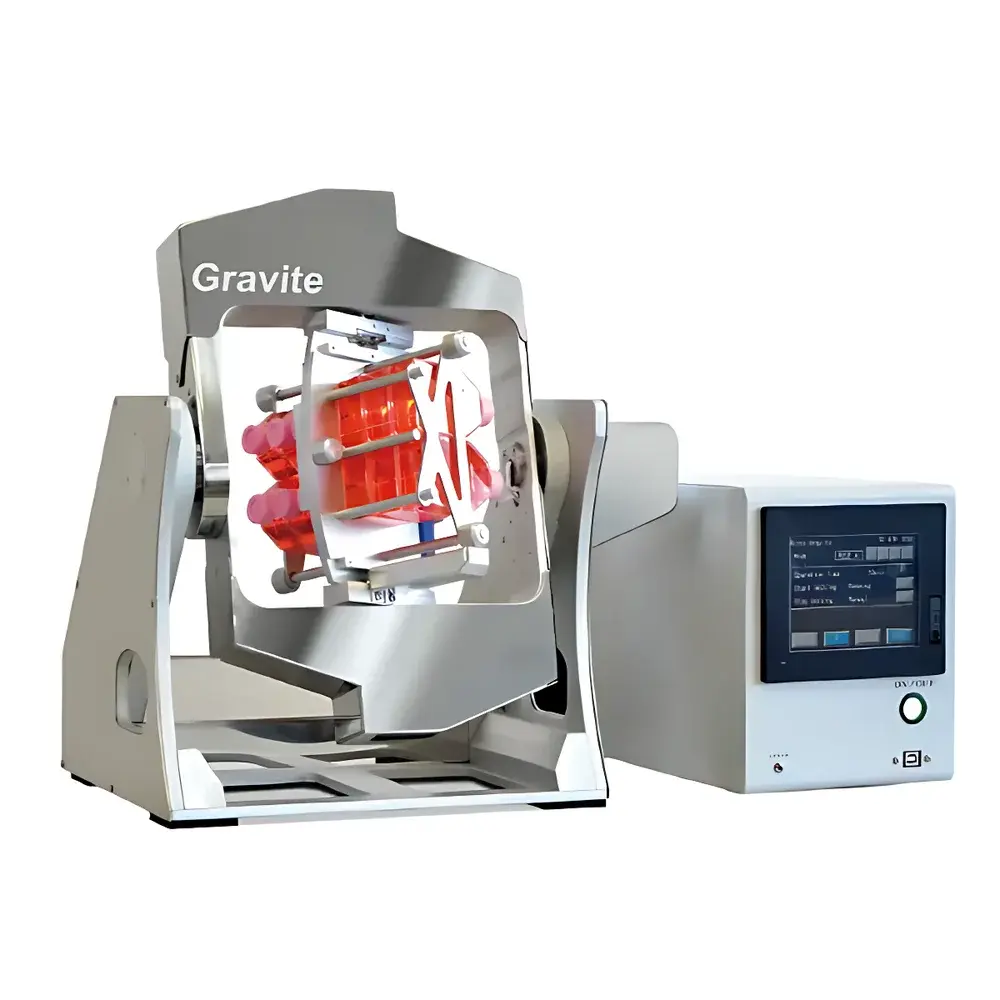
Gravite® GC-JP-RCE01 Microgravity 3D Cell Culture Rotational Bioreactor
| Brand | AS ONE |
|---|---|
| Origin | Japan |
| Manufacturer | AS ONE Corporation |
| Product Type | Imported Instrument |
| Model No. | 3-7413-01 |
| Power Supply | AC 220 V, 50/60 Hz, Max. 75 W |
| Dimensions (H×W×D) | 445 × 425 × 420 mm |
| Net Weight | 13.5 kg |
| Microgravity Simulation Range | ≤1 × 10⁻³ G |
| Hypergravity Range | 2–3 G |
| Sample Capacity | Up to twelve T25透气培养瓶 |
| Accelerometer Integration | Yes, real-time g-force monitoring |
| Incubator-Compatible Design | Yes (fits standard CO₂ incubators) |
Overview
The Gravite® GC-JP-RCE01 is a precision-engineered dual-axis rotational bioreactor designed for controlled simulation of variable gravitational environments in vitro. Unlike static or single-axis systems, it employs orthogonal rotation kinetics—based on the principle of time-averaged vector cancellation—to generate stable, reproducible low-g conditions (<1 × 10⁻³ G), as validated by NASA’s Kennedy Space Center Microgravity Simulation Facility. Its core architecture enables continuous three-dimensional reorientation of biological samples relative to Earth’s gravity vector, thereby minimizing sedimentation, enhancing nutrient/gas exchange, and promoting spontaneous 3D tissue-like aggregation. The system supports not only microgravity simulation but also programmable hypergravity exposure (2–3 G) via uniaxial rotation—making it uniquely suited for comparative gravitaxis studies across physiological, developmental, and regenerative biology domains.
Key Features
- Dual orthogonal rotation axes with independently controllable speed and phase relationship, enabling precise spatiotemporal modulation of net gravitational acceleration.
- Integrated triaxial accelerometer with real-time data logging (0.001 G resolution), providing traceable, audit-ready g-force profiles compliant with GLP documentation requirements.
- Incubator-compatible chassis (W425 × D420 × H445 mm; 13.5 kg), constructed from corrosion-resistant anodized aluminum and medical-grade stainless steel—designed for uninterrupted operation inside standard CO₂ incubators (37 °C, 5% CO₂, >95% RH).
- Modular sample carrier system supporting interchangeable adapters for T25 flasks, 6-/12-/24-well透气 plates, and custom bioreactor cartridges—up to 12 T25 vessels simultaneously.
- Low-power electromagnetic drive system (max. 75 W) with brushless DC motors and closed-loop position feedback, ensuring long-term operational stability and minimal thermal drift during extended culture runs (≥14 days).
- Compliance-ready firmware architecture supporting user-defined gravity protocols—including stepwise transitions between lunar (0.17 G), Martian (0.38 G), and microgravity (10⁻³ G) setpoints—with timestamped event logging.
Sample Compatibility & Compliance
The Gravite® GC-JP-RCE01 is validated for use with mammalian primary cells, stem cell lines (e.g., hESCs, iPSCs), organoids, and microbial cultures under ISO 13485-aligned manufacturing conditions. Its sample chamber meets ISO 5 cleanroom compatibility standards when operated within certified biosafety cabinets or laminar flow hoods. All wetted materials comply with USP Class VI biocompatibility testing. The device supports adherence to ASTM F2993-15 (Standard Guide for Microgravity Simulation Using Rotating Wall Vessels) and aligns with NASA NSBRI-recommended validation protocols for ground-based analog studies. Full traceability—including motor calibration certificates, accelerometer NIST-traceable calibration reports, and factory performance verification data—is provided with each unit.
Software & Data Management
Control and monitoring are managed via the GraviteControl™ v2.1 desktop application (Windows 10/11, 64-bit), which provides intuitive protocol sequencing, live g-force visualization, and export of CSV-formatted acceleration logs synchronized with system timestamps. Data files include metadata headers compliant with MIAME and ISA-Tab standards, facilitating integration into LIMS platforms. Audit trail functionality satisfies FDA 21 CFR Part 11 requirements, including electronic signatures, role-based access control, and immutable log archiving. Optional API support (RESTful JSON interface) enables integration with enterprise research informatics systems and automated workflow orchestration tools.
Applications
- Long-term maintenance of pluripotency in human embryonic and induced pluripotent stem cells without chemical inhibitors—demonstrated reduction in spontaneous differentiation markers (OCT4, NANOG) under 10⁻³ G conditions.
- Enhanced 3D spheroid formation and extracellular matrix deposition in tumor cell lines (e.g., MCF-7, U87-MG), improving predictive validity for drug penetration assays.
- Gravitational modulation of osteogenic vs. adipogenic lineage commitment in mesenchymal stromal cells—hypergravity (2.5 G) increases RUNX2 expression while suppressing PPARγ.
- Space biology ground analogs for ISS experiments, including NASA Rodent Research and ESA ELIPS program pre-flight validation.
- Microbial biofilm architecture analysis under altered g-forces, revealing shear-dependent EPS production dynamics relevant to spacecraft life support systems.
- Gravimetric effects on protein crystallization kinetics and crystal lattice homogeneity—supporting structural biology pipelines requiring high-order diffraction quality.
FAQ
Is the Gravite® GC-JP-RCE01 compatible with standard CO₂ incubators?
Yes—the device’s footprint and height are engineered to fit within commercial benchtop and upright CO₂ incubators (minimum internal dimensions: W450 × D450 × H480 mm). Ventilation slots and non-outgassing materials ensure no interference with incubator humidity or gas control.
Does the system provide temperature control?
No—it is intentionally designed as a passive, incubator-integrated platform. Temperature, CO₂, and humidity are maintained solely by the host incubator, eliminating thermal gradients and condensation risks associated with onboard heating elements.
Can acceleration data be exported for statistical analysis?
Yes—real-time accelerometer output is logged at 10 Hz and exportable in CSV format with millisecond-precision timestamps, compatible with MATLAB, Python (NumPy/Pandas), and JMP for time-series modeling.
What regulatory documentation accompanies the instrument?
Each unit ships with a Declaration of Conformity (CE), ISO 13485 manufacturing certificate, NIST-traceable accelerometer calibration report, and full technical manual compliant with IEC 61010-1 safety standards.
Is remote operation supported?
Local network connectivity (Ethernet) enables remote monitoring and protocol initiation via secure TLS-encrypted connection; however, physical intervention remains required for sample loading/unloading and routine maintenance.



