
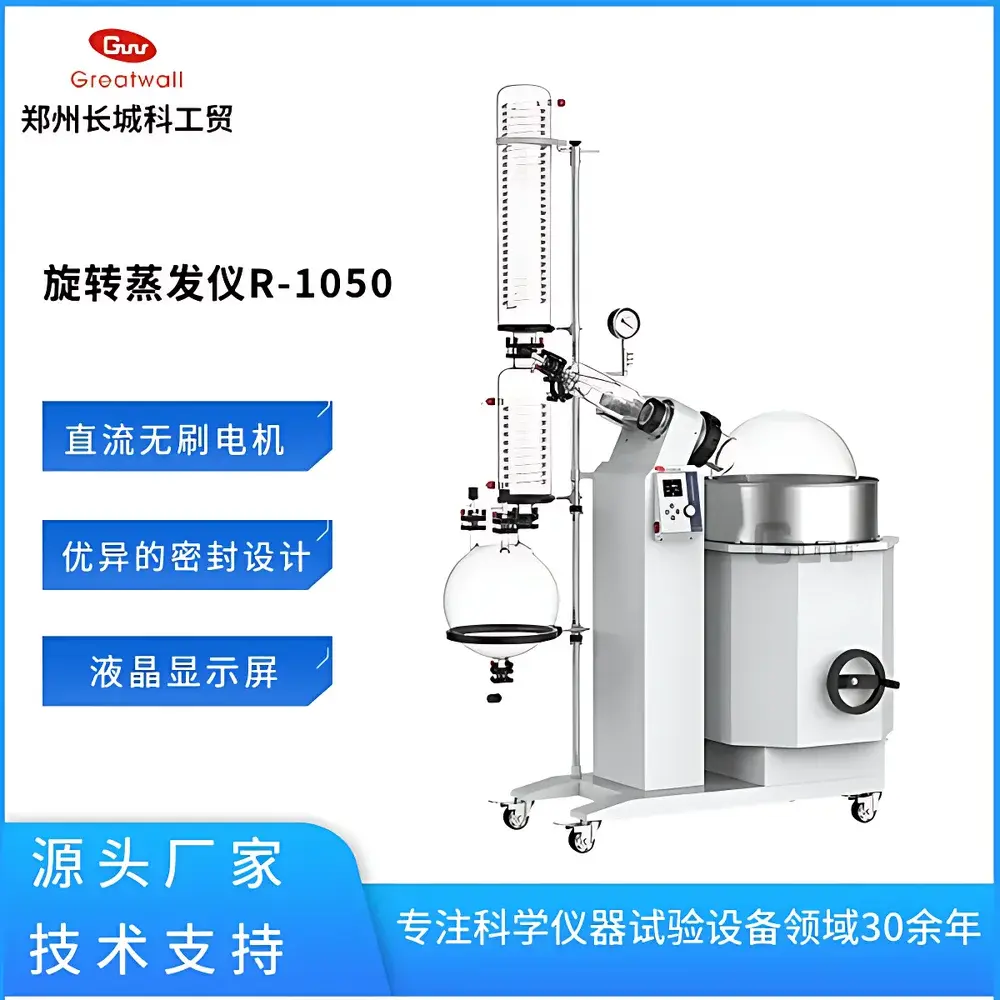
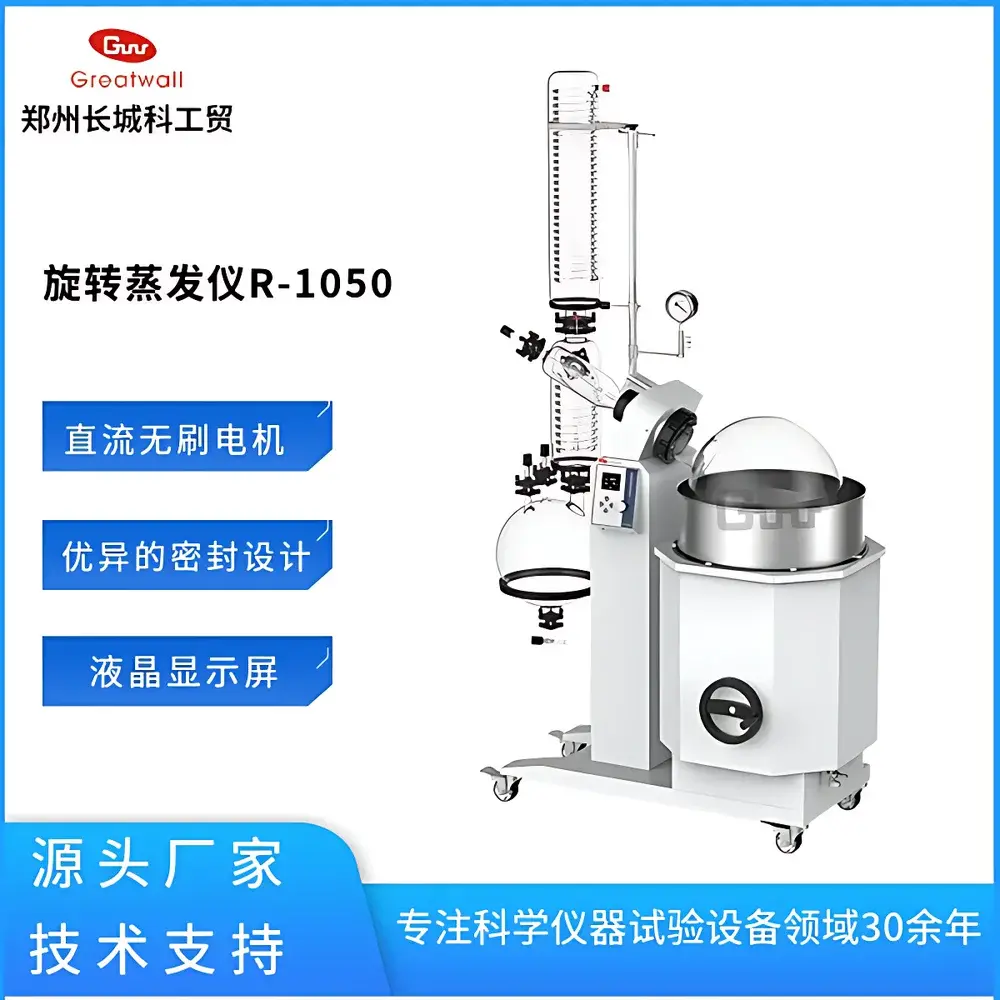
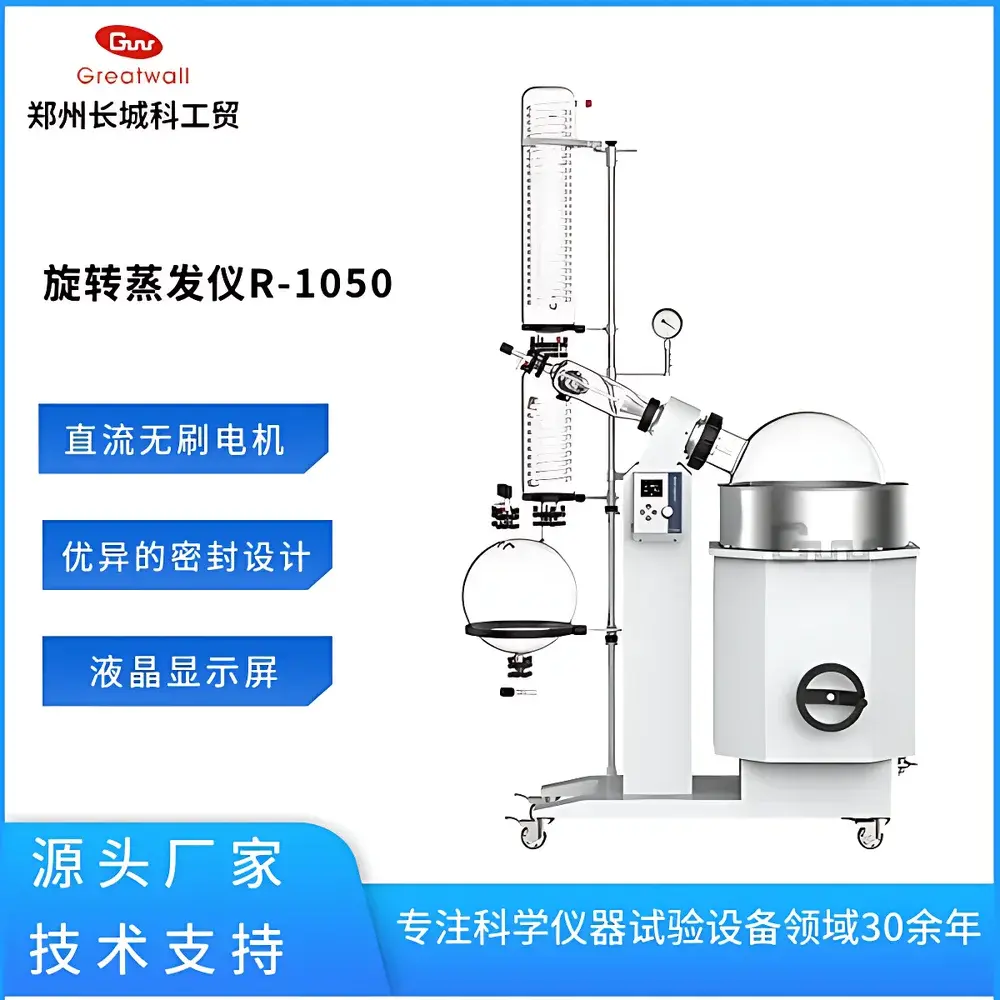
Great Wall R-1050 Rotary Evaporator for Solvent Removal and Sample Concentration
| Key | Brand: Great Wall |
|---|---|
| Origin | Henan, China |
| Manufacturer Type | Direct Manufacturer |
| Model | R-1050 |
| Rotating Flask Capacity | 50 L |
| Rotation Speed Range | 20–110 rpm |
| Bath Temperature Range | +5 °C to 95 °C (above ambient) |
| Temperature Control Accuracy | ±1.5 °C |
| Primary Condenser Area | ~1.15 m² |
| Secondary Condenser Area | ~0.4 m² |
| Power Supply | 3-phase, 380 V, 50 Hz |
| Total Power Consumption | 6300 W |
| Overall Dimensions (with glassware) | 1345 W × 770 D × 2230 H mm |
| Net Weight (with glassware) | 140 kg |
| IP Rating | IP20 |
| Pollution Degree | 2 |
| Max. Evaporation Rate (water) | 9 L/h |
| Sealing Leakage Rate | ≤0.03 kPa/min |
| Material of Glass Components | ASTM E438 Type I, Class A borosilicate 3.3 |
| Sealing Material | Dual-layer PTFE + fluororubber O-rings |
| Bath Vessel Material | AISI 304 stainless steel (06Cr19Ni10) |
| Enclosure Material | Electrostatically coated cold-rolled steel |
Overview
The Great Wall R-1050 Rotary Evaporator is a high-capacity, laboratory-grade solvent removal system engineered for reproducible concentration, purification, and recovery of heat-sensitive compounds under reduced pressure. Operating on the principle of vacuum-assisted rotary distillation, the R-1050 rotates a large-volume (50 L) borosilicate 3.3 flask in a thermostatically controlled water or oil bath while simultaneously applying vacuum via an external pump. This combination lowers the boiling point of solvents, enabling gentle, efficient evaporation without thermal degradation. Designed for industrial-scale R&D labs, pilot plants, and QC/QA facilities, the R-1050 meets functional requirements aligned with ISO/IEC 17025 documentation practices and supports GLP-compliant workflows when integrated with validated SOPs and audit-trail-capable data loggers.
Key Features
- Borosilicate 3.3 glass assembly (per ASTM E438 Type I, Class A), offering exceptional thermal shock resistance (ΔT ≥ 160 °C), chemical inertness against organic solvents, strong acids/bases, and low alkali leaching—critical for pharmaceutical and agrochemical residue analysis.
- Dual-stage condensation system: primary condenser (1.15 m²) paired with auxiliary condenser (0.4 m²), configured in triple-reflux geometry to maximize vapor capture efficiency and minimize solvent loss—even during high-throughput evaporation of low-boiling solvents such as diethyl ether, dichloromethane, or acetone.
- PTFE-fluororubber dual-seal design at all critical joints ensures long-term vacuum integrity (<0.03 kPa/min leakage rate), sustaining stable operating pressures down to <10 mbar without seal fatigue or extrusion under cyclic thermal loading.
- Motor-driven vertical bath lift mechanism (supplemented by manual override) enables precise positioning of the rotating flask relative to the condenser axis—reducing mechanical stress on glassware and improving film uniformity across the 50 L flask surface.
- Integrated safety architecture includes overtemperature cutoff (PT-100 sensor feedback loop), dry-run prevention logic, and electromagnetic braking on the rotation drive—meeting IEC 61000-6-2 EMC immunity and IEC 60529 IP20 enclosure compliance for indoor laboratory use only.
- Quick-release法兰 (DIN 2817 standard) connections simplify glassware assembly/disassembly without tools; PTFE-coated discharge valve allows solvent-free collection bottle exchange mid-process without breaking vacuum or interrupting distillation continuity.
Sample Compatibility & Compliance
The R-1050 accommodates viscous, foaming, and thermolabile samples—including natural product extracts, polymer solutions, essential oils, and synthetic intermediates—across pH 1–14 and temperatures up to 95 °C. All wetted parts contacting samples are either borosilicate 3.3 glass or USP Class VI-certified fluoropolymers, eliminating metal ion leaching concerns in trace-level analytical applications. While not certified to FDA 21 CFR Part 11 out-of-the-box, the system’s analog temperature/rotation outputs and optional RS-485 interface support integration with third-party compliant data acquisition systems meeting ALCOA+ principles. It conforms to EN 61010-1:2010 for electrical safety and operates within specified environmental limits: ambient temperature 5–35 °C, relative humidity ≤70 % RH non-condensing, and altitude ≤2000 m.
Software & Data Management
The R-1050 features embedded digital control with LCD display for real-time monitoring of bath temperature and rotation speed. Though it does not include onboard data logging or PC connectivity as standard, its analog 0–10 VDC outputs for temperature and speed signals enable seamless integration with programmable logic controllers (PLCs), SCADA platforms, or validated LIMS environments. When paired with external USB or Ethernet-based data loggers (e.g., Omega OM-DAQPRO-5300), users can generate time-stamped, tamper-evident records compliant with 21 CFR Part 11 Annex 11 requirements—provided electronic signatures, audit trails, and user access controls are implemented at the host system level.
Applications
- Concentration of large-volume botanical extracts (e.g., 40–50 L batches of ethanol or supercritical CO₂ extracts) prior to chromatographic fractionation.
- Removal of reaction solvents (THF, DMF, toluene) from scale-up synthesis campaigns in fine chemical manufacturing.
- Recovery and recycling of high-purity solvents in API process development, reducing waste disposal costs and environmental footprint.
- Preparative dehydration of heat-labile biopolymers (e.g., hyaluronic acid, chitosan derivatives) where conventional drying induces chain scission.
- Distillative purification of fragrance compounds and volatile flavor isolates under mild vacuum (10–50 mbar) to preserve organoleptic profiles.
FAQ
What is the maximum recommended vacuum level for optimal performance?
The R-1050 achieves highest condensation efficiency at operating pressures between 10 and 50 mbar; lower pressures may increase bumping risk with volatile solvents unless feed rate and rotation speed are precisely balanced.
Can the R-1050 be used with corrosive solvents like concentrated HCl or bromine-containing reagents?
Only with verified compatibility testing: while borosilicate 3.3 resists most organics and dilute acids, prolonged exposure to hot concentrated mineral acids or halogens requires supplemental PTFE-lined traps and cold traps to protect the condenser and vacuum pump.
Is the bath temperature sensor calibrated traceable to NIST standards?
The built-in PT-100 sensor is factory-calibrated; users must perform periodic verification using a NIST-traceable reference thermometer per ISO/IEC 17025 Section 6.6, especially before critical validation runs.
Does the unit support continuous feed operation?
No—the R-1050 is designed for batch processing; continuous feed requires integration with an external peristaltic pump and custom manifold, which falls outside the manufacturer’s scope of validation.
What maintenance intervals are recommended for long-term reliability?
Inspect seals and glassware for microfractures every 200 operational hours; replace PTFE/fluororubber O-rings annually or after 500 cycles; verify bath heater calibration semiannually using a secondary reference probe.
Related Products



