
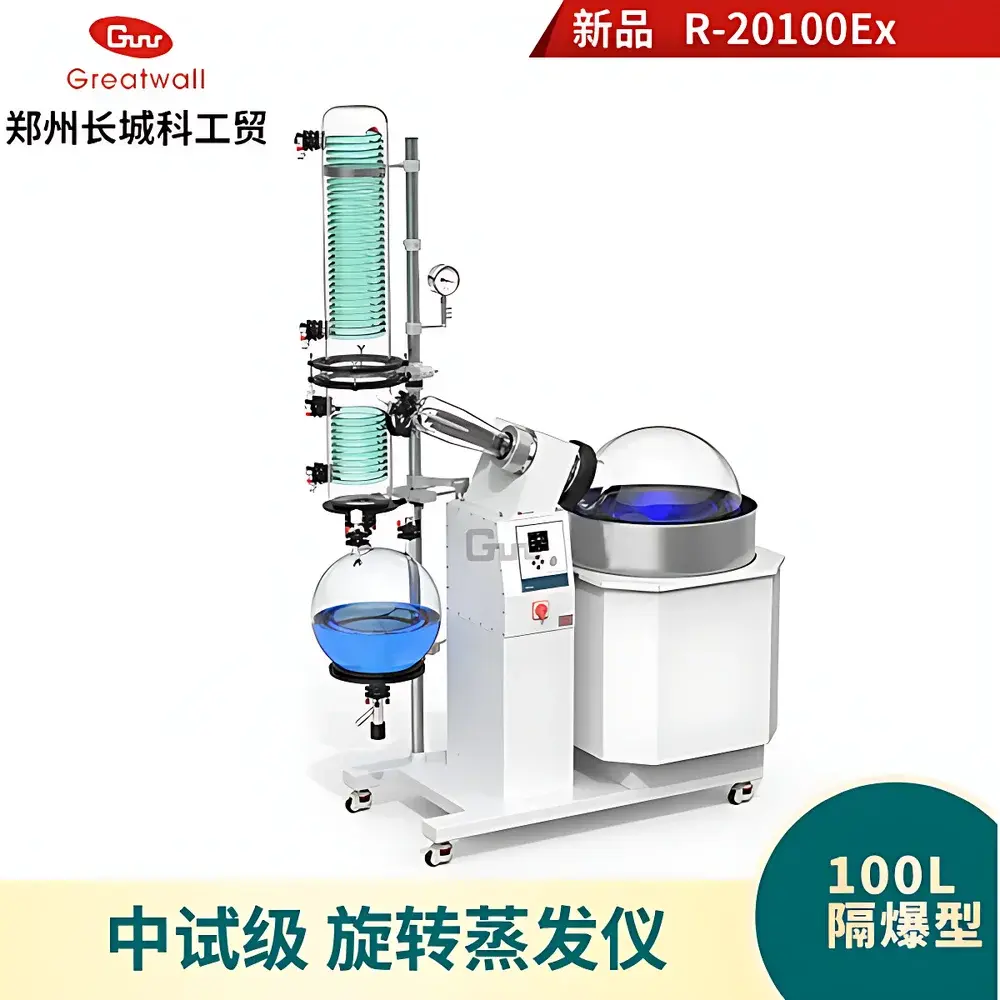
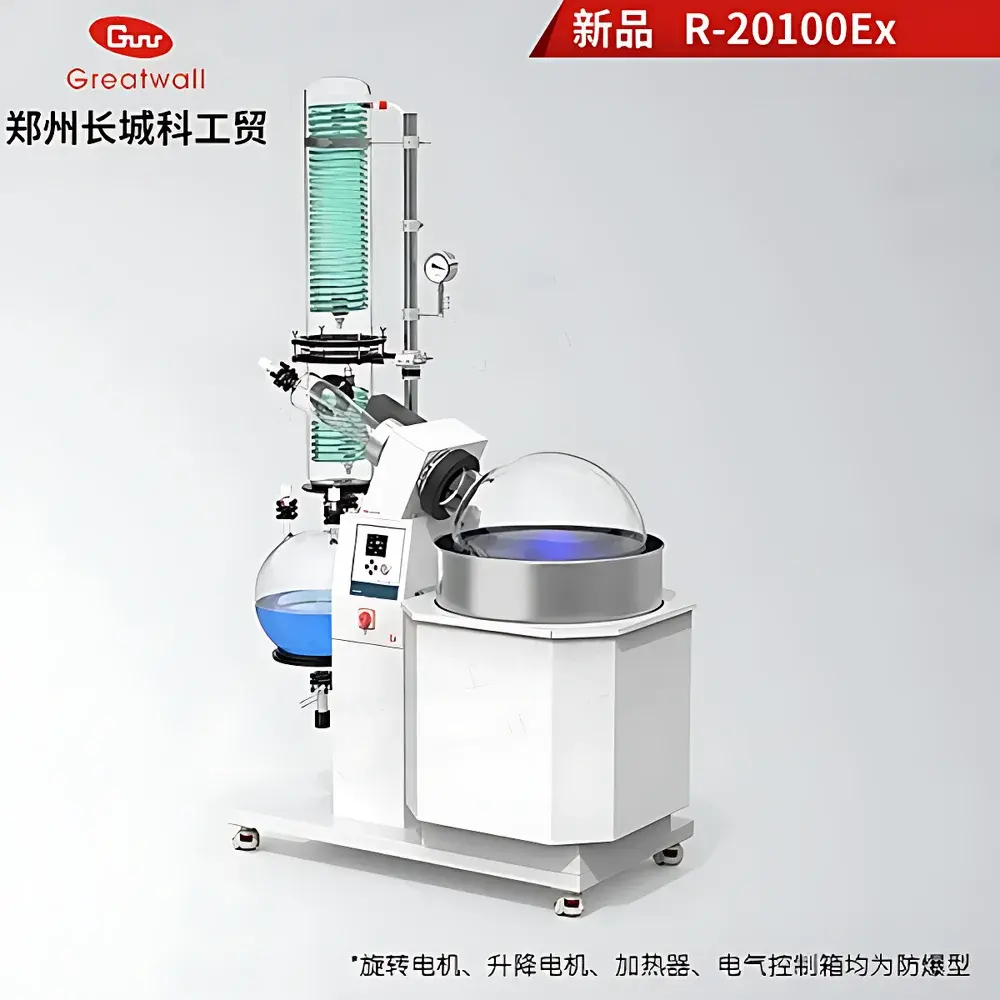
The Great Wall R-20100Ex Explosion-Proof Rotary Evaporator
| Brand | The Great Wall |
|---|---|
| Origin | Henan, China |
| Manufacturer Type | Direct Manufacturer |
| Origin Category | Domestic (China) |
| Model | R-20100Ex |
| Capacity | 100 L |
| Rotation Speed | 20–80 rpm |
| Temperature Control Range | Ambient +5°C to 80°C |
| Condenser Type | Dual-Cooling (Main + Auxiliary) Triple-Reflex Condenser |
| Glass Material | DIN 3.3 Borosilicate Glass |
| Explosion Protection | Ex db IIB T4 Gb (IEC 60079-1) |
| Bath Lift | Motorized with Liquid-Level & Dry-Burn Protection |
| Drain Valve | PTFE-Sealed |
| Connection | Flanged Joints |
| Mobility | Braked Casters |
Overview
The Great Wall R-20100Ex Explosion-Proof Rotary Evaporator is an industrial-grade vacuum distillation system engineered for safe, continuous solvent removal from heat-sensitive or volatile samples under hazardous area conditions. Designed in strict compliance with IEC 60079-1 for flameproof (Ex db) protection, it integrates a robust 100 L evaporation capacity with dual-zone cooling architecture and intrinsically safe control components—making it suitable for Zone 1/21 environments where flammable vapors (e.g., acetone, ethanol, ethyl acetate, or hydrocarbon solvents) may be present during large-scale purification workflows. Its core operating principle relies on reduced-pressure boiling facilitated by rotational thin-film formation, combined with precise temperature regulation of the heating bath and high-efficiency condensation via triple-reflux geometry. This configuration ensures stable vapor pressure gradients, minimized bumping, and enhanced thermal transfer reproducibility across extended batch cycles.
Key Features
- DIN 3.3 borosilicate glass assembly: All critical glassware—including rotary flask, condenser, receiving flask, and buffer three-way adapter—meets ISO 3585 specifications for thermal shock resistance (>150 K), chemical inertness against organic solvents and mild acids/bases, and mechanical durability under sustained vacuum (≤5 mbar).
- Explosion-proof certified components: Motor, heating element, PT100 temperature sensor, and main control cabinet are individually rated Ex db IIB T4 Gb per IEC 60079-1, ensuring surface temperatures remain below 135°C under fault conditions and eliminating ignition risk in gas group IIB atmospheres.
- Dual-cooling triple-reflux condenser: Combines primary water-cooled jacket with auxiliary coolant loop and optimized internal baffle geometry to maximize condensation surface area (>1.2 m² effective), achieving >95% solvent recovery efficiency even at elevated feed rates.
- Motorized lifting bath with safety interlocks: Electromechanical lift mechanism enables precise vertical positioning of the 100 L heating bath; integrated liquid-level sensor and dry-burn cutoff prevent heater activation without sufficient thermal fluid volume.
- PTFE-sealed drain valve and flanged joints: Corrosion-resistant polytetrafluoroethylene valve ensures leak-tight discharge of collected distillate without interrupting ongoing evaporation; standardized flange connections (ISO-KF 50 compatible) allow rapid, tool-free disassembly and cleaning.
- Intuitive encoder-based interface: Backlit LCD display with rotary encoder navigation simplifies parameter setting for rotation speed (20–80 rpm, ±1 rpm resolution) and bath temperature (ambient +5°C to 80°C, ±0.5°C accuracy), supporting GLP-compliant operation logs when paired with optional data export modules.
Sample Compatibility & Compliance
The R-20100Ex accommodates viscous, foaming, or particulate-laden feedstocks up to 100 L volume, including crude natural product extracts, polymer solutions, pharmaceutical intermediates, and agrochemical formulations. Its borosilicate glass train resists degradation from chlorinated solvents (e.g., DCM, chloroform), esters, ketones, and alcohols—enabling reuse across multiple campaigns without leaching or haze formation. The system complies with ISO 22196 for antimicrobial surface testing protocols and supports audit-ready documentation per FDA 21 CFR Part 11 when integrated with validated software packages. It meets mechanical safety requirements per EN 61000-6-2/6-4 (EMC) and electrical safety per EN 61010-1 for laboratory equipment.
Software & Data Management
While the base R-20100Ex operates via standalone hardware controls, optional RS-485/Modbus RTU or Ethernet interfaces enable integration into centralized lab automation platforms (e.g., LabVantage, Thermo Fisher SampleManager). Real-time acquisition of bath temperature, rotation speed, vacuum level (when paired with optional digital vacuum controller), and runtime duration is supported. Exported CSV or XML datasets include timestamped metadata, operator ID fields, and configurable alarm event logging—facilitating traceability for ISO/IEC 17025 accreditation or GMP process validation. Firmware updates maintain backward compatibility and incorporate security patches aligned with IEC 62443-3-3 cybersecurity standards.
Applications
- Large-scale concentration of botanical extracts in nutraceutical manufacturing
- Solvent recovery and residue removal in API synthesis under ATEX/IECEx-regulated facilities
- Removal of low-boiling solvents from polymer emulsions prior to spray drying
- Batch-wise purification of flavor & fragrance compounds requiring inert atmosphere handling
- Concentration of wastewater streams containing recoverable organics in environmental testing labs
FAQ
What explosion protection standard does the R-20100Ex meet?
It conforms to IEC 60079-1 (flameproof enclosure “d”) with certification marking Ex db IIB T4 Gb, suitable for use in Zone 1 (gas) and Zone 21 (dust) hazardous locations.
Can the system operate under inert gas purging?
Yes—the sealed glass train and pressure-relief valve configuration support nitrogen or argon blanketing during distillation to prevent oxidation or pyrophoric reactions.
Is vacuum control included as standard?
No; vacuum regulation requires an external diaphragm pump and optional digital vacuum controller (e.g., V-300 series), which can be interfaced via analog 0–10 V or Modbus.
What maintenance intervals are recommended for the explosion-proof motor?
Per manufacturer guidelines, inspect bearing lubrication and terminal housing integrity every 500 operational hours; replace seals and verify enclosure integrity annually or after any impact event.
Does the unit support automated start/stop sequences?
Not natively—but programmable logic controllers (PLCs) or third-party sequencers can be integrated via dry-contact I/O terminals located in the control cabinet.



