
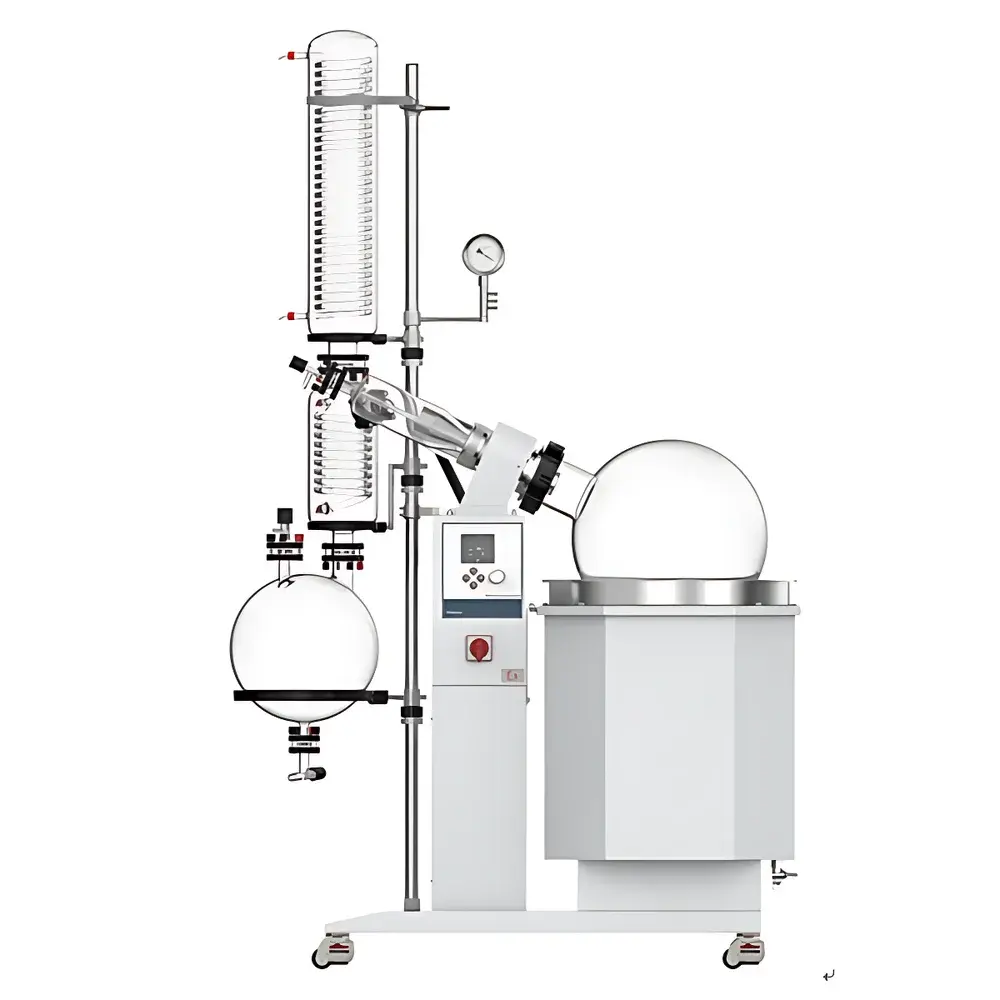
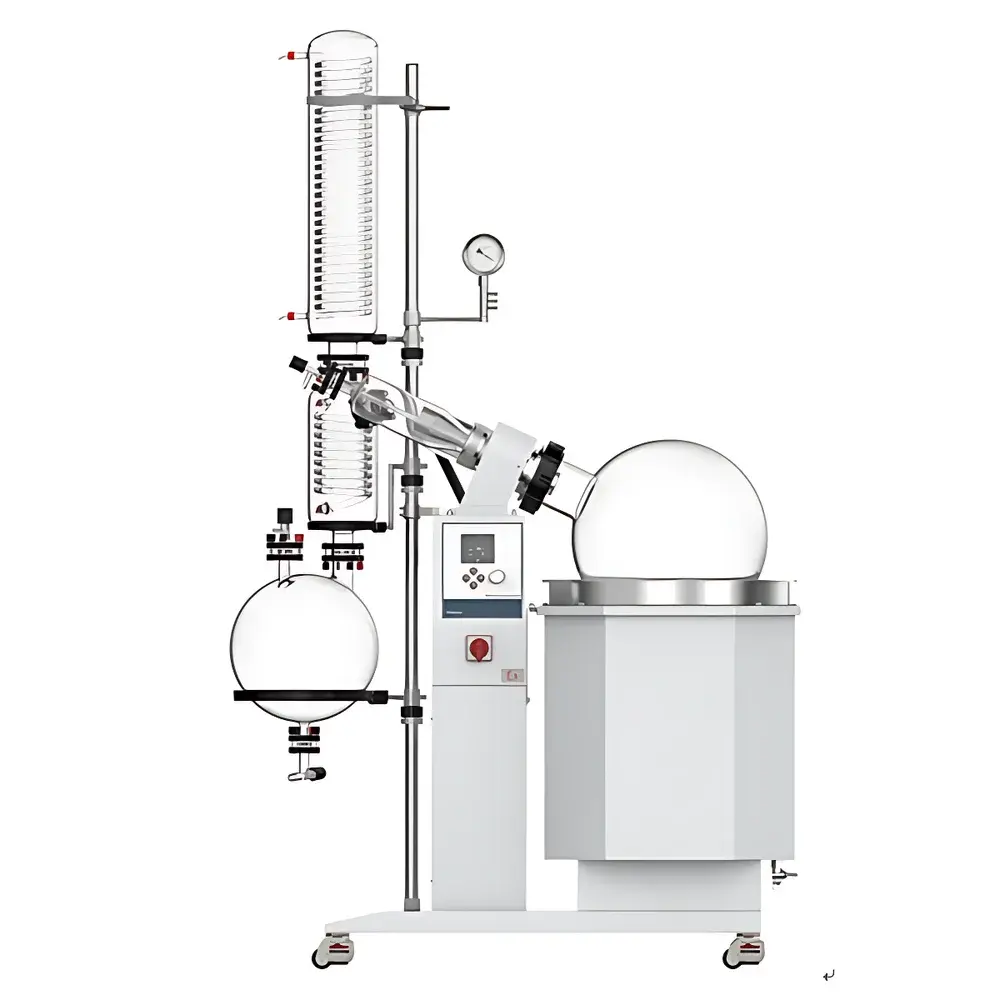
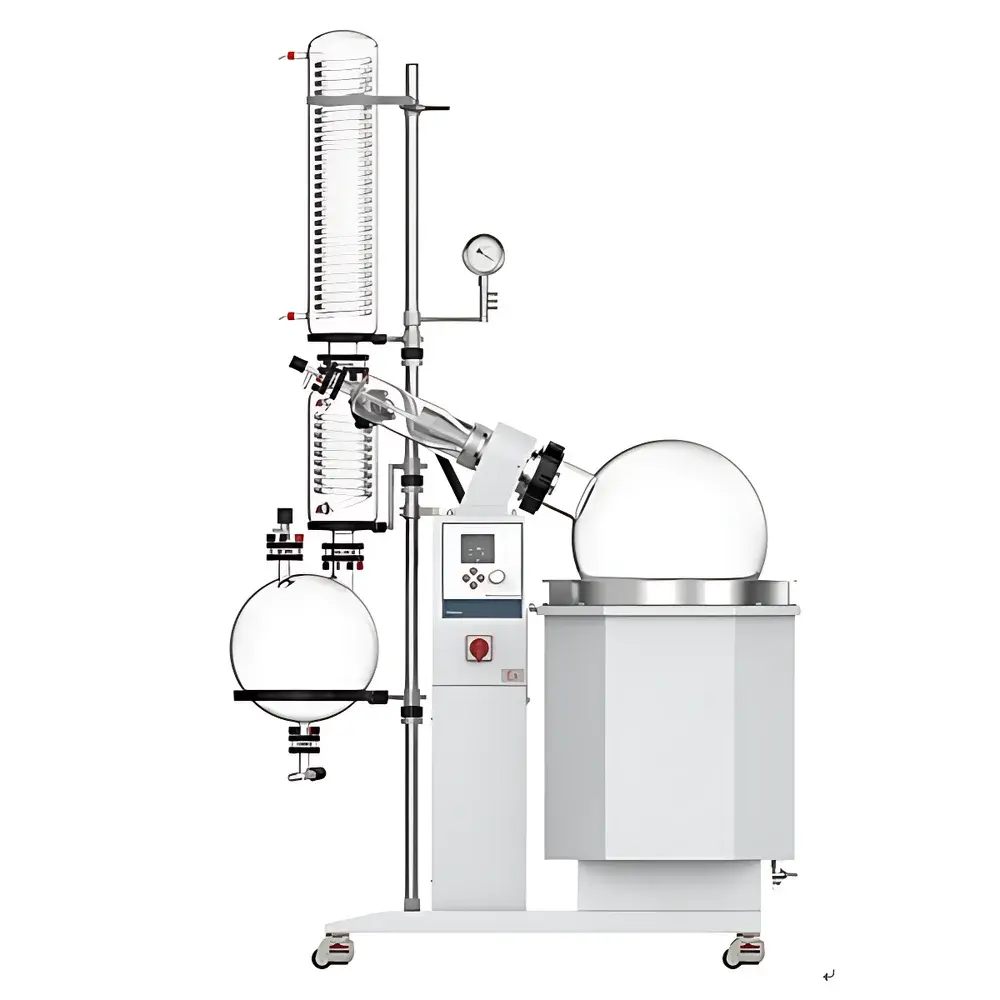
Great Wall R-2050EX Explosion-Proof Integrated Rotary Evaporator
| [Brand | Great Wall |
|---|---|
| Origin | Henan, China |
| Model | R-2050EX |
| Capacity | 50 L |
| Ultimate Vacuum | ≤2 kPa/h |
| Rotation Speed | 20–110 rpm |
| Temperature Range | Ambient +5 to 95 °C |
| Temperature Control Accuracy | ±1.5 °C |
| Condensing Area | Main Condenser 1.15 m², Auxiliary Condenser 0.4 m² |
| Heating Power | 6000 W |
| Total Rated Power | 6500 W |
| Motor Power | 370 W |
| Lift Stroke | 0–170 mm |
| Explosion Protection Rating | Ex d II BT4 |
| IP Rating (Electrical Cabinet) | IP65 |
| Communication Protocol | RS485 / MODBUS RTU |
| Material | Borosilicate Glass 3.3 (DIN ISO 3585), SUS304 Bath, PTFE Seals & Valve Core |
| Dimensions (W×D×H) | 1360 × 770 × 2250 mm] |
Overview
The Great Wall R-2050EX Explosion-Proof Integrated Rotary Evaporator is an engineered solution for safe, high-capacity solvent removal under reduced pressure in hazardous environments. Designed in accordance with IEC 60079-0 and GB 3836.1–2010 standards for explosive atmospheres, the system integrates vacuum distillation, precise temperature control, and motorized vertical lift into a single robust platform. Its core operating principle relies on rotary evaporation—where a rotating 50 L evaporation flask increases surface area and promotes efficient thin-film formation, while controlled bath heating (ambient +5 to 95 °C) and vacuum (≤2 kPa/h ultimate pressure) lower boiling points to accelerate gentle, selective volatilization. The unit is specifically configured for Class I, Group IIB, T4 environments (Ex d II BT4), making it suitable for laboratories handling flammable solvents such as acetone, ethanol, diethyl ether, or ethyl acetate where ignition risk mandates certified explosion-proof instrumentation.
Key Features
- Explosion-proof certified components throughout: motor, heating unit, electrical cabinet (Ex d II BT4), and liquid level switch—all bearing valid national explosion protection certifications.
- Dual-stage condensation architecture: vertical triple-reflux condenser with main (1.15 m²) and auxiliary (0.4 m²) cooling surfaces, fabricated from borosilicate glass 3.3 (DIN ISO 3585) for thermal shock resistance and chemical inertness.
- PTFE–fluoroelastomer dual-seal system at all vacuum interfaces ensures long-term integrity and leak-tight performance under continuous negative pressure operation.
- Motorized electric lift mechanism (0–170 mm stroke) with dry-run and liquid-level safety interlocks prevents heater damage and ensures reproducible immersion depth control.
- Quick-connect法兰 (ISO-KF 125 mm) mounting for rapid assembly/disassembly of glassware; integrated PTFE discharge valve enables corrosion-resistant, drip-free sample recovery.
- Intelligent control panel with LCD display showing real-time bath temperature, rotation speed, and system status; supports RS485 communication via MODBUS RTU protocol for centralized lab automation integration.
- Stainless steel (SUS304) heating bath (Φ560 × 340 mm), 6000 W heating capacity, and ±1.5 °C temperature stability across full operational range.
Sample Compatibility & Compliance
The R-2050EX accommodates heat-sensitive organic compounds, pharmaceutical intermediates, natural product extracts, and polymer solutions requiring low-residue solvent recovery. Its borosilicate glass 3.3 construction resists hydrolysis, alkali attack, and thermal cycling—ensuring compatibility with common laboratory solvents including methanol, chloroform, THF, and toluene. All electrical enclosures meet IP65 ingress protection requirements, and the entire system complies with GB/T 12801–2022 (Safety in Production Processes), GB 5226.1–2019 (Electrical Equipment of Machines), and relevant clauses of ISO/IEC 80079-36 for equipment used in potentially explosive atmospheres. Documentation includes traceable certification files for each Ex-rated component, supporting GLP-compliant audit readiness.
Software & Data Management
While the R-2050EX operates via embedded microcontroller-based logic without proprietary software, its RS485 interface enables seamless integration into existing laboratory information management systems (LIMS) or supervisory control and data acquisition (SCADA) platforms using standard MODBUS RTU registers. Users can log bath temperature, rotation speed, vacuum status, and fault codes remotely. The controller maintains non-volatile event history—including overtemperature alerts, lift limit triggers, and current overload events—with timestamping capability. For regulated environments (e.g., pharmaceutical QC labs), optional external data loggers compliant with FDA 21 CFR Part 11 may be deployed to capture and sign electronic records of critical process parameters during evaporation cycles.
Applications
- Concentration of thermolabile active pharmaceutical ingredients (APIs) under mild conditions to preserve stereochemistry and bioactivity.
- Removal of reaction solvents following Grignard, Suzuki, or esterification syntheses—particularly where flammable media necessitate intrinsically safe infrastructure.
- Essential oil isolation from botanical matrices via low-pressure steam distillation coupling.
- Preparative-scale purification of fine chemicals prior to crystallization or chromatographic separation.
- Environmental sample preparation (e.g., EPA Method 3510C) for VOC analysis, where explosion-proof design mitigates risks associated with halogenated solvent handling.
FAQ
What does Ex d II BT4 mean for this rotary evaporator?
It indicates flameproof enclosure protection (Ex d), suitable for use in Zone 1 explosive gas atmospheres (II), Group IIB (propane, ethylene), and maximum surface temperature class T4 (≤135 °C).
Is the entire unit certified as explosion-proof, or only selected components?
All critical subsystems—including motor, heater, control cabinet, and level sensor—are individually certified to Ex d II BT4; the integrated system conforms to GB 3836.1–2010 and IEC 60079-0.
Can the R-2050EX be connected to a central vacuum system?
Yes—via standard vacuum hose port with pressure regulation valve; however, ultimate vacuum performance (≤2 kPa/h) assumes use of the included diaphragm vacuum pump optimized for solvent-laden vapor streams.
Does the system support automated distillate collection across multiple receiving flasks?
No—the R-2050EX features a single 20 L collection flask with manual switching; continuous fraction collection requires external valve manifolds not included in base configuration.
What maintenance intervals are recommended for the PTFE–fluoroelastomer seals?
Under continuous operation with aggressive solvents, inspect seals every 500 hours; replace proactively every 1,000 operational hours or upon visible compression set or cracking.



