
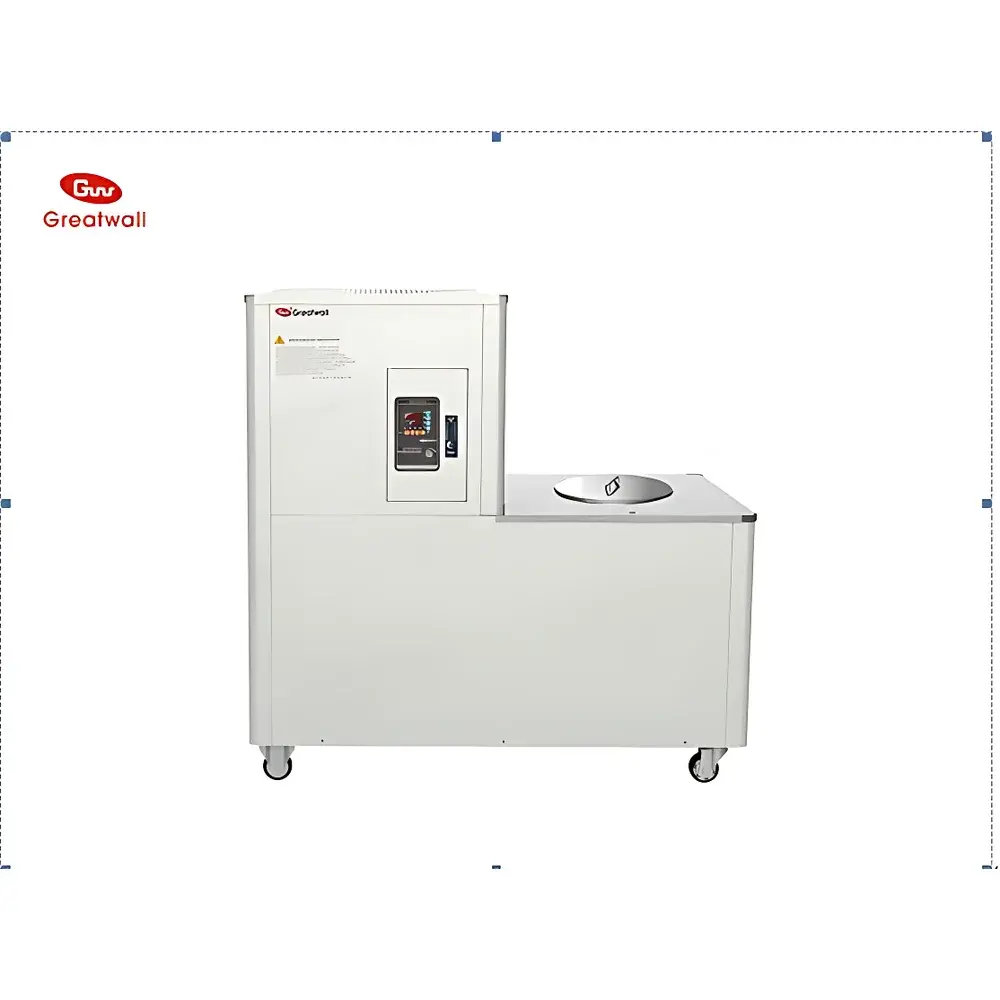
Great Wall DHJF-1020 Ultra-Low-Temperature Circulating Cooling Bath
| Brand | The Great Wall |
|---|---|
| Origin | Henan, China |
| Manufacturer Type | Original Equipment Manufacturer (OEM) |
| Country of Manufacture | China |
| Model | DHJF-1020 |
| Quotation | Upon Request |
| Refrigerant | Mixed Cryogenic Refrigerant |
| Tank Capacity | 20 L |
| Temperature Range | −100 °C to −60 °C |
| Temperature Stability | ±2 °C |
| Refrigeration Capacity | 600 W at −60 °C |
| Circulation Pump Power | 100 W |
| Flow Rate | 20 L/min |
| Max. Pressure | 0.4 bar |
| Power Supply | 3-phase, 380 V, 50 Hz |
| Total Power Consumption | 4000 W |
| Tank Dimensions (Ø×H) | 300 mm × 300 mm |
| Opening Diameter | 280 mm |
| External Port Size | 1/2″ BSP |
| Compatible Flask Volume | Up to 5000 mL |
| Tank Material | AISI 304 Stainless Steel |
| Unit Dimensions (W×D×H) | 810 × 1160 × 1310 mm |
| Net Weight | 154 kg |
| Ambient Operating Conditions | 5–35 °C, ≤70% RH |
| Safety Protections | Phase sequence monitoring, overcurrent protection, thermal overload cutoff, startup delay logic |
| Operational Constraint | External circulation function disabled when bath temperature < −90 °C |
Overview
The Great Wall DHJF-1020 Ultra-Low-Temperature Circulating Cooling Bath is an engineered solution for sustained, stable cryogenic temperature control in laboratory-scale reaction and material testing applications. Designed around a single-stage compression cascade refrigeration architecture with series-connected heat exchangers, the system achieves operational stability down to −100 °C using a proprietary mixed refrigerant blend—eliminating the need for liquid nitrogen or multi-compressor configurations. Its core thermodynamic design employs a Panasonic hermetic scroll compressor with integrated thermal overload protection, coupled with a high-efficiency finned air-cooled condenser fabricated from oxygen-free copper tubing and enhanced via proprietary tube-expansion bonding technology. The evaporator is a coil-type unit fully immersed in the 304 stainless steel reservoir, ensuring mechanical resilience even under full cryogenic load and preventing structural failure during solvent freezing events.
Key Features
- Single-compressor, multi-stage refrigeration architecture enabling −100 °C operation without external cryogens
- Hermetically sealed Panasonic scroll compressor with flexible rotor design and built-in thermal cutout for extended service life
- AISI 304 stainless steel reservoir (20 L capacity) with 280 mm access opening—compatible with standard 5 L jacketed reactors and glassware
- Low-temperature-rated shielded circulation pump (100 W), delivering up to 20 L/min at 0.4 bar pressure through 304 stainless steel fluid pathways
- Intelligent digital controller with backlit LCD interface, supporting full parameter logging, setpoint ramping, and real-time deviation monitoring
- Comprehensive safety suite including phase-sequence detection, overcurrent interruption, thermal overload cutoff, and programmable startup delay
- Welded refrigerant circuit with minimal joint count—optimized for leak integrity, long-term reliability, and simplified maintenance
Sample Compatibility & Compliance
The DHJF-1020 accommodates a broad range of low-temperature experimental configurations, including jacketed glass reactors (up to 5 L), cryostat-mounted spectroscopy cells, and solid-state synthesis vessels. Its 304 stainless steel wetted components ensure compatibility with common organic solvents (e.g., THF, toluene, DCM), low-viscosity silicone oils, and ethanol/water mixtures—provided formulations remain non-corrosive and below their respective freezing points. While not certified to ISO/IEC 17025 or ASTM E2912 as a standalone metrological instrument, the system’s temperature stability (±2 °C over time) supports GLP-aligned process validation protocols. All electrical components comply with IEC 61000-6-3 (EMC emissions) and IEC 61000-6-2 (immunity). The unit meets CE marking requirements for machinery safety (2006/42/EC) and low-voltage directive (2014/35/EU).
Software & Data Management
The DHJF-1020 operates via an embedded microcontroller platform with no external PC dependency. The front-panel LCD displays real-time bath temperature, setpoint, pump status, and active fault codes. All operational parameters—including target temperature, ramp rate, hold duration, and safety thresholds—are configurable via membrane keypad. System logs record timestamped temperature deviations, alarm events, and power-cycle history for up to 30 days (non-volatile memory). Though lacking native Ethernet or USB data export, analog 0–10 V and 4–20 mA outputs are provided for integration into centralized lab monitoring systems (e.g., LabVIEW, DeltaV, or Siemens Desigo CC). Audit trail functionality conforms to basic ALCOA+ principles: attributable, legible, contemporaneous, original, and accurate—supporting routine GMP documentation workflows where electronic records are manually transcribed.
Applications
- Low-temperature Grignard and organolithium reaction control (−78 °C to −100 °C)
- Cryogenic crystallization studies requiring precise thermal ramping and isothermal holds
- Calibration of infrared and Raman spectrometers using temperature-stabilized reference samples
- Thermal cycling tests for polymer composites and battery electrolyte formulations
- Condensation trapping in vacuum distillation and rotary evaporation setups
- Stabilization of superconducting magnet cooling circuits in materials characterization labs
FAQ
Can the DHJF-1020 operate continuously at −100 °C?
Yes—within ambient conditions of 5–35 °C and ≤70% RH—but external circulation must be disabled below −90 °C per operational safety protocol.
What refrigerants are used, and are they compliant with EU F-Gas Regulation?
The unit employs a proprietary zeotropic mixture classified under Annex I of Regulation (EU) No 517/2014; GWP values are documented in the technical datasheet supplied with each unit.
Is remote monitoring possible?
Analog voltage and current outputs enable third-party SCADA integration; however, no native Wi-Fi, Modbus TCP, or cloud connectivity is included.
What maintenance intervals are recommended?
Compressor oil inspection every 24 months; condenser coil cleaning quarterly; refrigerant leak check annually per ISO 5149-2 guidelines.
Does the system support external PID feedback from a probe placed in the reaction vessel?
No—the controller regulates only the bath temperature; external probe input is not supported. For reactor-jacket temperature matching, users must rely on empirical correlation or secondary control loops.



