
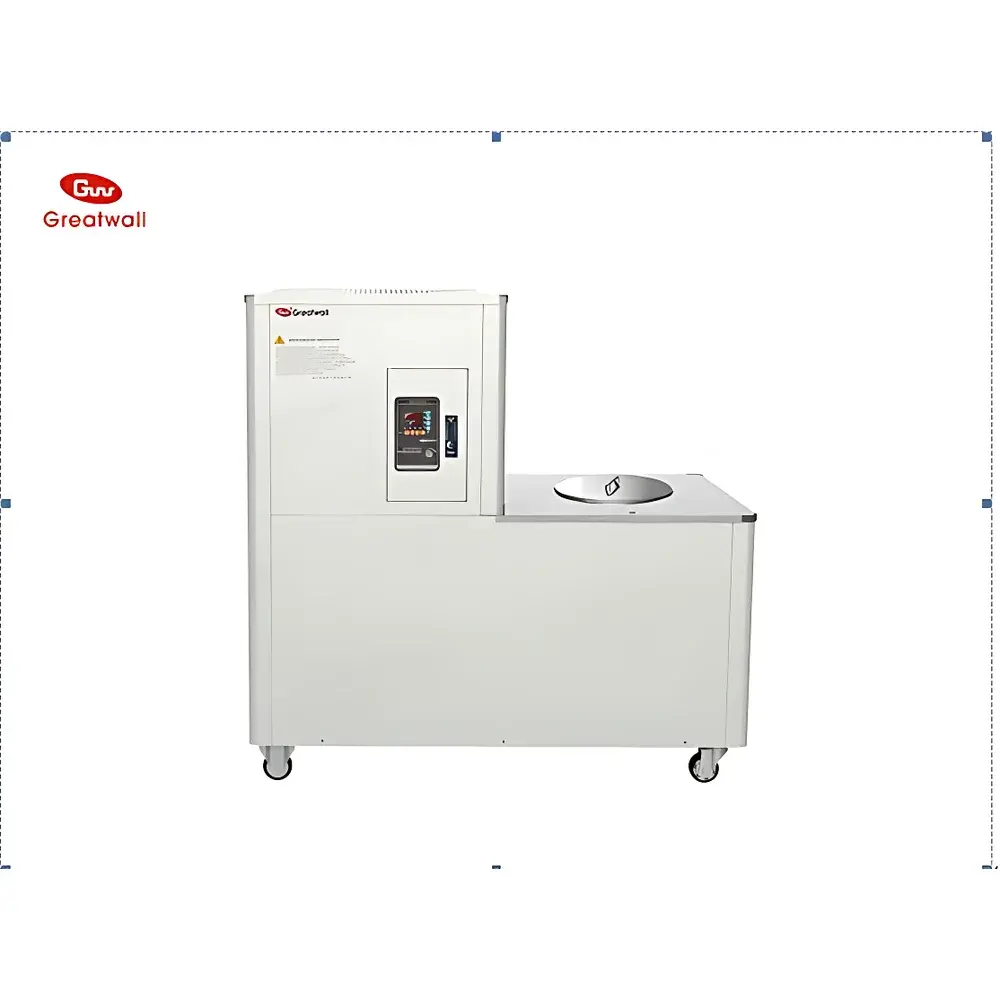
Great Wall DHJF-1250 Ultra-Low-Temperature Circulating Cooling Bath
| Brand | The Great Wall |
|---|---|
| Origin | Henan, China |
| Manufacturer Type | Original Equipment Manufacturer (OEM) |
| Country of Manufacture | China |
| Model | DHJF-1250 |
| Quotation | Available Upon Request |
| Refrigerant | Mixed Cryogenic Refrigerant Blend |
| Reservoir Volume | 50 L |
| Temperature Range | −120 °C to −60 °C |
| Temperature Stability | ±2 °C |
| Refrigeration Capacity | 700 W at −60 °C |
| Circulating Pump Power | 100 W |
| Flow Rate | 20 L/min |
| Max. Pressure | 0.4 bar |
| Display Resolution | 0.1 °C |
| Power Supply | 3-phase, 380 V, 50 Hz |
| Dimensions (W×D×H) | 1340 × 820 × 1310 mm |
| Weight | 265 kg |
| Reservoir Material | 304 Stainless Steel |
| External Port Size | 1/2″ BSP |
| Reservoir Opening Diameter | Ø400 mm |
| Reservoir Internal Dimensions | Ø450 × 320 mm |
| Max. Flask Capacity | 20,000 mL |
| Ambient Operating Conditions | 5–35 °C, ≤70% RH |
| Safety Protections | Phase Sequence Detection, Overcurrent, Overheat, Delayed Start, Thermal Cut-off |
Overview
The Great Wall DHJF-1250 Ultra-Low-Temperature Circulating Cooling Bath is an engineered thermal management system designed for sustained operation in the cryogenic range of −120 °C to −60 °C. It integrates a single-stage compression cascade refrigeration architecture with serially coupled heat exchangers—enabling deep cooling without multi-compressor complexity. At its core lies a hermetically sealed scroll compressor with integrated thermal overload protection, paired with a high-efficiency finned air-cooled condenser fabricated from oxygen-free copper tubing and enhanced via proprietary tube-expansion bonding technology. The evaporator adopts a coil-in-tank configuration, fully immersed within the 304 stainless steel reservoir; this design ensures mechanical integrity even under solidification of low-temperature heat transfer fluids (e.g., ethylene glycol/methanol blends), eliminating risk of thermal stress fracture. The system operates exclusively with a custom-blended mixed refrigerant formulation optimized for stability and phase behavior across extreme sub-zero conditions.
Key Features
- Single-compressor cascade refrigeration system achieving −120 °C using serial heat exchanger topology—reducing weld joints, improving leak integrity, and simplifying maintenance.
- Immersion-type coiled evaporator housed directly inside the reservoir—providing uniform thermal distribution and structural resilience during cryogenic fluid phase transitions.
- Corrosion-resistant circulation loop constructed entirely from 304 stainless steel, including pump housing, piping, and reservoir liner—compatible with common low-temperature heat transfer media.
- Digital microprocessor controller with 0.1 °C temperature resolution, intuitive keypad interface, and real-time status monitoring of refrigeration load, pump operation, and safety interlocks.
- Comprehensive safety suite: phase sequence verification, delayed compressor restart, overcurrent cutoff, dual-stage thermal shutdown, and automatic circulator disable below −90 °C to prevent thermal shock-induced fluid crystallization in lines.
Sample Compatibility & Compliance
The DHJF-1250 supports external jacketed reactors, rotary evaporators, and low-temperature condensation traps requiring stable, controllable bath temperatures between −60 °C and −120 °C. Its Ø400 mm open-top reservoir accommodates vessels up to 20 L volume (e.g., 20 L three-neck flasks with standardized ground-glass joints). All wetted components comply with ASTM A240/A240M for 304 stainless steel, ensuring resistance to chloride-induced pitting and cryogenic embrittlement. While not certified to ISO/IEC 17025 or FDA 21 CFR Part 11 out-of-the-box, the system’s deterministic control logic, non-volatile parameter storage, and hardware-enforced safety limits support integration into GLP/GMP-aligned laboratory workflows when validated per internal SOPs. Ambient operating specifications conform to IEC 61000-6-2 (immunity) and IEC 61000-6-4 (emissions).
Software & Data Management
The DHJF-1250 features embedded firmware with local data logging capability: temperature setpoint, actual bath temperature, compressor runtime, and fault codes are recorded at user-configurable intervals (1–60 min) and retained in non-volatile memory for ≥30 days. Export is supported via USB flash drive (FAT32 formatted) in CSV format for traceability and audit readiness. No remote connectivity (Ethernet/Wi-Fi) is provided—ensuring electromagnetic isolation in sensitive analytical environments. For laboratories requiring electronic record integrity, optional RS485 Modbus RTU interface enables integration with SCADA or LIMS platforms supporting time-stamped transaction logs and alarm history export—facilitating alignment with Annex 11 and ALCOA+ data governance principles.
Applications
- Cryogenic synthesis of organometallic compounds requiring precise thermal control below −80 °C (e.g., n-BuLi-mediated lithiations, Grignard additions).
- Low-temperature fractional distillation and solvent recovery where condenser temperatures must remain < −100 °C to prevent volatile loss.
- Calibration of cryogenic sensors and thermocouples against NIST-traceable reference baths within the −120 °C to −60 °C range.
- Stabilization of superconducting magnet cooling circuits during commissioning and quench testing protocols.
- Material science studies involving glass transition characterization of polymers and amorphous solids under controlled thermal ramping.
FAQ
Can the DHJF-1250 operate continuously at −120 °C?
Yes—provided ambient conditions remain within 5–35 °C and relative humidity does not exceed 70%. Continuous operation requires adequate ventilation around the condenser and periodic verification of refrigerant charge integrity every 12 months.
Is external recirculation compatible with all heat transfer fluids?
Only fluids with freezing points ≥20 °C below the target operating temperature and viscosity < 50 cSt at minimum use temperature are recommended. Ethylene glycol/water (30/70 v/v) is unsuitable below −40 °C; methanol/ethylene glycol blends (60/40) are validated down to −125 °C.
Why is the circulation pump disabled below −90 °C?
To prevent mechanical failure caused by localized freezing of residual fluid in narrow pump volutes or check valves—this safeguard is hardwired into the control logic and cannot be overridden.
Does the system include validation documentation?
Factory-assembled IQ/OQ documentation is available upon request. PQ protocol templates aligned with ISO 17025 clause 6.4.10 are supplied for end-user execution under qualified environmental conditions.



