
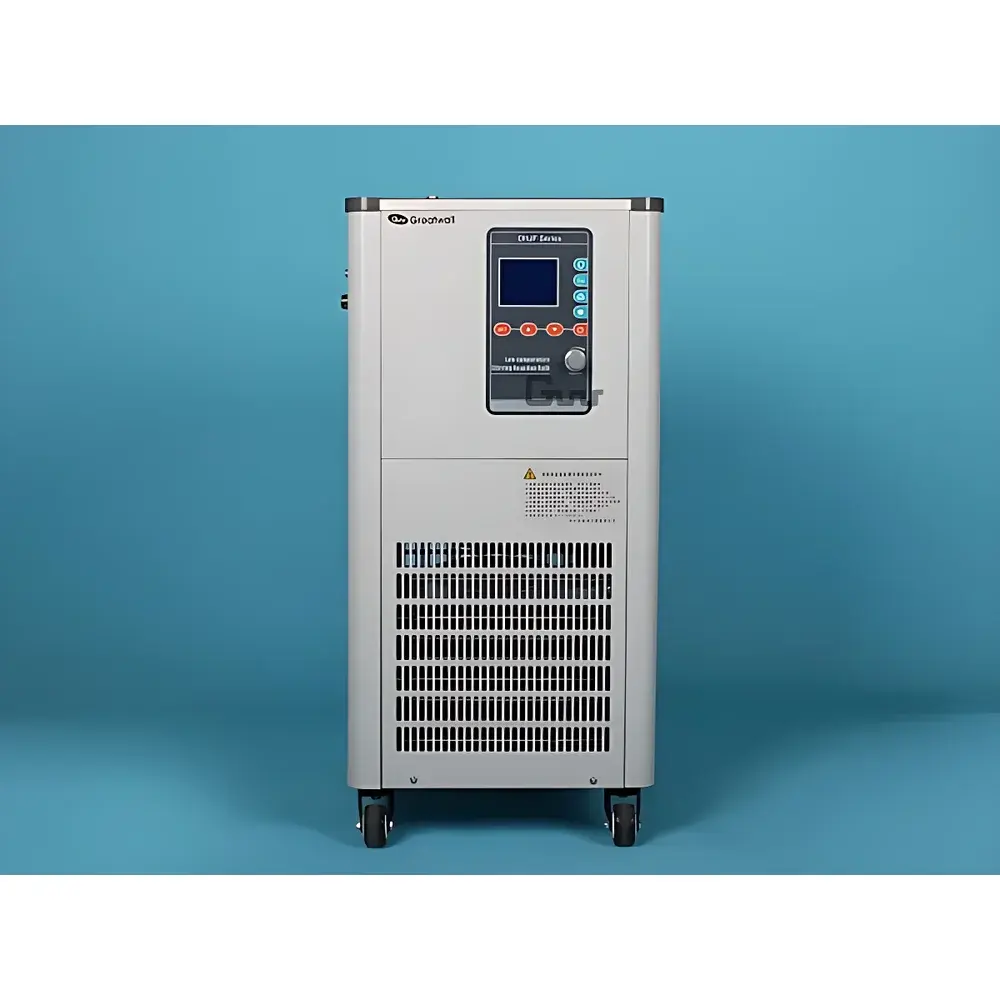
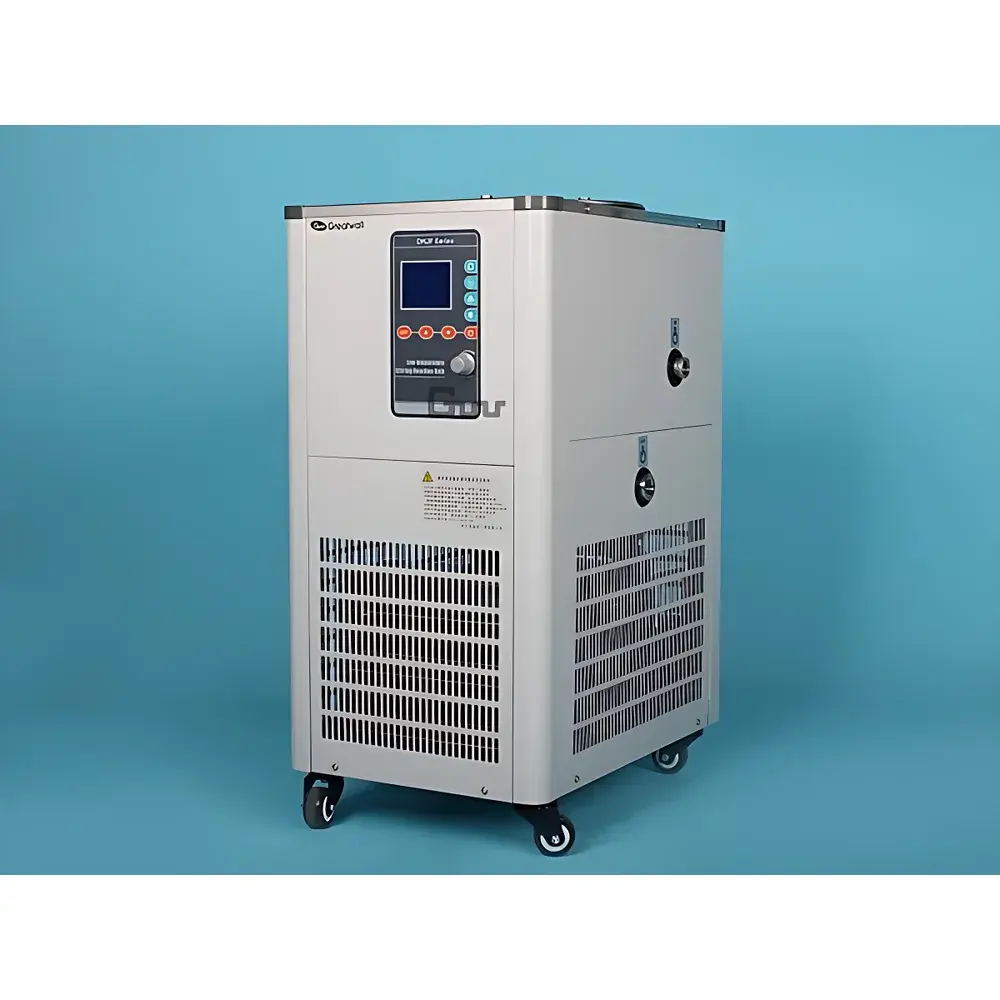
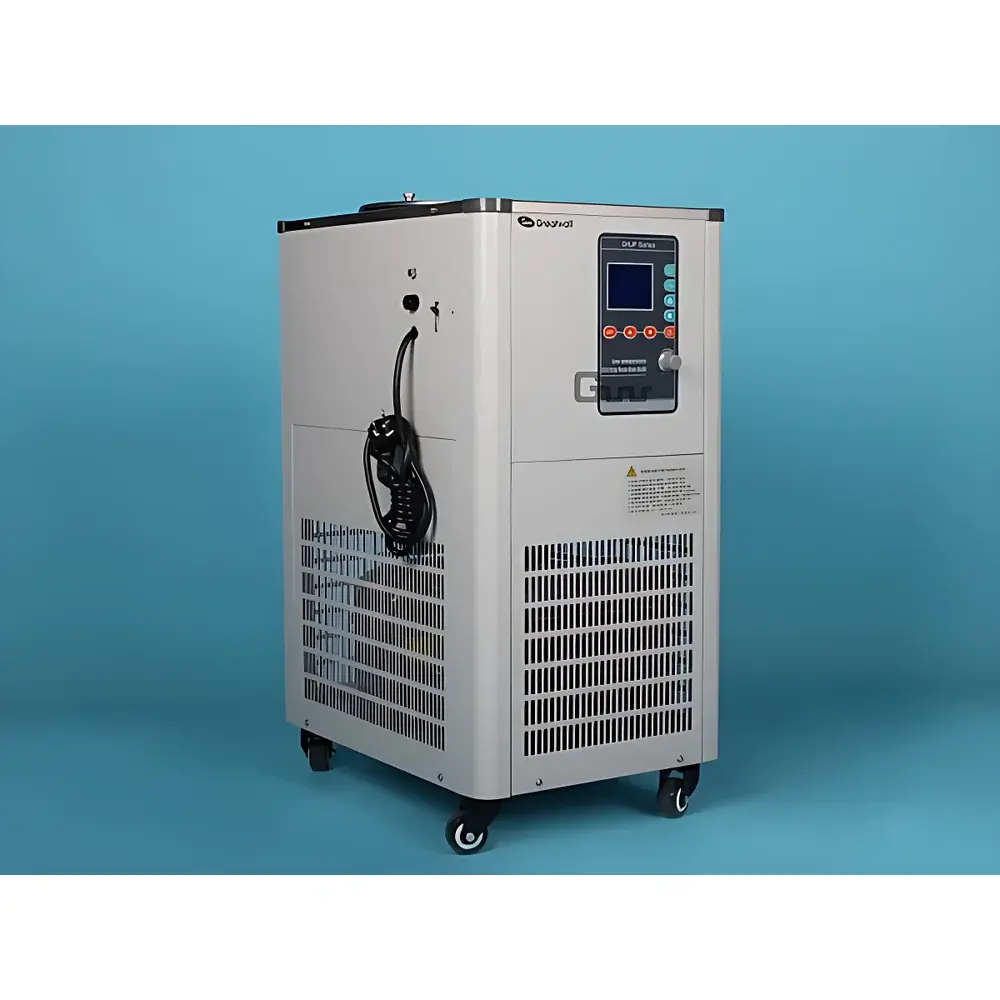
Great Wall DHJF-4005 Low-Temperature Circulating Bath
| Brand | The Great Wall |
|---|---|
| Origin | Henan, China |
| Manufacturer Type | Direct Manufacturer |
| Country of Origin | China |
| Model | DHJF-4005 |
| Temperature Range | −40 °C to +99 °C |
| Temperature Stability | ±0.2 °C |
| Bath Volume | 5 L |
| Bath Dimensions (Ø × H) | 250 mm × 130 mm |
| Opening Diameter | 210 mm |
| Max Flask Capacity | 2000 mL |
| Heating Power | 1500 W |
| Rated Flow Rate | 20 L/min |
| Maximum Pressure | 0.4 bar |
| Ambient Operating Temperature | 5–25 °C |
| Power Supply | 220–240 V~, 50 Hz |
| Refrigeration Capacity | 1000 W at 10 °C / 450 W at −20 °C / 40 W at −40 °C |
| Refrigerant | R404A |
| Total Power Consumption | 2450 W |
| Housing Material | Cold-Rolled Steel with Electrostatic Powder Coating |
| Overall Dimensions (W×D×H) | 400 mm × 535 mm × 790 mm |
| Net Weight | 56 kg |
Overview
The Great Wall DHJF-4005 Low-Temperature Circulating Bath is an engineered thermal control system designed for precise temperature regulation in laboratory-scale chemical synthesis, reaction calorimetry, low-temperature crystallization, and material testing applications. It employs a cascade refrigeration architecture—comprising two independent refrigeration circuits operating in series—to achieve stable sub-zero operation down to −40 °C while maintaining high thermal uniformity across the bath medium. The primary circuit uses R404A refrigerant, while the secondary stage utilizes R23 for deep-cold performance. This dual-stage design eliminates reliance on liquid nitrogen or cryogenic solvents, offering operational continuity, reduced consumable costs, and improved safety in routine lab environments. The unit integrates a high-efficiency finned air-cooled condenser with oxygen-free copper spiral tubing and proprietary tube-expansion jointing technology, ensuring long-term heat-transfer reliability and simplified maintenance. Its compact footprint and self-contained wind-cooled design eliminate dependency on external water sources—making it suitable for laboratories with limited utility infrastructure.
Key Features
- Cascade refrigeration system with dual compressors (Secop hermetic piston compressors) for extended service life, low acoustic emission (<62 dB(A)), and high operational reliability under continuous load.
- High-thermal-conductivity coil-type evaporator fully immersed in the reservoir—designed to withstand freeze-thaw cycling without mechanical failure, even when the heat transfer fluid solidifies.
- Digital intelligent controller with PID algorithm, full Chinese-language LCD interface, real-time monitoring of bath temperature, flow rate, and system status; supports manual/automatic mode switching and programmable ramp-hold profiles.
- Air-cooled condenser with optimized fin density and copper-aluminum heat exchanger geometry—engineered for consistent performance in ambient conditions between 5 °C and 25 °C.
- Integrated safety suite including compressor delay start, overcurrent protection, ground-fault interruption, overtemperature cutoff, and thermal runaway prevention logic.
- Stainless steel-reinforced circulation pump with adjustable pressure output (up to 0.4 bar), delivering stable flow rates up to 20 L/min with minimal pulsation for compatibility with external jacketed reactors and analytical instrumentation.
Sample Compatibility & Compliance
The DHJF-4005 accommodates standard laboratory glassware up to 2000 mL capacity (e.g., round-bottom flasks, jacketed vessels, and immersion coils). Its open-bath configuration and 210 mm aperture allow unobstructed access for stirrer shafts, thermocouple probes, and reflux condensers. The system is compatible with common heat transfer fluids—including silicone oils, ethylene glycol/water mixtures, and specialized low-temperature baths—provided viscosity remains within the pump’s operational range (≤500 cSt at operating temperature). From a regulatory standpoint, the unit complies with GB/T 2894–2008 (Chinese safety signage standards), GB 4706.1–2005 (household and similar electrical appliance safety), and IEC 61000-6-3 (EMC emissions). While not certified to UL/CSA or CE for export markets without additional conformity assessment, its design principles align with ISO/IEC 17025 laboratory environmental control requirements for temperature-sensitive analytical workflows.
Software & Data Management
The DHJF-4005 operates as a standalone instrument with embedded firmware—no external PC or proprietary software required for basic operation. However, optional RS485 or analog 4–20 mA outputs enable integration into centralized lab automation systems (e.g., LabVIEW, DeltaV, or Siemens Desigo CC) for remote setpoint adjustment, data logging, and alarm forwarding. All temperature readings are traceable to internal Pt100 sensor calibration (±0.1 °C accuracy at 25 °C), and the controller maintains a local event log of critical faults (e.g., compressor shutdown, overtemp events) with timestamping—supporting GLP-aligned troubleshooting and audit readiness. For regulated environments requiring electronic record integrity, third-party SCADA platforms may be deployed to enforce 21 CFR Part 11-compliant user authentication, audit trails, and electronic signatures.
Applications
- Controlled-temperature organic synthesis requiring −40 °C to +99 °C stability (e.g., Grignard reactions, lithiation steps, Diels–Alder cycloadditions).
- Calorimetric studies using reaction calorimeters (RC1, EasyMax) where precise thermal coupling and low-temperature baseline control are essential.
- Material property evaluation—including polymer crystallization kinetics, phase-change behavior of PCM formulations, and low-temperature viscoelastic characterization.
- Chromatography system cooling—supporting column ovens, detector chillers, and solvent degassing modules in HPLC and GC workflows.
- Biotechnology applications such as cold-room simulation for enzyme activity assays, protein refolding studies, and cryopreservation protocol development.
FAQ
What is the minimum achievable temperature with standard heat transfer fluid?
The DHJF-4005 achieves −40 °C using a 50/50 ethylene glycol/water mixture. Lower temperatures require specialized low-viscosity silicone oils or fluorinated fluids—viscosity limits must be verified against pump specifications.
Can this unit be used for external recirculation only (without internal bath immersion)?
Yes—the integrated pump supports closed-loop external circulation via inlet/outlet ports. Maximum recommended external loop volume is 15 L to maintain dynamic temperature stability within ±0.3 °C.
Is the controller compatible with Modbus RTU communication?
Not natively. Optional RS485 expansion modules supporting Modbus RTU are available upon request and require factory configuration prior to shipment.
What maintenance intervals are recommended for optimal refrigeration performance?
Compressor oil inspection every 24 months; condenser coil cleaning every 6 months in dusty environments; annual verification of refrigerant charge and pressure switch calibration by authorized service personnel.
Does the unit include built-in data logging capability?
No internal memory-based logging is provided. Real-time temperature and status data can be exported via analog output or RS485 using external DAQ hardware and compatible software platforms.



