
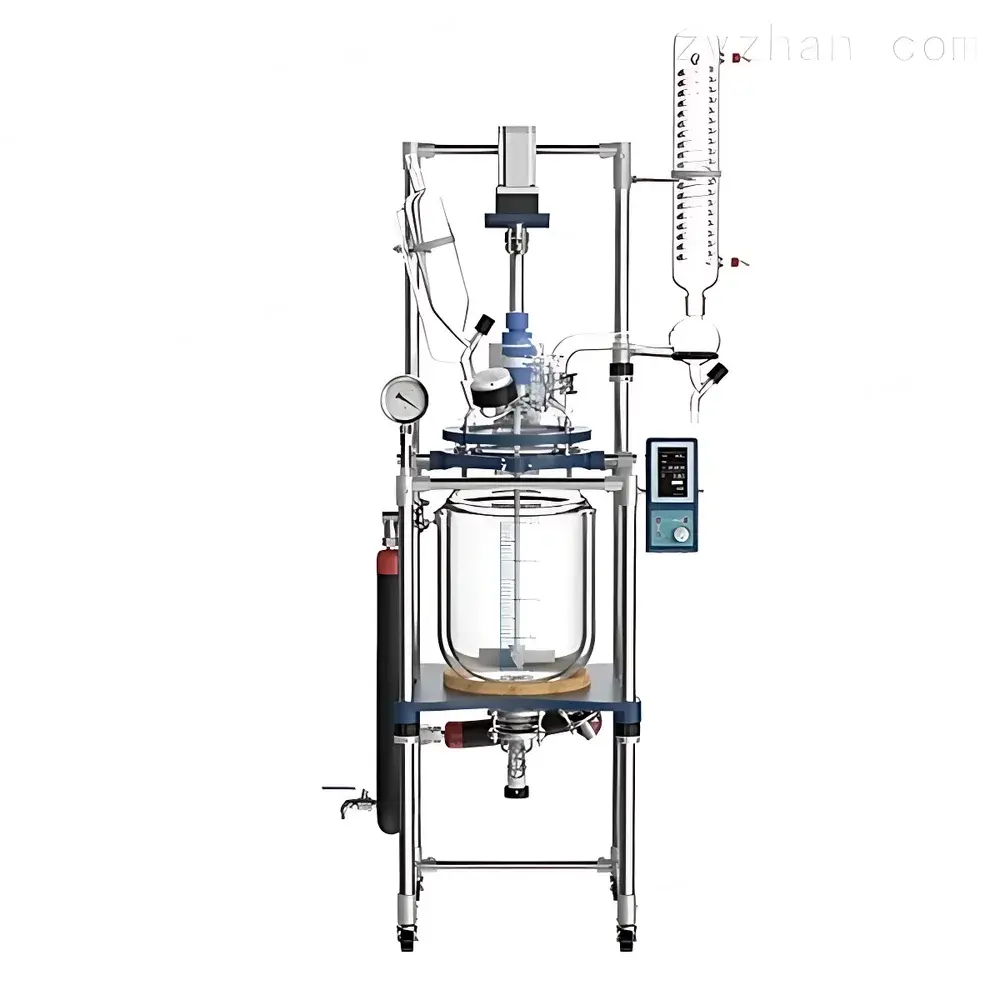
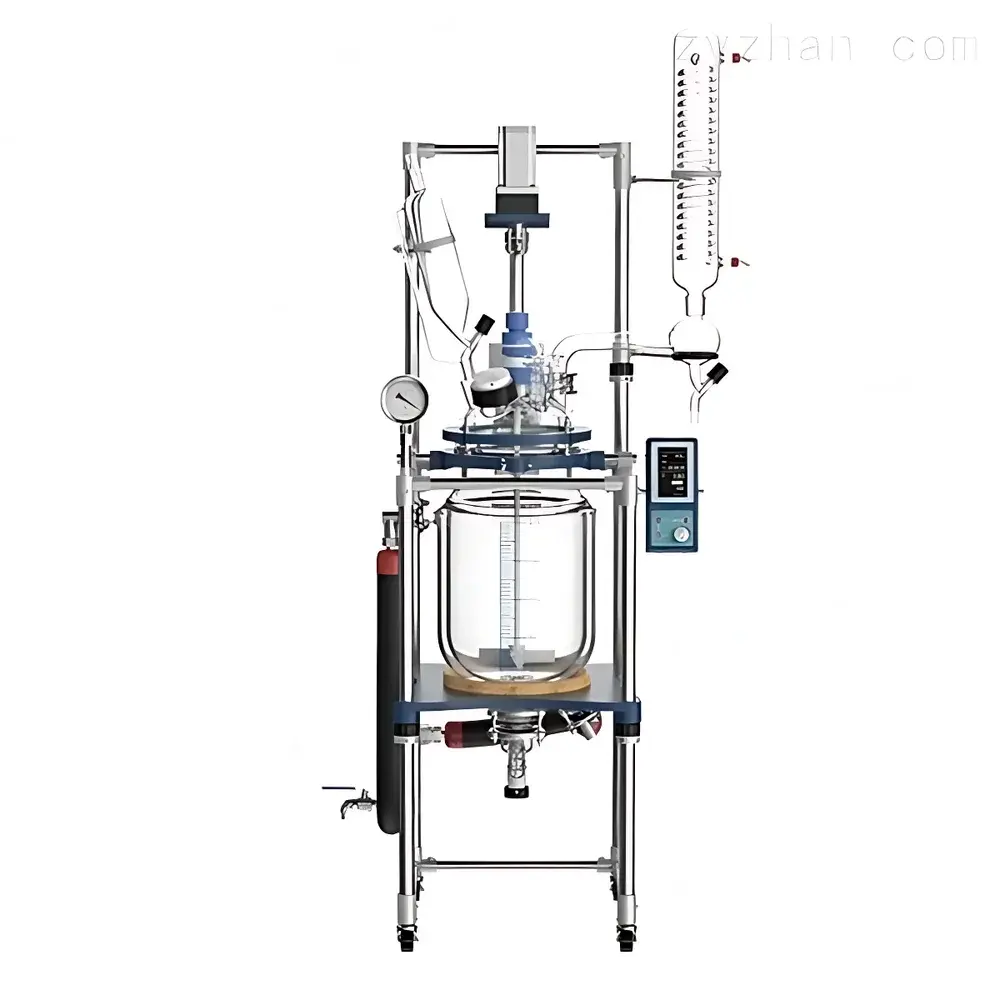
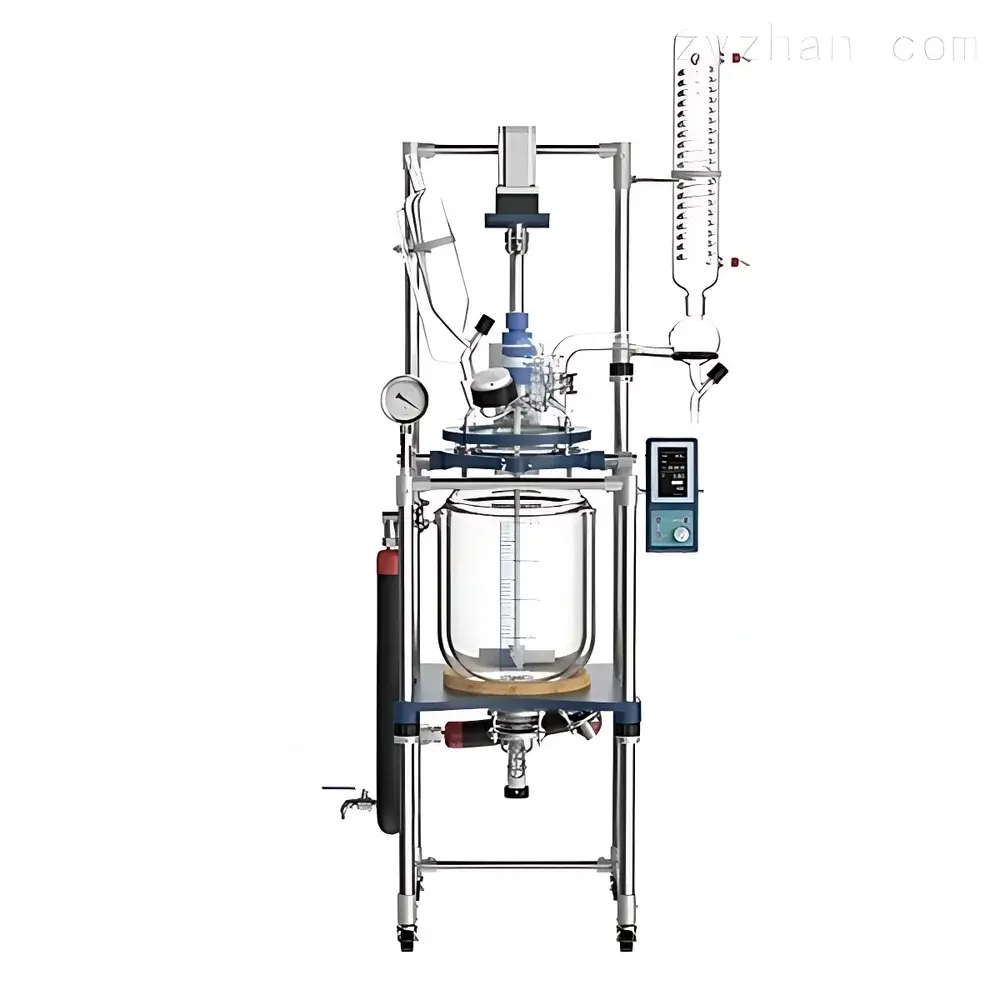
The Great Wall GR-50EX Explosion-Proof Single-Layer Glass Reactor
| Brand | The Great Wall |
|---|---|
| Origin | Henan, China |
| Manufacturer Type | Authorized Distributor |
| Origin Category | Domestic (China) |
| Model | GR-50EX |
| Price | USD 3,350 (FOB Henan) |
| Construction Material | Borosilicate Glass 3.3 (DIN ISO 3585) |
| Temperature Range | −80 °C to +200 °C |
| Pressure Rating | −0.1 MPa (vacuum) to 0 MPa (atmospheric only) |
| Frame | SUS304 stainless steel + 6061-F aluminum alloy with epoxy powder coating |
| Mobility | Locking casters (two with brakes) |
| Drive Motor & Control Box | Exd II BT4 certified explosion-proof (IEC 60079-1, GB 3836.1–2010) |
| Stirring Shaft | SUS304 core with full PTFE overmolding |
| Impeller | Solid PTFE blades |
| Sealing System | Proprietary dual-lip mechanical seal with graphite-impregnated PTFE stationary ring |
| Drain Valve | Zero-holdup PTFE-lined ball valve with bottom-mounted flush port |
| Jacket Inlet/Outlet | Dual 1/2″ NPT stainless steel ports with flexible insulated SS braided hoses (stress-relieved connection) |
Overview
The Great Wall GR-50EX is an IEC 60079-compliant single-layer glass reactor engineered for safe, precise chemical synthesis and process development under atmospheric pressure in hazardous environments classified as Zone 1 or Zone 2 (Group IIB, T4). Unlike jacketed reactors, the GR-50EX relies on external thermal control via immersion in temperature-controlled baths or integration with external circulators—eliminating internal jacket integrity concerns while maintaining full visibility of reaction progress. Its core vessel is fabricated from DIN ISO 3585-certified borosilicate glass 3.3, offering ≤3.3 × 10⁻⁶ K−1 coefficient of thermal expansion, hydrolytic resistance Class 1 (ISO 719), and acid resistance Class 1 (ISO 1776). The reactor operates exclusively at ambient pressure (0 MPa gauge) with vacuum capability down to −0.1 MPa, making it suitable for solvent removal, crystallization, inert-atmosphere reactions, and catalyst screening where pressurization is unnecessary or undesirable.
Key Features
- Explosion-Proof Certification: Full Exd II BT4 compliance (IEC 60079-1 / GB 3836.1–2010) covers motor, control enclosure, and all field-wiring interfaces—enabling safe operation in laboratories handling flammable solvents (e.g., ether, acetone, THF) without requiring purge systems or intrinsically safe barriers.
- Borosilicate Glass 3.3 Construction: All wetted components—including vessel, condenser, addition funnel, and distillation head—are made from high-purity borosilicate glass 3.3, ensuring long-term stability against thermal shock, alkali corrosion, and repeated autoclave cycles.
- Zero-Holdup Drain System: Bottom-mounted PTFE-lined ball valve with flush-seat geometry eliminates product entrapment during discharge—critical for GMP-aligned batch transfers and residue-sensitive pharmaceutical intermediates.
- Stress-Relieved Thermal Interface: Dual 1/2″ NPT inlet/outlet ports connect via flexible, insulated stainless-steel braided hoses, preventing torque transmission from external circulation lines to the glass vessel—a known failure mode in rigid-jacketed systems.
- Corrosion-Resistant Mechanical Architecture: Load-bearing frame combines electropolished SUS304 structural members with 6061-F aluminum panels finished in UV-stable epoxy powder coating (≥75 µm DFT), meeting ISO 14644-1 Class 8 cleanroom compatibility for surface particulate generation.
- Chemically Inert Stirring Assembly: Proprietary stirrer shaft features a solid SUS304 core fully overmolded with virgin PTFE; impeller blades are machined from homopolymer PTFE (ASTM D4894), providing zero metal leaching and resistance to halogenated, strongly oxidizing, or HF-containing media.
Sample Compatibility & Compliance
The GR-50EX accommodates liquid-phase, slurry, and heterogeneous catalytic reactions involving organic solvents, aqueous electrolytes, organometallics, and air-sensitive reagents when used under nitrogen or argon blanket. It is routinely deployed in academic synthetic labs, fine chemical pilot plants, and QC testing facilities conducting ASTM E2656 (solvent stability), USP compounding verification, and ISO 13485 raw material release testing. While not rated for pressure operation, its −0.1 MPa vacuum rating supports ASTM D1296 (volatility determination) and ISO 2719 (flash point by Pensky-Martens). Documentation includes full traceable material certifications (EN 10204 3.1), explosion-proof type test reports, and glass batch conformance certificates per DIN 4752.
Software & Data Management
The GR-50EX operates as a standalone unit with analog speed control (0–250 rpm, ±2 rpm repeatability) and manual temperature setpoint adjustment via external bath or circulator. For regulated environments, it integrates seamlessly with third-party data acquisition systems compliant with FDA 21 CFR Part 11 through optional 4–20 mA or 0–10 V analog outputs (available upon request). Audit trails, electronic signatures, and user access levels are managed externally—consistent with laboratory-wide LIMS or ELN deployments. No embedded firmware requires validation; all operational parameters remain mechanically and electrically transparent for GLP/GMP inspection readiness.
Applications
- Small-scale API synthesis under inert atmosphere (e.g., Grignard additions, lithiations)
- Solvent recovery and concentration via rotary evaporation-compatible configurations
- Catalyst immobilization studies using silica- or carbon-supported metals
- Polymerization kinetics monitoring with inline FTIR probe ports (standard 10/32 UNF thread)
- Electrochemical cell assembly for battery electrolyte stability testing
- Extraction optimization (e.g., botanicals, cannabinoids) with reflux and phase separation
FAQ
Can the GR-50EX be operated under positive pressure?
No. The single-layer design is rated exclusively for atmospheric pressure (0 MPa(g)) and vacuum (−0.1 MPa). Positive pressure operation requires a certified jacketed reactor with ASME U-Stamp or PED 2014/68/EU compliance.
Is PTFE used in the stirring system compliant with USP Class VI?
Yes. All PTFE components meet USP Class VI biological reactivity requirements and are supplied with extractables documentation per USP .
What maintenance intervals are recommended for the mechanical seal?
Under continuous operation with non-abrasive media, the dual-lip graphite-PTFE seal requires inspection every 1,000 operating hours; replacement is advised at 3,000 hours or after exposure to particulates, crystallizing salts, or dry-running events.
Does the Exd II BT4 rating cover the entire system including glass joints?
Yes—the certification applies to the motor, control box, wiring glands, and all electrical interfaces. Glass-to-metal and glass-to-glass joints are inherently non-electrical and fall outside explosion-protection scope; standard PTFE or Viton® O-rings maintain static sealing integrity.
Can the reactor be cleaned in place (CIP)?
CIP is not supported due to lack of spray balls or recirculation manifolds. However, the zero-holdup drain, smooth interior surface (Ra ≤ 0.8 µm), and disassembly-free access enable rapid, validated cleaning with ultrasonic baths or manual wipe-down per ISO 14644-1 protocols.



