
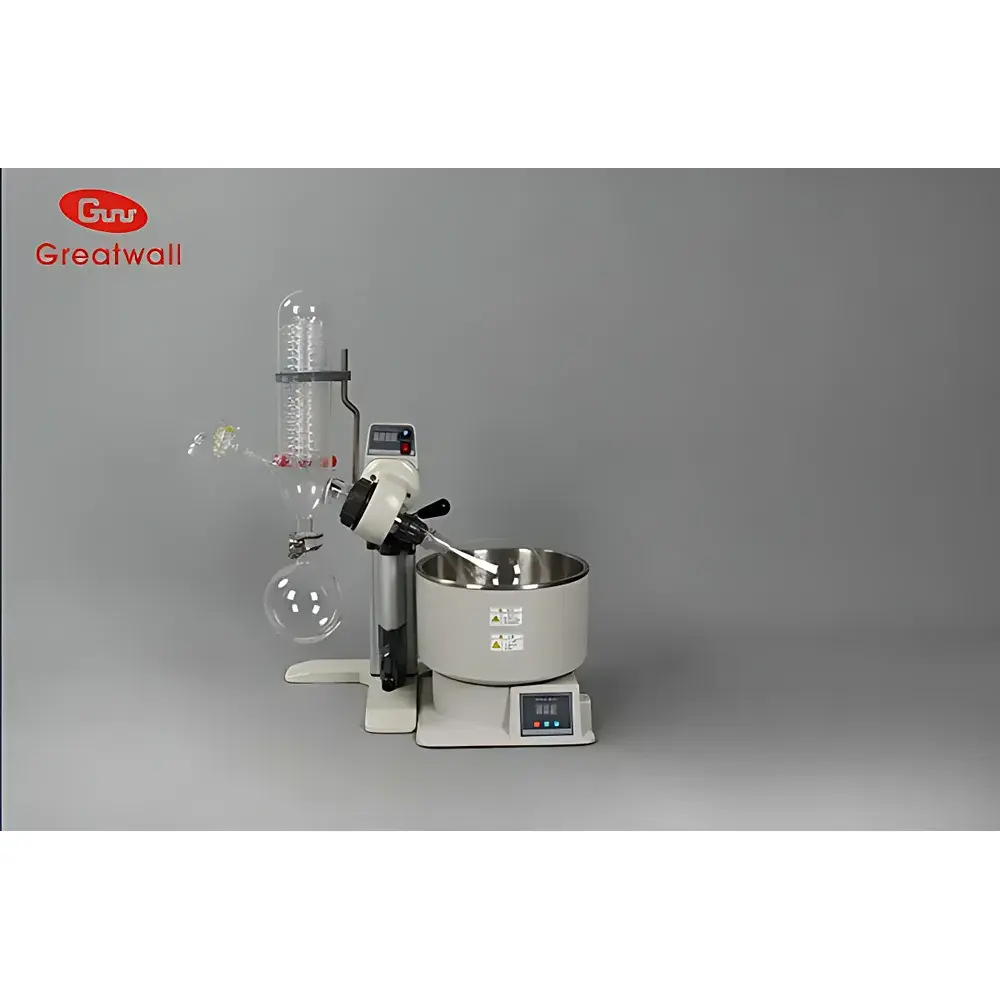
Great Wall R1001 1L Benchtop Rotary Evaporator for Laboratory Use
| Brand | The Great Wall |
|---|---|
| Origin | Henan, China |
| Manufacturer Type | Direct Manufacturer |
| Instrument Type | Vertical |
| Temperature Setting Accuracy | ±1.5 °C |
| Bath Volume | 1 L |
| Circulating Medium | Ethanol |
| Sealing System | Dual-Seal (PTFE + FKM) |
| Rotation Speed Control | Digital LCD Interface with Knob |
| Lifting Stroke | 150 mm |
| Lift Mechanism | Motorized |
| Bath Angle Adjustment Range | 15°–45° |
| Condenser Type | Double-Coil Spiral |
| Heating Method | Bottom-Mounted Hidden Heater (Electric, Immersion-Free) |
| Bath–Heater Isolation | Yes |
| Optional Accessory | Insulating Bath Cover |
Overview
The Great Wall R1001 is a compact, vertically configured benchtop rotary evaporator engineered for precise, repeatable solvent removal under reduced pressure in academic research labs, pharmaceutical development units, and analytical quality control environments. It operates on the principle of vacuum-assisted rotary distillation: rotation of the sample flask generates a thin, uniform film across the inner surface, dramatically increasing evaporation surface area; simultaneous application of controlled heat (via an isolated bottom-heating element) and sub-atmospheric pressure (typically 10–100 mbar) lowers the boiling point of volatile solvents—enabling gentle, efficient concentration of thermally sensitive compounds without decomposition. Designed for daily use with small-to-moderate batch volumes (up to 1 L), the R1001 integrates fundamental distillation mechanics with ergonomic engineering—ensuring operator safety, process reproducibility, and long-term system integrity.
Key Features
- Dual-material sealing system (PTFE + fluorocarbon rubber FKM) provides high-vacuum compatibility and chemical resistance against common organic solvents including ethanol, acetone, ethyl acetate, and dichloromethane.
- Motorized vertical lift mechanism with 150 mm travel range enables rapid, hands-free immersion and withdrawal of the evaporation flask from the heating bath—critical for process interruption, cleaning, or flask exchange.
- Adjustable flask immersion angle (15°–45°) optimizes film thickness and heat transfer efficiency across varying viscosities and volumes, supporting both low-boiling solvents and higher-boiling extracts.
- Bottom-mounted hidden heater separates the heating element from the circulating medium (e.g., ethanol), eliminating direct contact corrosion and extending bath longevity—compliant with long-term GLP maintenance protocols.
- Double-coil spiral condenser maximizes thermal exchange surface area; compatible with dry ice/acetone or recirculating chiller cooling for condensation of low-boiling fractions (e.g., diethyl ether, pentane).
- Integrated digital LCD interface allows intuitive setpoint adjustment of rotation speed and bath temperature via rotary encoder—ensuring stable rotational output (<±2 rpm deviation) and consistent thermal profiles.
- Modular architecture: bath vessel and main drive unit are physically decoupled, permitting flexible lab layout integration and optional upgrades such as external vacuum controllers or solvent recovery traps.
Sample Compatibility & Compliance
The R1001 accommodates standard 1 L round-bottom flasks (ISO 297, 24/40 joint) and supports aqueous, alcoholic, and non-aqueous solvent systems typical in natural product isolation, synthetic chemistry workups, and HPLC fraction concentration. Its sealed vacuum path meets ASTM E2912-22 requirements for laboratory distillation apparatus integrity testing. While not certified to IEC 61010-1 as a standalone medical device, its electrical design conforms to Class I protection principles, including reinforced insulation and grounding continuity—verified per factory QC procedures. The dual-seal configuration achieves ≤5 × 10⁻³ mbar·L/s helium leak rate, satisfying routine QC validation for solvent-sensitive applications under ISO/IEC 17025-accredited laboratories.
Software & Data Management
The R1001 operates as a stand-alone instrument with no embedded firmware-based data logging. All operational parameters—including set temperature, actual bath temperature, rotation speed, and lift status—are displayed in real time on the front-panel LCD. For regulated environments requiring audit trails (e.g., pharmaceutical R&D under FDA 21 CFR Part 11), users may integrate the unit with third-party environmental monitoring systems via analog 0–10 V or 4–20 mA outputs (available on optional IO module). Calibration records for temperature sensors and speed encoders are retained per internal lab SOPs, supporting annual verification cycles aligned with ISO/IEC 17025 clause 6.6.
Applications
- Concentration of crude extracts following liquid–liquid extraction or solid-phase extraction (SPE) workflows.
- Removal of volatile reaction solvents (e.g., THF, toluene, methanol) prior to NMR or mass spectrometry analysis.
- Preparative-scale solvent exchange (e.g., DMSO → acetonitrile) in peptide synthesis and formulation development.
- Distillative purification of low-molecular-weight organics under mild conditions to preserve stereochemical integrity.
- Teaching laboratory demonstrations of colligative properties, vapor pressure depression, and phase equilibria principles.
FAQ
What vacuum level is recommended for optimal performance with the R1001?
A base pressure of 15–30 mbar is typically sufficient for most low-boiling solvents (e.g., ethanol, acetone); lower pressures (5–10 mbar) may be used for high-boiling or heat-labile compounds—always paired with appropriate cold trap protection.
Is the R1001 compatible with water as a bath medium?
Yes, though ethanol is specified as the default circulating medium due to its wider operating temperature range (−114 °C to 78 °C) and superior thermal stability at elevated setpoints; water is suitable only up to 95 °C and requires anti-corrosion treatment.
Can the lifting function be manually overridden in case of power failure?
No—the motorized lift is not equipped with manual release; users should plan for brief power interruptions using uninterruptible power supplies (UPS) in critical applications.
Does the unit include a vacuum pump or chiller?
No—both vacuum source and cooling system are external accessories; compatibility is confirmed with standard diaphragm pumps (≤1 m3/h) and recirculating chillers (−20 °C to +40 °C range).



