
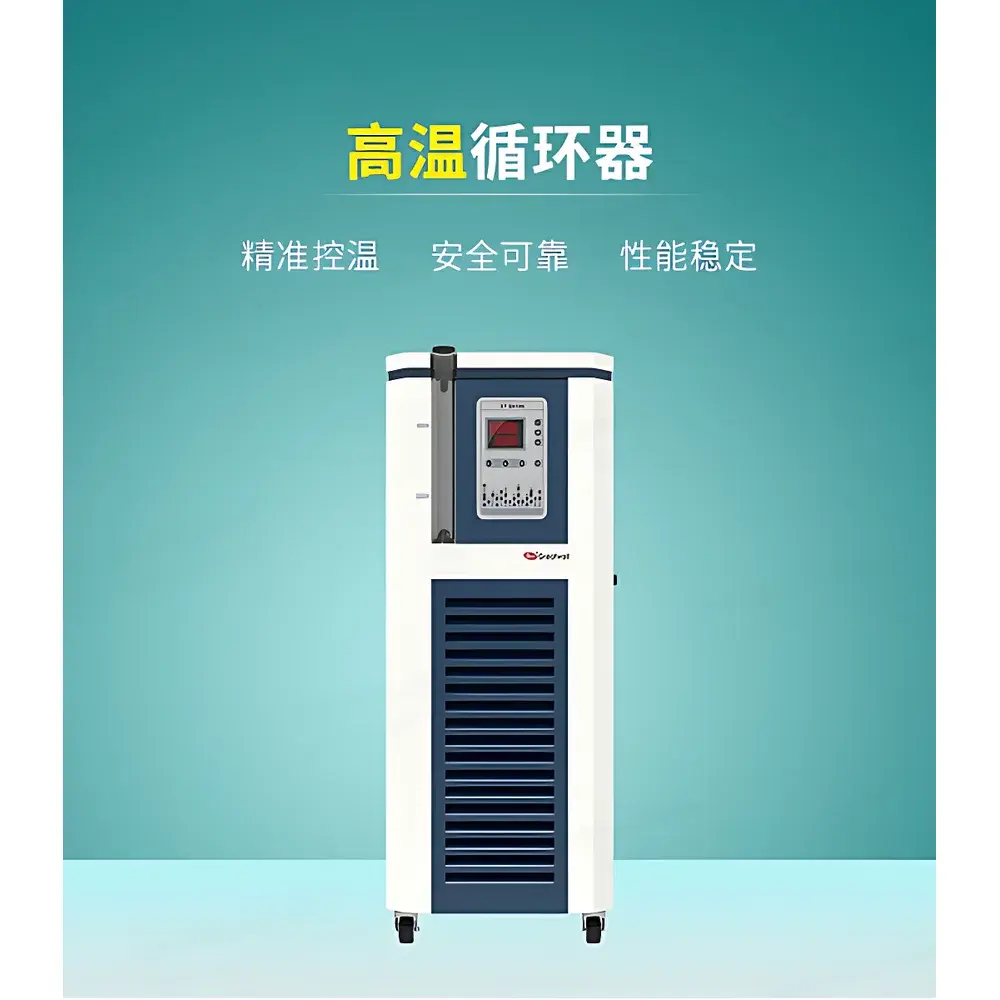
Great Wall SY-200-200 Sealed High-Temperature Circulating Heater
| Brand | The Great Wall |
|---|---|
| Origin | Henan, China |
| Manufacturer Type | Direct Manufacturer |
| Product Origin | Domestic (China) |
| Model | SY-200-200 |
| Circulation Mode | Internal & External Loop |
| Temperature Control | Heating-Only |
| Bath Volume | 22 L |
| Temperature Range | 5–200 °C |
| Temperature Stability | ±0.5 °C |
| Power Supply | 3-phase, 380 V, 50 Hz |
| Cooling Interface | Dedicated Inlet/Outlet for External Cooling Water |
| Safety Features | Overtemperature Alarm, Overcurrent Protection, Overload Protection |
| Control Method | PID Digital Temperature Control |
| Display | LCD Panel with Real-Time Temperature Readout |
| System Design | Fully Sealed Closed-Loop Circulation |
Overview
The Great Wall SY-200-200 Sealed High-Temperature Circulating Heater is an engineered thermal management system designed to deliver precise, stable, and contamination-free heating for demanding laboratory and pilot-scale applications. Unlike open-bath systems, this unit operates as a fully sealed closed-loop circulation device—circulating thermally stable heat-transfer fluid (e.g., silicone oil or high-temperature synthetic fluids) through external process equipment such as jacketed reactors, distillation columns, or semiconductor thermal test fixtures. Its operational principle relies on resistive electric heating combined with high-efficiency centrifugal pumping and PID-regulated feedback control to maintain setpoint accuracy within ±0.5 °C across its full 5–200 °C range. The sealed architecture prevents oxidation, evaporation, and moisture ingress—significantly extending fluid service life and ensuring long-term reproducibility in temperature-critical processes.
Key Features
- Fully sealed closed-loop circulation system minimizes thermal fluid degradation and eliminates atmospheric contamination
- Dual-mode circulation support: internal recirculation for bath temperature stabilization and external loop for process integration with jacketed vessels or heat exchangers
- Integrated cooling water interface enables rapid thermal quenching—critical for reaction stoppage, safety shutdowns, or process transitions
- PID digital temperature controller with LCD display provides real-time monitoring, programmable ramp/soak profiles, and intuitive parameter navigation
- Comprehensive safety architecture including overtemperature cutoff, electronic overcurrent protection, motor overload sensing, and audible/visual alarm signaling
- Stainless steel fluid reservoir (22 L capacity) with dedicated air vent valve for safe, controlled thermal fluid top-up without system depressurization
- Industrial-grade 3-phase 380 V power input ensures stable operation under continuous load and compatibility with standard laboratory/utility electrical infrastructure
Sample Compatibility & Compliance
The SY-200-200 is compatible with a wide range of heat-transfer media—including silicone oils (up to 300 °C), polyalphaolefins (PAOs), and specialized high-temperature synthetic fluids—enabling use across pharmaceutical synthesis, fine chemical processing, polymerization studies, and semiconductor wafer thermal cycling. Its sealed design complies with general good laboratory practice (GLP) requirements for thermal stability and fluid integrity. While not certified to specific ISO/IEC 17025 calibration standards out-of-box, the unit supports traceable temperature validation using external Class A PT100 probes and is routinely deployed in environments adhering to FDA 21 CFR Part 11–aligned documentation workflows when integrated with compliant data acquisition systems. It meets CE-marked electrical safety prerequisites for industrial equipment (EN 61000-6-2/6-4) and conforms to IEC 60529 IP20 enclosure rating for indoor laboratory use.
Software & Data Management
The SY-200-200 operates via embedded firmware with no proprietary software dependency—ensuring reliability and ease of maintenance. All temperature setpoints, ramp rates, hold durations, and alarm thresholds are configured directly via the front-panel interface. For integration into automated laboratories, optional analog (4–20 mA / 0–10 V) and digital (RS485 Modbus RTU) outputs allow connection to SCADA platforms, PLC-based control systems, or LIMS. When paired with validated third-party data loggers, the heater supports audit-trail-capable temperature recording aligned with GLP/GMP documentation requirements. No cloud connectivity or remote access features are included—preserving network security and simplifying qualification (IQ/OQ/PQ) protocols.
Applications
- Heating and temperature control of jacketed glass or stainless-steel reactors (1–50 L scale) in API synthesis and catalytic hydrogenation
- Thermal conditioning of distillation apparatus during high-boiling-point solvent recovery or fractional separation
- Process temperature stabilization in pilot-scale bioreactor jackets and downstream purification skids
- Thermal testing of electronic components, thin-film deposition substrates, and photovoltaic materials under controlled ambient conditions
- Supporting accelerated stability studies per ICH Q1 guidelines where precise, sustained elevated temperatures (e.g., 40–60 °C) are required
- Integration with rotary evaporators and falling-film concentrators requiring consistent hot-fluid supply above 100 °C
FAQ
What types of heat-transfer fluids are compatible with the SY-200-200?
Silicone oils (e.g., Dow Corning 200 Fluid series), polydimethylsiloxanes (PDMS), and high-temperature synthetic hydrocarbons rated for continuous operation up to 200 °C are recommended. Avoid water-based or low-flash-point fluids.
Can the unit be used for cooling applications?
No—the SY-200-200 is a heating-only system. However, its dedicated cooling water ports allow auxiliary heat extraction from the circulating fluid loop when connected to an external chiller or tap-water supply.
Is external temperature probe input supported for cascade control?
The standard configuration does not include an external sensor input; temperature regulation is based on the built-in PT100 sensor in the reservoir. Custom OEM variants with dual-sensor PID logic are available upon request.
What maintenance intervals are recommended?
Thermal fluid level and condition should be inspected quarterly; filter elements (if installed in external loop) require cleaning every 500 operating hours. Annual verification of pressure relief valve function and electrical insulation resistance is advised.
Does the unit meet explosion-proof requirements for hazardous area use?
No—it is rated for general laboratory environments only (non-classified zones). For Zone 1/2 installations, consult certified explosion-proof heater alternatives with ATEX/IECEx certification.



