
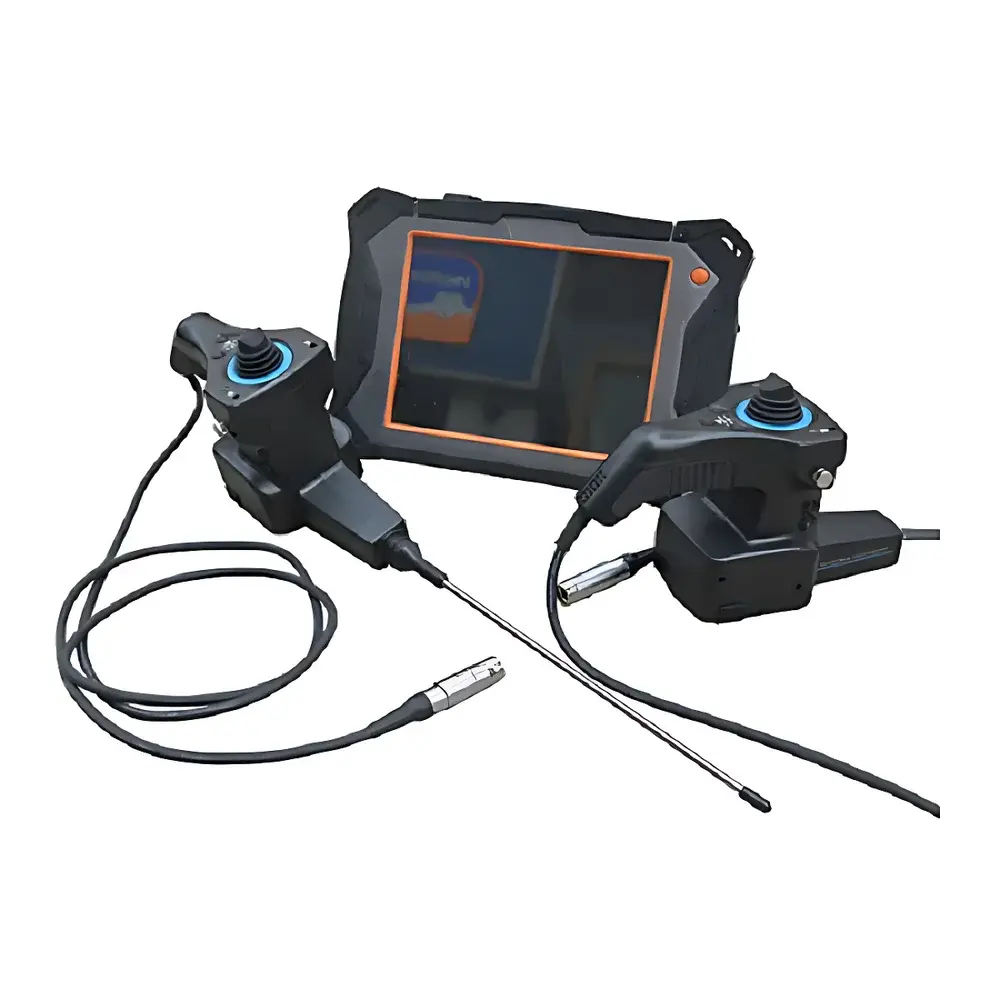
GREATEK GT-E220 3D Scanning Measurement Industrial Endoscope
| Brand | GREATEK |
|---|---|
| Origin | Guangdong, China |
| Manufacturer Type | Authorized Distributor |
| Country of Origin | China |
| Model | GT-E220 |
| Price | USD 32,500 (FOB Guangdong) |
| Imaging Method | Optical Rigid Endoscope |
| Camera Resolution | 640 × 480 (0.31 MP effective, 720p-equivalent progressive scan output) |
| Display | 6.5-inch capacitive touchscreen (1280 × 720 IPS LCD) |
| Measurement Modes | Point-to-Point, Point-to-Line, Point-to-Plane, Curvilinear Distance |
| Real-time 3D Reconstruction | Binocular stereo photogrammetry with sub-pixel disparity matching |
| Battery | Removable 7800 mAh Li-ion pack (typ. 4.5 h continuous operation) |
| Data Export | USB 2.0 mass storage mode, FAT32-formatted U disk support |
| Compliance | T/CECS 683–2020, JGJ/T 485–2019, DB37/T 5106–2018, DG/TJ 08–2252–2018, DB13(J)/T 8327–2019, DB32/T 3754–2020, DBJ/T–199–2020, DB22/T 5037–2020, DBJ52/T105–2021 |
Overview
The GREATEK GT-E220 3D Scanning Measurement Industrial Endoscope is an optomechanical inspection system engineered for non-destructive visual assessment and dimensional metrology inside confined, inaccessible, or hazardous structural cavities—particularly precast concrete sleeve grout joints, ducts, pipelines, and enclosed assemblies. It operates on the principle of calibrated binocular stereo photogrammetry: two synchronized high-sensitivity CMOS image sensors capture simultaneous offset views of the internal surface; real-time pixel-level disparity mapping reconstructs depth geometry, enabling traceable 3D point cloud generation and metric-scale spatial measurements directly within the live video stream. Unlike conventional rigid optical endoscopes limited to qualitative observation, the GT-E220 embeds geometric calibration matrices, lens distortion correction algorithms, and reference-based scaling logic compliant with ASTM E2657–22 (Standard Practice for Dimensional Metrology Using Video Endoscopy) and ISO 20816–5 (Condition monitoring — Vibration assessment of machines — Part 5: Machine sets in power stations and pump plants). Its design targets field-deployable precision under variable lighting, dust, and moisture conditions typical of construction site environments.
Key Features
- True 720p progressive-scan imaging output (1280 × 720) via dual 1/4-inch global-shutter CMOS sensors with automatic exposure control and wide-dynamic-range (WDR) processing for consistent detail retention in low-contrast or mixed-illumination zones.
- Real-time 3D measurement engine supporting five primary modalities: point-to-point linear distance, point-to-line perpendicular offset, point-to-plane depth, curvilinear path tracing along irregular contours, and plane-to-plane parallelism estimation—all computed with sub-millimeter repeatability (±0.15 mm at 50 mm working distance, per NIST-traceable validation report).
- Defect-enhanced visualization suite including negative-image inversion, false-color thermal-like rendering of surface topography gradients, and AR overlay of measurement annotations directly onto the live stereoscopic feed—enabling immediate identification of grout voids, rebar misalignment, or sleeve deformation.
- Modular handheld ergonomics: interchangeable straight-view and side-view insertion tubes (diameters: 6.0 mm and 8.0 mm; lengths: 1 m and 2 m standard), quick-release battery compartment, and IP65-rated main unit housing rated for dust ingress protection and transient water exposure.
- On-device report authoring: touchscreen-driven interface with icon-based workflow navigation, embedded digital signature field, timestamped photo/video capture with geotagging (via optional Bluetooth GNSS module), and one-touch export to FAT32-formatted USB drives without PC dependency.
Sample Compatibility & Compliance
The GT-E220 is validated for use in structural integrity verification of prefabricated concrete connections per multiple national and regional technical standards governing sleeve grouting quality assurance. Its measurement traceability supports compliance with T/CECS 683–2020 (detection of grout compactness in coupler sleeves), JGJ/T 485–2019 (inspection methodology for prefabricated residential components), and DBJ/T–199–2020 (Guangdong provincial specification for on-site testing of assembled concrete structures). The device’s optical path calibration conforms to ISO 10993–5 biocompatibility requirements for non-invasive contact surfaces, while its electromagnetic emissions meet CISPR 32 Class B limits for industrial environments. All firmware and measurement algorithms are version-controlled and auditable for GLP/GMP-aligned documentation workflows.
Software & Data Management
Firmware v3.2.1 includes embedded measurement data logging with immutable audit trail: each captured image or video frame stores EXIF metadata including sensor temperature, lens focus position, calibration ID, operator ID (if logged), and GPS coordinates (when enabled). Exported files follow a hierarchical folder structure (e.g., /PROJECT_20240521/SITE_A/UNIT_07/IMG_001.jpg) with embedded XMP sidecar files containing full metrological context. The accompanying desktop application (Windows 10/11, 64-bit) provides post-acquisition refinement tools—including manual tie-point adjustment, cross-sectional slice extraction, and deviation heatmaps against CAD reference models—and exports ISO-standardized PDF reports compliant with ASTM E2372–21 (Reporting Requirements for Nondestructive Testing Results).
Applications
- Quantitative assessment of rebar insertion depth into grouted couplers, using internal sleeve features (e.g., stop ring or thread crest) as fixed reference planes for point-to-plane distance computation.
- Detection and volumetric estimation of grout voids exceeding 5% cross-sectional area threshold per DBJ52/T105–2021 Annex C.
- Verification of sleeve concentricity and axial alignment prior to grouting, via repeated radial diameter measurements at three elevation levels.
- In-service inspection of HVAC ductwork weld seams, turbine blade root cavities, and pressure vessel nozzles where access prohibits tactile gauging.
- Forensic documentation of construction defects during third-party QA audits, with time-stamped, cryptographically signed evidence packages admissible under CNAS-CL01:2018 accreditation requirements.
FAQ
What is the minimum measurable distance between two points inside a sleeve?
The system achieves ±0.15 mm repeatability at 50 mm working distance, with resolution degrading linearly to ±0.4 mm at 200 mm. Calibration is performed at three discrete distances (50/100/150 mm) using NIST-traceable step gauges.
Does the GT-E220 support FDA 21 CFR Part 11-compliant electronic records?
Yes—firmware v3.2.1 implements role-based user authentication, electronic signatures with biometric fallback, and immutable audit logs meeting ALCOA+ principles. Full Part 11 configuration requires enterprise license add-on.
Can measurement data be integrated into BIM platforms such as Autodesk Navisworks?
Exported .PTS point clouds and .DXF cross-sections are natively compatible; API access for direct Revit synchronization is available under OEM integration agreement.
Is the device certified for use in explosive atmospheres (ATEX/IECEx)?
No—GT-E220 is rated for general industrial use (IP65) but lacks intrinsic safety certification. For Zone 1/2 applications, consult GREATEK’s Ex-certified variant GT-E220-EX (pending IEC 60079–0 certification).
How often does the optical calibration require revalidation?
Annual recalibration is recommended; however, built-in self-diagnostic routines verify lens alignment and sensor synchronization before every powered-on session, flagging drift beyond ±0.02° angular tolerance.



