
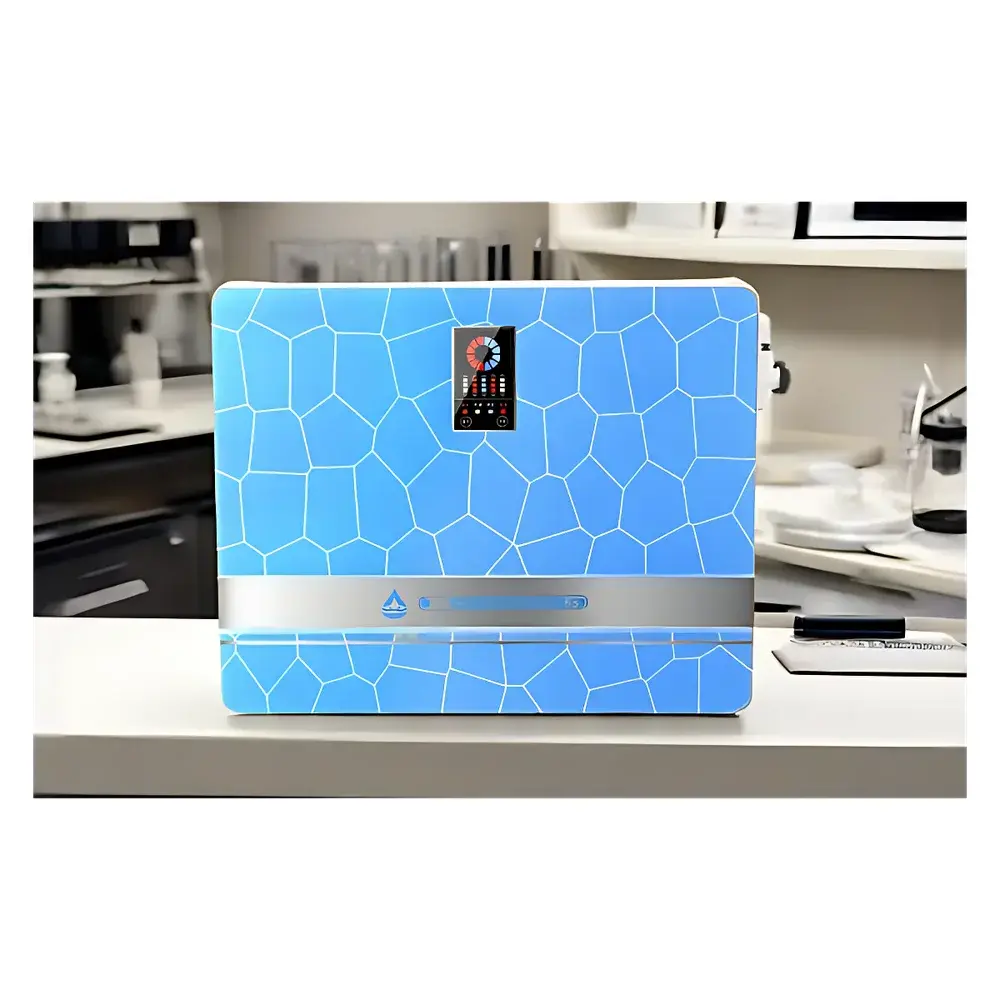
Green-Q1 Deionized Pure Water System
| Brand | 1124123/13213112 |
|---|---|
| Origin | Jiangsu, China |
| Manufacturer Type | Authorized Distributor |
| Country of Origin | China |
| Model | Green-Q1 |
| Pricing | Upon Request |
| Purified Water Grade | ASTM Type III / GB/T 6682–2008 Grade III |
| Resistivity | 13–17.5 MΩ·cm @ 25 °C |
| Feed Water | Municipal Tap Water |
| Operating Pressure | 0.1–0.5 MPa (1.0–5.0 kg/cm²) |
| Inlet Temperature Range | 5–45 °C |
| Output Flow Rate | 10–60 L/h |
| Power Supply | 220 VAC, 50 Hz |
| Rated Power | 50 W |
| Safety Compliance | 24 VDC Low-Voltage Control Circuit, IPX4 Splash Resistance, EMC-Compliant Design |
| Protection Features | Dry-run Protection, Full-Tank Shut-off, RO Membrane Auto-Flush Cycle, Acoustic-Optical Alarm |
Overview
The Green-Q1 Deionized Pure Water System is an integrated, microprocessor-controlled water purification platform engineered for consistent production of Type III laboratory-grade water per ASTM D1193 and GB/T 6682–2008 specifications. It employs a multi-stage purification architecture comprising sediment prefiltration, activated carbon adsorption, reverse osmosis (RO), mixed-bed ion exchange, and optional final polishing—delivering deionized water with resistivity ranging from 13 to 17.5 MΩ·cm at 25 °C. Designed for continuous operation in analytical laboratories, QC facilities, and teaching environments, the system accepts municipal tap water as feedstock and operates within standard ambient conditions (5–45 °C inlet temperature, 0.1–0.5 MPa pressure). Its modular construction supports scalable integration with downstream equipment via quick-connect fittings, while its 24 VDC low-voltage control architecture ensures compliance with IEC 61000-6-3 (EMC) and IEC 60950-1 (safety) requirements for humid lab spaces.
Key Features
- Microcontroller-based automation with real-time LED LCD interface displaying dynamic process animation, system status, and operational diagnostics
- Electro-mechanically isolated design: primary power (220 VAC) and control circuitry (24 VDC) are physically segregated to eliminate leakage risk and support safe deployment in high-humidity zones
- Intelligent RO membrane management including scheduled auto-flush cycles to inhibit scale formation and extend membrane service life beyond 24 months under typical feedwater TDS < 300 ppm
- Comprehensive safety suite: dry-run detection, high-pressure tank full-shutoff, overtemperature cutoff, and dual-mode (audible + visual) alarm activation
- Ergonomic stainless-steel chassis with tool-free access panels, optimized cable routing, and IPX4-rated enclosure for splash resistance
- Low-noise operation (<45 dB(A)) enabled by vibration-damped pump mounting and EMC-compliant power regulation
Sample Compatibility & Compliance
The Green-Q1 is validated for use with municipal tap water meeting WHO Guidelines for Drinking-water Quality (4th ed.) and national potable water standards (e.g., GB 5749–2022). It delivers water suitable for non-critical laboratory applications including buffer preparation, glassware rinsing, media autoclaving, and instrument feed for HPLC mobile phase reservoirs (when paired with optional 0.22 µm final filtration). Output meets or exceeds GB/T 6682–2008 Grade III specifications—including maximum conductivity ≤ 0.5 µS/cm, total organic carbon (TOC) < 500 ppb (typical), and bacterial count < 100 CFU/mL—making it appropriate for ISO/IEC 17025-accredited testing labs operating under GLP frameworks. While not certified to USP or ASTM D1193 Type I/II, its performance envelope aligns with routine preparatory workflows requiring stable resistivity and low particulate load.
Software & Data Management
The Green-Q1 features embedded firmware with non-volatile memory logging of cumulative runtime, RO membrane flush cycles, alarm events, and daily output volume (stored for ≥12 months). All operational parameters—including feed pressure, outlet resistivity, and tank level—are timestamped and exportable via USB port in CSV format for audit trail generation. The system supports basic electronic record integrity per FDA 21 CFR Part 11 Annex A guidelines through user-accessible password-protected configuration menus and immutable event logs. No cloud connectivity or remote monitoring is implemented; data sovereignty remains fully on-site.
Applications
- Preparation of reagent-grade diluents and calibration standards in environmental and food testing labs
- Routine cleaning and rinsing of volumetric glassware, pipettes, and spectrophotometer cuvettes
- Feed water supply for steam autoclaves, ultrasonic cleaners, and climate-controlled incubators
- Mobile phase reservoir replenishment in reversed-phase HPLC systems where Type III water suffices for gradient elution stability
- Supporting electrophoresis buffer formulation and gel casting in molecular biology core facilities
- General-purpose water sourcing in university teaching labs conducting titrations, pH calibration, and gravimetric analysis
FAQ
What feed water quality is required for optimal Green-Q1 performance?
Municipal tap water with total dissolved solids (TDS) < 300 ppm, free chlorine < 3 ppm, and turbidity < 1 NTU is recommended. Pre-installation testing using a handheld TDS meter and chlorine test strips is advised.
Can the Green-Q1 be connected directly to analytical instruments requiring constant flow?
Yes—via the standard quick-fit 1/4″ push-to-connect outlet port. For pressure-sensitive instruments, a calibrated back-pressure regulator (optional accessory) is recommended to maintain stable delivery at 0.1–0.3 MPa.
How often must consumables be replaced?
Sediment and carbon cartridges require replacement every 6–12 months depending on feedwater hardness; RO membranes typically last 24–36 months; mixed-bed resin columns require regeneration or replacement after 1,500–2,500 L of cumulative output.
Is the system compliant with ISO 9001 or ISO 13485 quality management systems?
The Green-Q1 itself is not certified to these standards; however, its documented maintenance log, traceable calibration records, and built-in alarm history support internal QMS documentation requirements for laboratories maintaining ISO 9001:2015 or ISO 13485:2016 conformity.
Does the unit include validation documentation for IQ/OQ protocols?
Factory-supplied Installation Qualification (IQ) checklists and Operational Qualification (OQ) test templates are provided in English and Chinese, supporting user-executed qualification per GAMP 5 principles. Performance Qualification (PQ) must be conducted onsite using accredited conductivity/resistivity meters.



