
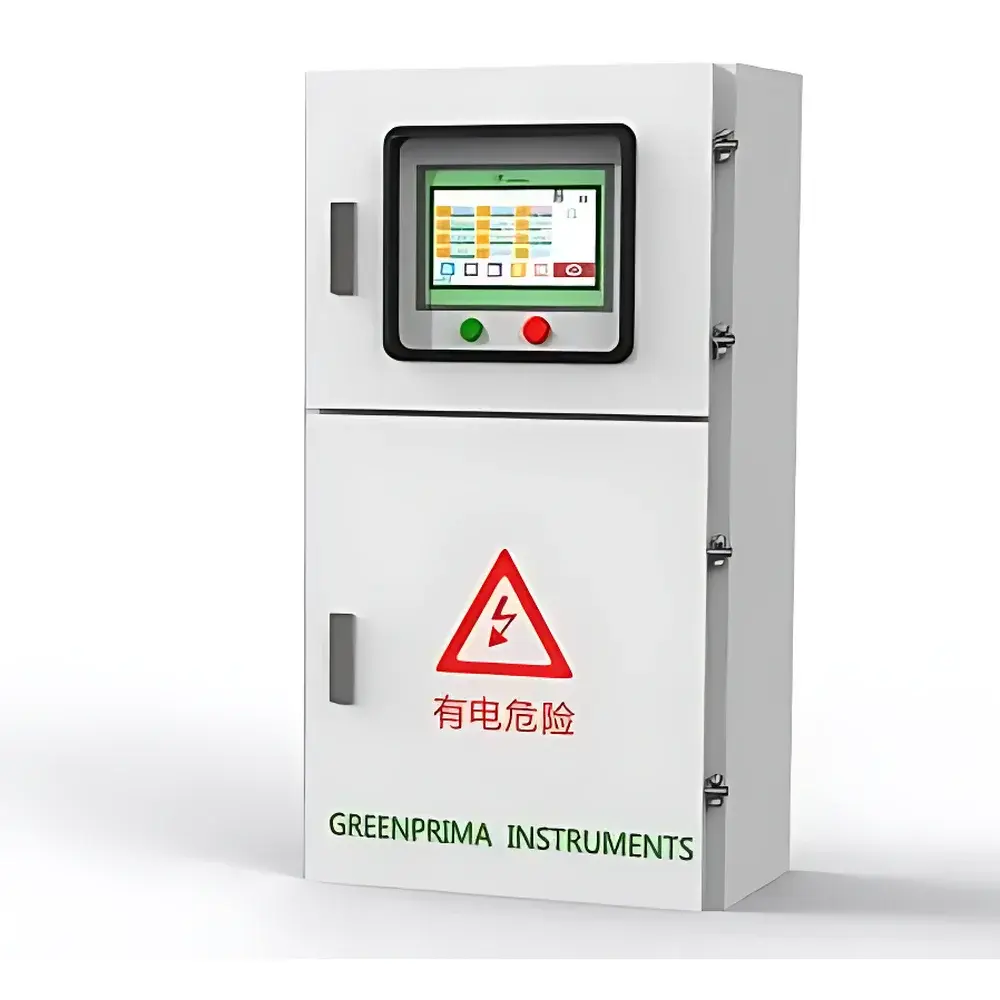
GreenPrima GP8200MAS Multi-Parameter Online Water Quality Analyzer
| Brand | GreenPrima |
|---|---|
| Origin | United Kingdom |
| Manufacturer Type | Original Equipment Manufacturer (OEM) |
| Product Category | Imported Instrument |
| Model | GP8200MAS |
| Instrument Type | Online Water Quality Analyzer |
| Measured Parameters | pH, Free Chlorine, Turbidity, Conductivity, Oxidation-Reduction Potential (ORP), Dissolved Oxygen (DO), Suspended Solids (SS) / Sludge Concentration, Temperature, Flow Rate, Liquid Level |
| Measurement Principle | Electrochemical (pH, ORP, DO, Cl₂), Nephelometric (Turbidity), Inductive/Conductive (Conductivity), Thermal Resistance (Temperature), Ultrasonic/Electromagnetic (Flow), Hydrostatic/Non-contact (Level) |
| Display | 10-inch Capacitive Touchscreen LCD with Backlight |
| Data Storage Capacity | Up to 600,000 Records |
| Communication Interfaces | RS485 (Modbus RTU), Optional GPRS (China Mobile/Unicom/Telecom), NB-IoT, Ethernet, Wi-Fi |
| Output Signals | 8-channel 4–20 mA (configurable, load <750 Ω), 8 SPST Relays (5 A @ 250 VAC / 30 VDC) |
| Power Supply | AC 200 V / 20 W or DC 24 V / 15 W (solar-compatible) |
| Enclosure Rating | IP65 |
| Dimensions (H×W×D) | 780 × 600 × 200 mm |
| Weight | 20 kg |
Overview
The GreenPrima GP8200MAS is a modular, industrial-grade multi-parameter online water quality analyzer engineered for continuous, real-time monitoring of critical physicochemical parameters in diverse aquatic environments. Designed and manufactured in the United Kingdom, the system integrates electrochemical, optical, and physical sensing principles—including potentiometric pH and ORP measurement, amperometric free chlorine detection, nephelometric turbidity analysis at 850 nm, inductive conductivity determination, luminescent-based dissolved oxygen sensing, and precision thermal resistance temperature compensation—into a single robust platform. Its architecture supports simultaneous acquisition and synchronized logging of up to ten independent parameters: pH, free chlorine, turbidity, conductivity, ORP, dissolved oxygen, suspended solids concentration, temperature, volumetric flow rate, and liquid level. The GP8200MAS operates under ambient temperatures from 0 °C to 70 °C and accommodates sample pressures from 1 to 200 psi via an integrated pressure regulator (factory-set at 15 psi), ensuring stable performance across municipal, industrial, and environmental applications without reagent consumption or secondary pollution.
Key Features
- Modular sensor architecture enabling parameter-specific measurement channels—eliminating cross-sensitivity and allowing flexible configuration of any subset of the ten supported parameters
- High-precision electrochemical sensors with automatic temperature compensation (−10 °C to 130 °C) using NTC10K or PT1000 reference elements
- 10-inch capacitive touchscreen HMI with bilingual (English/Chinese) menu navigation, intuitive calibration workflows, and real-time graphical trend visualization
- Onboard data logger storing up to 600,000 timestamped records with configurable sampling intervals (5 s to 24 h)
- Dual-output capability: eight isolated 4–20 mA analog outputs (field-configurable per parameter) and eight SPST control relays rated for 5 A at 250 VAC or 30 VDC
- Expandable communications suite supporting RS485 (Modbus RTU), optional NB-IoT, tri-band GPRS (China Mobile/Unicom/Telecom), Wi-Fi, and Ethernet for seamless integration into SCADA, IoT cloud platforms, or centralized EMS systems
- IP65-rated stainless-steel enclosure suitable for outdoor deployment in wastewater plants, riverbanks, reservoirs, and urban secondary water supply stations
Sample Compatibility & Compliance
The GP8200MAS is validated for use with raw surface water, groundwater, drinking water, treated effluent, seawater (with appropriate sensor variants), aquaculture ponds, and industrial process streams. It complies with foundational metrological requirements outlined in ISO 5667 (water quality sampling), ISO 7027 (turbidity measurement), ASTM D1293 (pH of water), ASTM D3370 (conductivity), and EN 27888 (electrochemical sensor performance). While not pre-certified for regulatory submission, its data integrity framework—including time-stamped audit logs, user-access levels, and non-volatile memory retention—supports alignment with GLP and GMP documentation practices. Optional configurations meet IEC 61000-6-2/6-4 immunity/emission standards for industrial electromagnetic environments.
Software & Data Management
Data acquisition, visualization, and alarm management are handled locally via the embedded Linux-based firmware and the 10-inch HMI. All measurements are stored with UTC timestamps, sensor IDs, calibration history, and diagnostic flags (e.g., electrode fouling alerts, signal saturation warnings). Export options include USB mass storage (CSV), Modbus TCP polling, and secure HTTP(S) RESTful API endpoints for integration with third-party platforms such as Ignition SCADA, Siemens Desigo, or custom cloud dashboards. Remote firmware updates and configuration backups are supported over Ethernet or GPRS. Audit trails record all operator actions—including calibration events, relay state changes, and parameter modifications—with user ID and timestamp, satisfying traceability expectations under internal QA protocols and preliminary FDA 21 CFR Part 11 readiness (when paired with external identity management).
Applications
- Municipal drinking water distribution: real-time residual chlorine and pH verification at booster stations and secondary supply points
- Surface water and river basin monitoring: autonomous turbidity spikes, DO depletion events, and conductivity anomalies indicating runoff or illicit discharge
- Wastewater treatment plants: activated sludge monitoring via suspended solids and DO profiles; effluent compliance tracking for COD/NH₃-N surrogate indicators
- Aquaculture and hydroponics: closed-loop control of DO, pH, and temperature to maintain optimal biological conditions
- Smart city infrastructure: integration into urban digital twins for flood-level forecasting, combined sewer overflow (CSO) event detection, and green infrastructure performance evaluation
- Industrial pretreatment monitoring: early warning of conductivity excursions or ORP shifts signaling process upsets or chemical dosing failures
FAQ
What calibration protocols does the GP8200MAS support?
It supports two-point pH calibration (using standard buffers), single-point or slope-based ORP calibration, air-saturation and zero-point DO calibration, and dry/wet turbidity validation with Formazin or AMCO AEPA standards.
Can the system operate autonomously on solar power?
Yes—the DC 24 V / 15 W input enables direct integration with photovoltaic arrays and charge controllers; battery backup compatibility is supported via external UPS modules.
Is sensor cleaning automated?
Mechanical wiper and ultrasonic cleaning modules are available as factory-installed options for turbidity and DO sensors; pH and chlorine electrodes require manual periodic maintenance.
How is data security managed during remote transmission?
GPRS/NB-IoT transmissions use TLS 1.2 encryption; Modbus TCP supports configurable read/write access masks; local HMI enforces role-based authentication (admin/operator/viewer).
Does the GP8200MAS meet drinking water regulatory reporting requirements?
While it provides metrologically sound measurements aligned with ISO/ASTM methods, formal regulatory acceptance (e.g., EPA UCMR, EU Drinking Water Directive Annex II) requires site-specific validation per local authority protocols and certified field verification.







