
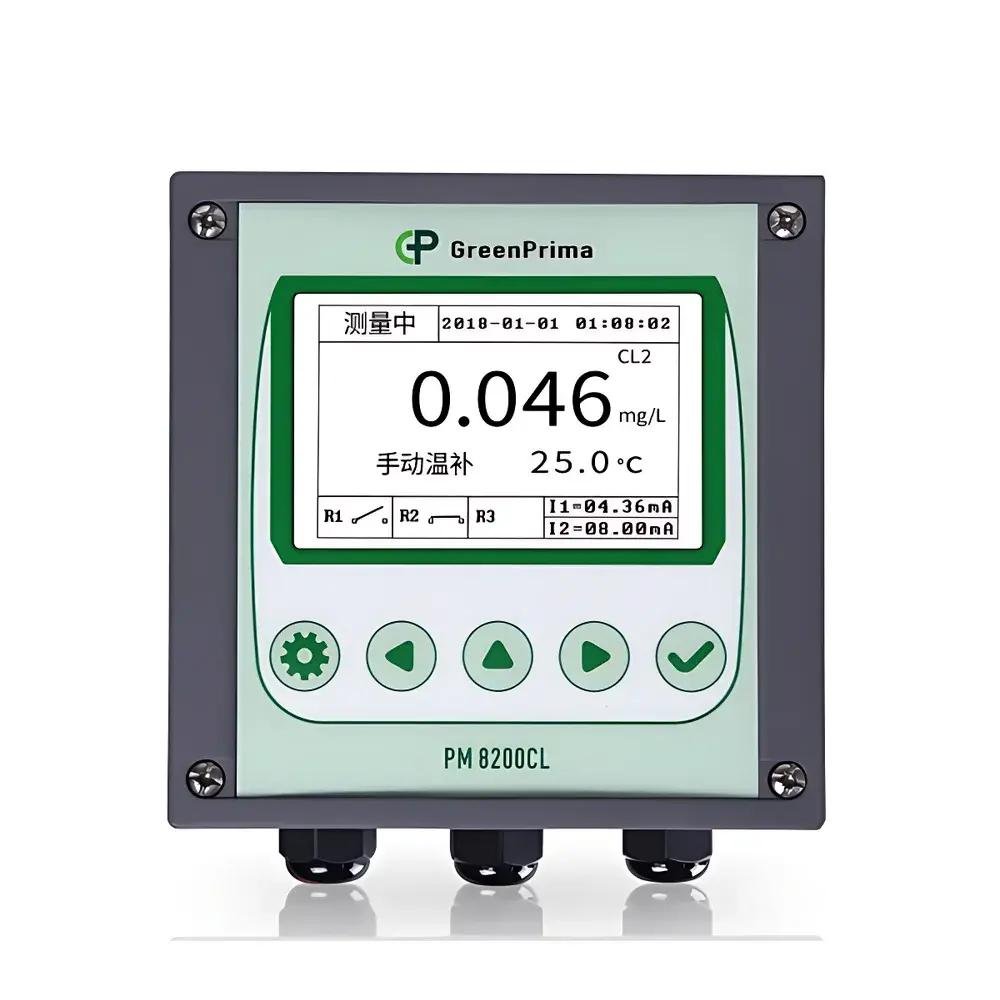
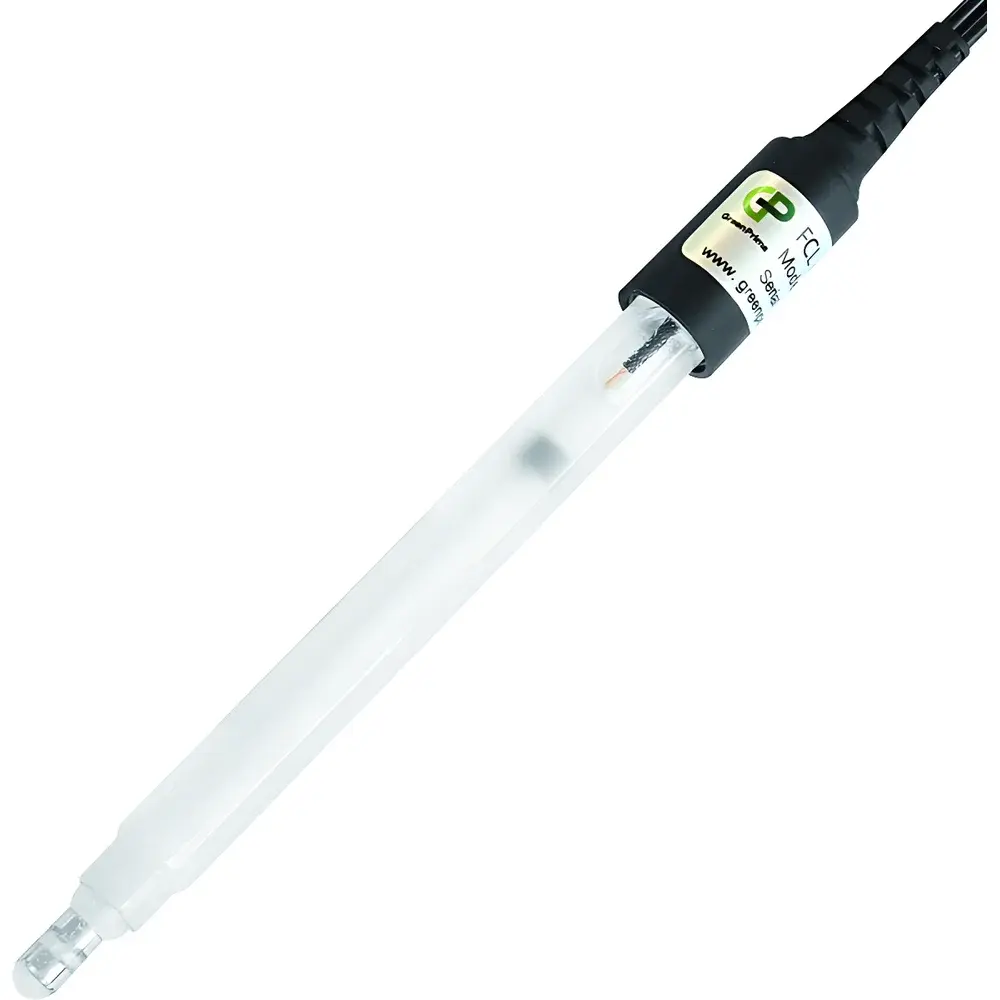
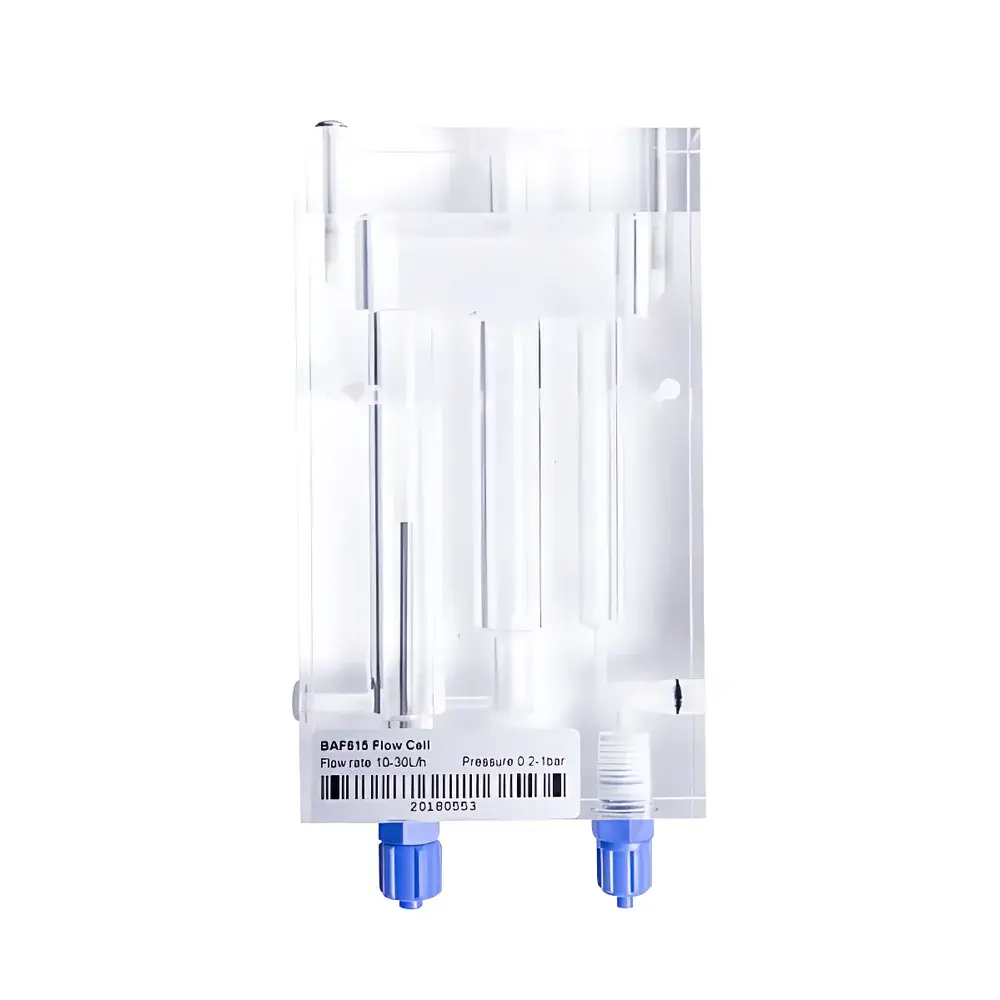
GreenPrima PM8200Cl Online Residual Chlorine Analyzer
| Brand | GreenPrima |
|---|---|
| Origin | United Kingdom |
| Manufacturer Type | Original Equipment Manufacturer (OEM) |
| Product Category | Imported Instrument |
| Model | PM 8200Cl |
| Instrument Type | Online Analyzer |
| Measurement Principle | Amperometric Electrochemical Sensor (Constant Potential Method) |
| Measured Parameter | Free Chlorine (Cl₂) |
| Measurement Ranges | 0–2.000 ppm and 0–20.00 ppm |
| Accuracy | ±0.001 ppm / ±0.01 ppm |
| Repeatability | ±0.001 ppm / ±0.01 ppm |
| Resolution | 0.001 ppm / 0.01 ppm |
| Detection Limit | 0.001 ppm / 0.01 ppm |
| Temperature Compensation | –10 to 130 °C (NTC10K or PT1000, manual/automatic) |
| Operating Temperature | 0–70.0 °C |
| Storage Temperature | –20 to 70.0 °C |
| Enclosure Rating | IP65 |
| Power Supply | 90–260 VAC, 50/60 Hz or 24 VDC optional |
| Output | Dual isolated 4–20 mA (max. loop resistance 500 Ω, accuracy 0.1% FS) |
| Communication | RS485 with standard MODBUS RTU protocol |
| Relay Output | 1 multifunctional relay (cleaning control, periodic alarm, fault alarm) |
| Data Logging | 600,000 records with timestamped query capability |
| Display | Backlit graphical LCD with adjustable contrast |
| User Interface | Bilingual (English/Chinese), password-protected, keyless operation with auto-backlight timeout |
| Mounting Options | Wall-mounted, panel-mounted, or pipe-mounted |
| Dimensions | 144 × 144 × 106 mm |
| Panel Cutout | 138 × 138 mm |
| Weight | 0.86 kg |
| Sensor Model | Bsens650 |
| Sensor Range | 0–2.000 ppm / 0–20.00 ppm |
| Sensor Accuracy | ±2% FS |
| Sensor Electrode Material | Glass body with dual platinum ring working electrode |
| Sensor Operating Temperature | 0–70.0 °C |
| Max. Pressure Rating | 5 bar |
Overview
The GreenPrima PM8200Cl Online Residual Chlorine Analyzer is an industrial-grade, amperometric electrochemical instrument engineered for continuous, real-time monitoring of free chlorine (Cl₂) concentration in potable water distribution systems, municipal drinking water treatment plants, food & beverage process lines, pharmaceutical water loops, and wastewater disinfection stages. It operates on the constant-potential amperometric principle—applying a stable bias voltage across a dual-platinum-ring working electrode immersed directly in the aqueous stream, enabling selective reduction of hypochlorous acid (HOCl) and hypochlorite ion (OCl⁻) at the electrode surface. The resulting diffusion-controlled current is linearly proportional to residual chlorine concentration and is digitally compensated for temperature using integrated NTC10K or PT1000 sensors. Unlike colorimetric or DPD-based analyzers, the PM8200Cl requires no reagents, zero sample filtration, and eliminates chemical waste, tubing clogging, or photometric drift—making it compliant with long-term unattended operation under GLP and GMP-aligned water quality assurance frameworks.
Key Features
- Triple-analyte capability: Configurable for free chlorine (Cl₂), chlorine dioxide (ClO₂), and ozone (O₃) via sensor module selection and firmware calibration—supporting multi-point disinfectant verification in hybrid treatment processes.
- Direct immersion architecture: The Bsens650 sensor mounts inline or in flow-through cells without peristaltic pumps, bypass lines, or pressure regulators—reducing hydraulic head loss and maintenance points.
- Robust industrial enclosure: IP65-rated sealed housing with corrosion-resistant polycarbonate front panel and stainless-steel mounting hardware ensures operational integrity in humid, chemically aggressive environments including pump stations and chlorination rooms.
- Dual isolated 4–20 mA analog outputs: Each channel supports independent range mapping (e.g., 0–2 ppm and 0–20 ppm) with 0.1% full-scale accuracy, facilitating integration into PLCs, SCADA systems, or DCS controllers without external signal conditioners.
- MODBUS RTU over RS485: Enables scalable network deployment—up to 32 analyzers on a single bus—with register-level access to live measurements, temperature, relay status, calibration history, and diagnostic flags.
- Comprehensive data stewardship: Onboard non-volatile memory stores 600,000 timestamped records (measurement, temperature, relay events, cleaning cycles) with chronological search and export-ready CSV structure—fully traceable for regulatory audits per ISO 9001, ISO/IEC 17025, and EPA Method 334.0 requirements.
- Intelligent maintenance logic: Programmable cleaning interval (0.1–1000 h) and duration (1–1000 s) synchronizes mechanical or ultrasonic electrode cleaning with operational downtime, minimizing fouling-induced drift without manual intervention.
Sample Compatibility & Compliance
The PM8200Cl is validated for use in clarified, low-turbidity (<5 NTU) aqueous streams with pH 4.0–8.5 and conductivity >50 µS/cm. It meets EN ISO 7888:2019 (water quality — determination of free chlorine) for field-deployable electrochemical methods and aligns with US EPA Guidance Manual for Disinfectants (2021) regarding continuous chlorine monitoring in distribution system compliance reporting. Its reagent-free design avoids interference from bromide, nitrite, or manganese commonly encountered in groundwater sources. The sensor’s glass body and dual-platinum electrode configuration provide immunity to sulfide poisoning and exhibit <2% FS drift over 90 days under steady-state conditions—verified per ASTM D1253-22 Annex A1 stability protocols. All firmware and calibration routines support audit trails meeting FDA 21 CFR Part 11 electronic record requirements when deployed with secure user authentication and change logging enabled.
Software & Data Management
Data acquisition and configuration are managed via the embedded web interface (accessible via Ethernet or serial-to-USB adapter) or GreenPrima’s PC-based Configuration Utility v3.2. The utility enables batch calibration using NIST-traceable standard solutions (e.g., 0.1, 1.0, and 5.0 ppm Cl₂), slope/offset validation, temperature coefficient adjustment, and relay logic programming. Historical datasets export as ISO 8601-compliant .csv files with UTC timestamps, supporting trend analysis in third-party platforms such as Ignition SCADA or LabVIEW. Firmware updates preserve all configuration parameters and logged data—ensuring continuity during version upgrades required for cybersecurity patching or regulatory alignment (e.g., IEC 62443-3-3). Audit logs capture operator ID, timestamp, parameter modified, and pre-/post-value—enabling full accountability in regulated facilities subject to WHO Guidelines for Drinking-water Quality or EU Directive 98/83/EC.
Applications
- Municipal drinking water: Real-time monitoring at clearwell outlets, booster station inlets, and zone boundary valves to maintain minimum residual (0.2–4.0 ppm) per AWWA C651 and WHO recommendations.
- Pharmaceutical purified water (PW) and water-for-injection (WFI) systems: Continuous verification of post-UV or membrane disinfection efficacy without introducing organic contaminants from reagents.
- F&B process water: Inline control of chlorine concentration in bottle rinsing, CIP rinse cycles, and ingredient water lines—ensuring microbial kill while preventing equipment corrosion or taste carryover.
- Swimming pool & spa management: Integration with automated dosing controllers to maintain ANSI/APSP-11 compliant levels (1–3 ppm free Cl₂) with adaptive response to bather load surges.
- Industrial cooling towers: Corrosion-aware monitoring where excessive residual accelerates copper alloy degradation—enabling dynamic dosing to balance biocide efficacy and metallurgical safety.
FAQ
What measurement principle does the PM8200Cl employ?
It uses constant-potential amperometry with a dual-platinum-ring sensor (Bsens650), selectively detecting electroactive chlorine species (HOCl/OCl⁻) via diffusion-limited current generation.
Can the analyzer operate without temperature compensation?
No—temperature compensation is mandatory for accurate free chlorine quantification due to strong kinetic dependence; the unit supports automatic (NTC10K/PT1000) or manual input.
Is the sensor compatible with high-pressure applications?
Yes—the Bsens650 withstands up to 5 bar static pressure, suitable for pressurized distribution mains and recirculating loops when installed with appropriate isolation valves.
How frequently does the sensor require recalibration?
Under typical municipal water conditions, quarterly verification against certified standards is recommended; extended intervals (6–12 months) are permissible with documented stability trending per ISO/IEC 17025 Clause 7.7.
Does the device support remote diagnostics and firmware updates?
Yes—via embedded HTTP server or MODBUS register interrogation; firmware updates retain all configuration and historical logs, ensuring compliance continuity during maintenance.
Related Products







