
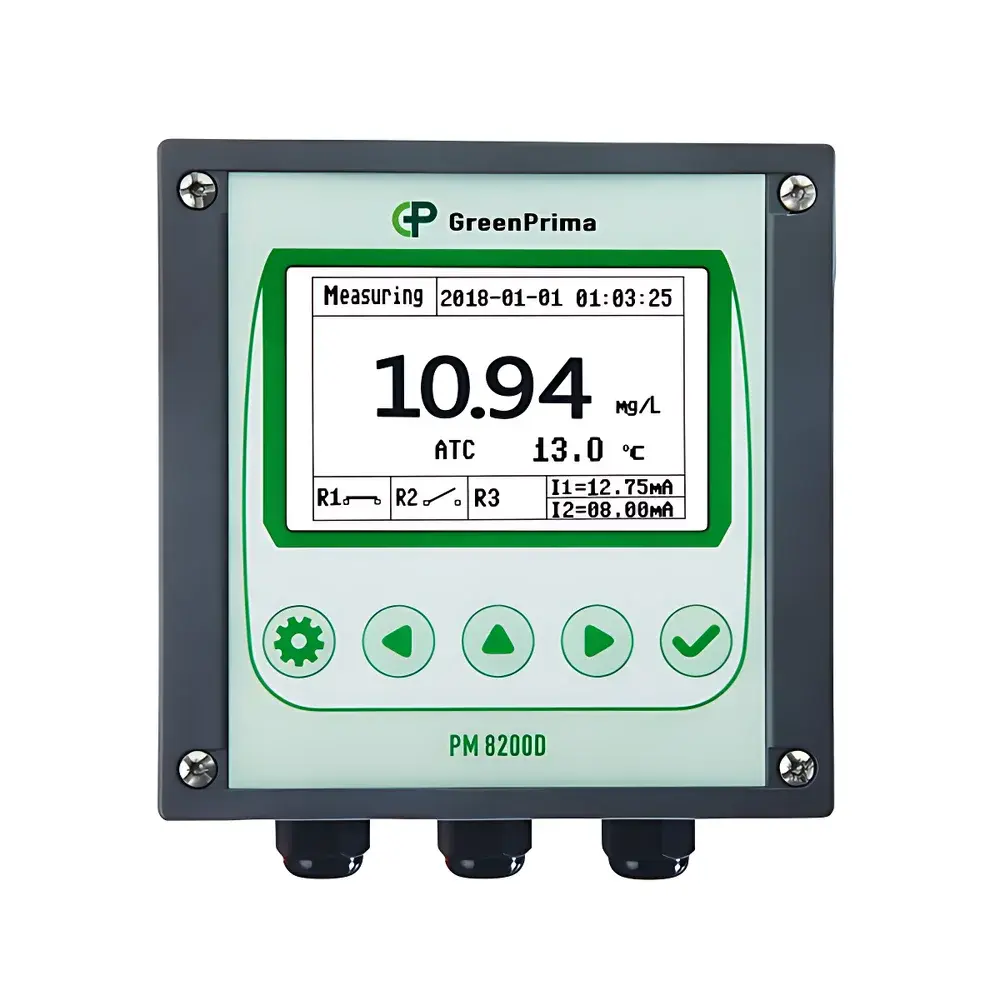
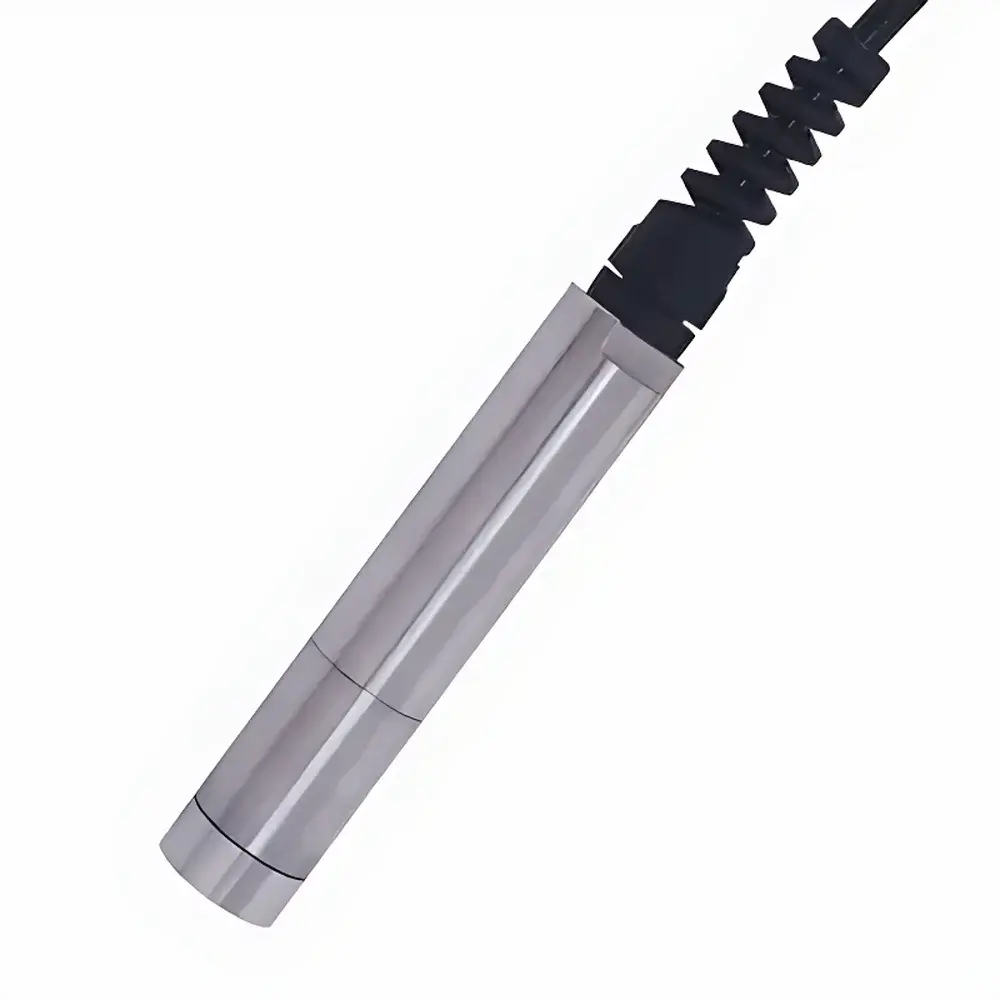
GreenPrima PM8200D Online Fluorescence-Based Dissolved Oxygen Analyzer
| Brand | GreenPrima |
|---|---|
| Model | PM 8200D |
| Measurement Principle | Fluorescence Quenching |
| Range | 0.00–20.00 ppm / 0–200% saturation |
| Accuracy | ±0.1 ppm or ±1% of reading |
| Repeatability | 0.05% |
| Detection Limit | 0.01 ppm |
| Response Time | <60 s |
| Temperature Compensation | Built-in NTC, -10–130 °C |
| Output | Dual 4–20 mA (DO & temp), RS485 Modbus RTU |
| Display | Backlit dot-matrix LCD with English/Chinese interface |
| Power Supply | 90–260 VAC, 50/60 Hz |
| Enclosure Rating | IP65 (controller), IP68 (sensor) |
| Sensor Material | 316L stainless steel |
| Max. Pressure | 5 bar |
| Cable Length | 10 m standard |
| Cleaning Interval | Programmable (1–1000 h) |
| Data Storage | 600,000 records |
| Dimensions (H×W×D) | 144×144×106 mm |
| Panel Cutout | 138×138 mm |
| Weight | 0.86 kg |
Overview
The GreenPrima PM8200D is an industrial-grade online dissolved oxygen (DO) analyzer engineered for continuous, high-stability measurement in demanding water quality monitoring applications. It operates on the physical principle of fluorescence quenching—where molecular oxygen modulates the lifetime and intensity of fluorescent emission from a proprietary oxygen-sensitive luminophore. Unlike electrochemical sensors, the PM8200D employs no membrane, electrolyte, or cathode-anode assembly; instead, it uses a solid-state optical sensing element (BSens 410 sensor) that emits red fluorescence upon blue LED excitation. The phase shift between the excitation pulse and the decayed fluorescence signal is precisely measured and correlated to DO concentration via factory-calibrated algorithms. This non-consumptive, zero-oxygen-depletion methodology ensures accurate readings even under stagnant or low-flow conditions—critical for wastewater bioreactors, aquaculture tanks, and surface water monitoring stations where traditional Clark-type sensors suffer from drift, fouling, or flow dependency.
Key Features
- Fluorescence quenching-based detection eliminates membrane replacement, electrolyte refills, and polarization time—reducing total cost of ownership and operational downtime.
- Zero-flow dependency: validated performance across static, laminar, and turbulent hydraulic environments without calibration drift or response lag.
- Dual independent 4–20 mA analog outputs support simultaneous transmission of DO concentration and temperature signals to DCS/SCADA systems, each with configurable scaling and fault current settings.
- RS485 interface compliant with Modbus RTU protocol enables seamless integration into industrial automation networks for remote configuration, real-time data polling, and firmware updates.
- ARM-based embedded controller architecture ensures deterministic timing, robust memory management, and immunity to electromagnetic interference in plant-floor environments.
- Backlit dot-matrix LCD with dual-language (English/Chinese) menu navigation simplifies field commissioning, diagnostics, and maintenance—even under low-ambient-light conditions.
- IP65-rated controller housing and IP68-rated submersible sensor provide protection against dust ingress, temporary submersion, and chemical exposure in outdoor or wet-process installations.
Sample Compatibility & Compliance
The PM8200D is validated for use in municipal and industrial wastewater streams, activated sludge basins, effluent discharge points, drinking water distribution networks, and aquaculture recirculating systems. Its optical sensing mechanism is insensitive to hydrogen sulfide, chlorine residuals, cyanide, and other common interferents that poison electrochemical electrodes. The BSens 410 sensor’s 316L stainless steel body meets ASTM A240 requirements for corrosion resistance in chloride-rich media. While not certified to specific ISO/IEC 17025 laboratory accreditation standards (as it is a process analyzer, not a reference instrument), its measurement traceability aligns with ISO 5814:2012 (water quality — determination of dissolved oxygen — electrochemical probe method) and supports compliance with EPA Method 360.1 and APHA Standard Methods 4500-O G. Data logging functionality (600,000 timestamped records) satisfies basic GLP audit-trail requirements for trend analysis and regulatory reporting.
Software & Data Management
The PM8200D embeds non-volatile flash memory capable of storing up to 600,000 timestamped measurement records—including DO value, temperature, sensor status flags, and system diagnostics. All stored data are accessible via Modbus register mapping or local display export. The cleaning interval timer (programmable from 1 to 1000 hours) triggers visual alerts and optional relay outputs to initiate automated or manual sensor surface maintenance—critical for long-term stability in algae-prone or biofouling-prone applications. Firmware updates are performed over RS485 using standardized Modbus write commands, eliminating the need for proprietary software or laptop dependency. No cloud connectivity or SaaS platform is required; all configuration, calibration history (if manually initiated), and alarm logs reside locally within the device—supporting air-gapped network architectures common in critical infrastructure.
Applications
- Wastewater Treatment: Real-time DO control in aerobic digesters, nitrification zones, and oxidation ditches—enabling energy-efficient aeration optimization and nitrogen removal compliance.
- Surface Water Monitoring: Continuous deployment in rivers, reservoirs, and estuaries for ecological assessment, eutrophication tracking, and early warning of hypoxic events.
- Aquaculture & Hatcheries: Precise DO management in recirculating aquaculture systems (RAS), net pens, and larval rearing tanks—preventing stress-induced mortality and maximizing feed conversion ratios.
- Industrial Process Water: Monitoring in cooling towers, boiler feedwater pretreatment, and pharmaceutical water-for-injection (WFI) loops where oxygen ingress must be minimized to prevent corrosion or oxidative degradation.
- Environmental Research Stations: Battery-operated or solar-powered deployments with low power draw (<5 W), supporting unattended operation in remote field sites for multi-month campaigns.
FAQ
Does the PM8200D require periodic calibration?
No—fluorescence quenching is inherently stable over time. While initial factory calibration is traceable to NIST-certified standards, routine recalibration is not required. Users may perform verification checks using air-saturated water or zero-oxygen solutions if mandated by internal QA protocols.
What is the expected service life of the optical sensing element?
The BSens 410 sensor’s fluorescent cap is rated for 12–24 months under typical municipal wastewater conditions. Replacement is a field-serviceable procedure requiring no tools or disassembly of the sensor body.
Can the PM8200D operate at elevated pressures?
Yes—the sensor is rated for continuous operation up to 5 bar (72.5 psi), making it suitable for pressurized pipelines, deep-well monitoring, and submerged pump intakes.
Is temperature compensation automatic?
Yes—integrated NTC thermistor provides real-time temperature measurement with automatic compensation across -10 °C to +130 °C, ensuring accuracy regardless of seasonal or process-induced thermal variation.
How is sensor fouling mitigated?
The optical design minimizes surface adhesion, and the programmable cleaning interval allows scheduled mechanical wiping or ultrasonic cleaning cycles—documented in the event log for maintenance auditing.







