
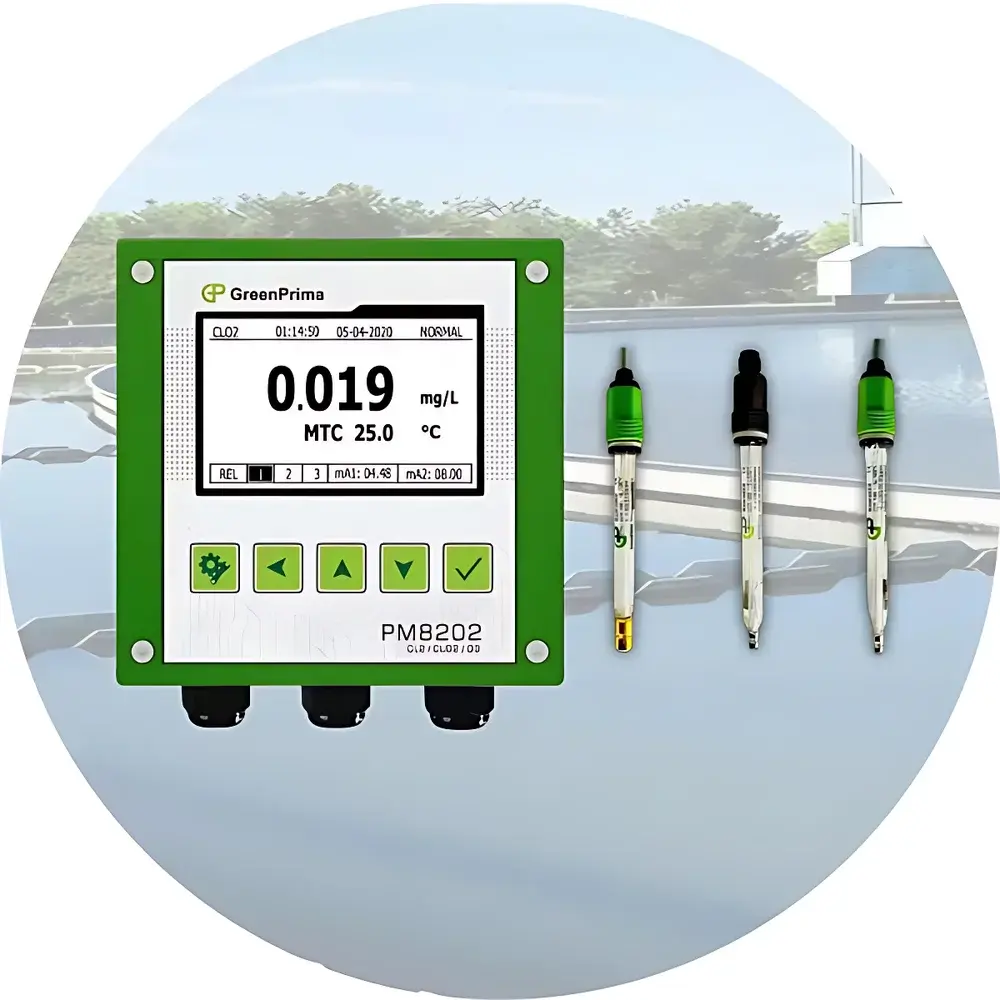
GreenPrima PM8202CL Online Residual Chlorine, Chlorine Dioxide & Ozone Analyzer
| Brand | GreenPrima |
|---|---|
| Origin | United Kingdom |
| Manufacturer Type | Manufacturer |
| Origin Category | Imported |
| Model | PM8202CL |
| Instrument Type | Online Analyzer |
| Measurement Principle | Amperometric (Constant Voltage) |
| Measured Parameters | Residual Chlorine, Chlorine Dioxide, Ozone |
| Range | 0.00–20.00 ppm / 0.00–200.00 ppb |
| Accuracy | ±2% F.S. |
| Resolution | 0.001 ppm / 0.01 ppm |
| Temperature Compensation | –10 to 130 °C (NTC10K or PT1000) |
| Operating Temperature | –10 to 70.0 °C |
| Storage Temperature | –20 to 70.0 °C |
| Display | Backlit Graphic LCD |
| Data Storage | 600,000 records |
| Power Supply | 90–260 VAC, 50/60 Hz or 24 VDC optional |
| Output | Dual isolated 4–20 mA (0.1% F.S., max. loop resistance 500 Ω), RS485 Modbus RTU |
| Relay Outputs | 2 programmable Hi/Lo alarms (5 A / 250 VAC / 30 VDC) |
| Cleaning Cycle | Adjustable interval (0.1–1000 h) and duration (1–1000 s) |
| Enclosure Rating | IP65 |
| Dimensions | 144 × 144 × 108 mm |
| Panel Cutout | 138 × 138 mm |
| Weight | 0.87 kg |
Overview
The GreenPrima PM8202CL is a robust, industrial-grade online analyzer engineered for continuous, real-time monitoring of residual chlorine, chlorine dioxide, and ozone in aqueous streams. It operates on the amperometric principle using constant-voltage electrochemical detection—specifically optimized for oxidant species in water matrices. Unlike colorimetric or photometric methods, this approach eliminates dependence on reagents, optical path integrity, or sample filtration, making it particularly suitable for challenging environments such as hospital wastewater effluent, where particulate load, organic interference, and fluctuating pH may compromise alternative techniques. The system integrates a dedicated flow cell (BAF615) with precise laminar-flow control, ensuring stable hydraulic conditions critical for reproducible electrochemical response. Its design conforms to the operational demands of regulated water quality management, supporting compliance-driven workflows in healthcare facilities, municipal utilities, and pharmaceutical process water systems.
Key Features
- Triple-analyte capability: Simultaneous measurement of free residual chlorine, chlorine dioxide, and ozone without hardware modification
- Reagent-free, membrane-free operation: Eliminates consumables including electrolyte refills, replacement membranes, and colorimetric reagents—reducing total cost of ownership and maintenance frequency
- Dual-electrode sensor options: Bsens650 (platinum working electrode) for broad-spectrum oxidant detection; Bsens660 (gold working electrode) for enhanced selectivity in high-chloride or complex matrix applications
- Integrated BAF615 constant-flow cell: Maintains consistent sample velocity and residence time, minimizing polarization effects and improving signal stability
- Full temperature compensation: Supports NTC10K or PT1000 probes across –10 to 130 °C, enabling accurate measurements in sterilization loops, cooling towers, or warm wastewater streams
- Configurable digital and analog I/O: Two isolated 4–20 mA outputs (assignable to analyte concentration and temperature), RS485 Modbus RTU interface for SCADA integration, and two independent relay outputs with hysteresis
- Secure local operation: Password-protected configuration menu, multilingual (English/Chinese) GUI, backlit graphic LCD, and onboard storage of up to 600,000 timestamped records
Sample Compatibility & Compliance
The PM8202CL is validated for use in heterogeneous water streams typical of hospital wastewater treatment—characterized by variable turbidity, suspended solids, organic loading, and intermittent disinfectant dosing. Its amperometric architecture inherently tolerates moderate fouling, and the programmable cleaning function (adjustable interval and duration) supports autonomous maintenance cycles aligned with facility SOPs. The instrument meets CE marking requirements and complies with IEC 61326-1 (EMC for industrial environments) and IEC 61000-6-2/6-4. While not certified to ISO 9001 or ISO/IEC 17025 as a standalone device, its output data are compatible with GLP- and GMP-aligned laboratory information management systems (LIMS) when integrated via Modbus into validated infrastructure. For regulatory reporting, raw sensor output and compensated values adhere to ASTM D1253 (Standard Test Method for Residual Chlorine in Water) and EN ISO 7890-3 (Water quality — Determination of chlorine — Part 3: Electrochemical method).
Software & Data Management
Data acquisition and configuration are managed through the embedded firmware interface, accessible locally via the front-panel LCD or remotely via Modbus RTU. All measurements are time-stamped and stored in non-volatile memory with automatic overwrite protection. The dual 4–20 mA outputs support analog transmission to PLCs or DCS systems, while Modbus registers expose real-time concentration, temperature, sensor status flags (e.g., low flow, electrode saturation), calibration history, and cleaning event logs. Optional PC-based configuration software (available under NDA) enables batch export of CSV-formatted datasets, trend visualization, and audit trail generation—including operator ID, parameter change timestamps, and calibration verification entries—supporting FDA 21 CFR Part 11 readiness when deployed within validated IT environments.
Applications
- Hospital wastewater disinfection monitoring: Verification of post-treatment residual oxidant levels prior to discharge or reuse
- Central sterile supply department (CSSD) water loops: Continuous assurance of chlorine dioxide efficacy in instrument reprocessing systems
- Pharmaceutical purified water (PW) and water-for-injection (WFI) distribution networks: Monitoring of sanitization residuals during periodic hot-water or chemical sanitization cycles
- Municipal secondary effluent reuse: Compliance tracking for irrigation or industrial non-potable reuse standards
- Food & beverage process rinse water: Validation of sanitizer concentration in CIP final rinse stages
FAQ
Does the PM8202CL require daily calibration?
No. The sensor exhibits long-term baseline stability; field calibration is recommended every 7–30 days depending on matrix severity, using standardized DPD-based reference measurements per ASTM D1253.
Can it distinguish between free chlorine and combined chlorine?
No. The amperometric method measures total electrochemically active chlorine species; speciation requires complementary methods such as DPD colorimetry or ion chromatography.
Is the BAF615 flow cell compatible with pressurized pipelines?
Yes. It supports inlet pressures up to 6 bar and integrates seamlessly with standard ½″–1″ sanitary or BSP threaded connections.
What maintenance is required beyond scheduled cleaning?
Annual verification of electrode surface integrity and zero-point drift using deionized water; sensor replacement is typically required every 18–24 months under continuous operation.
Does the unit support alarm logging with timestamps?
Yes. All relay activation events—including Hi/Lo threshold breaches and cleaning cycle initiation—are logged with millisecond-resolution timestamps and retained in internal memory.
Related Products







