
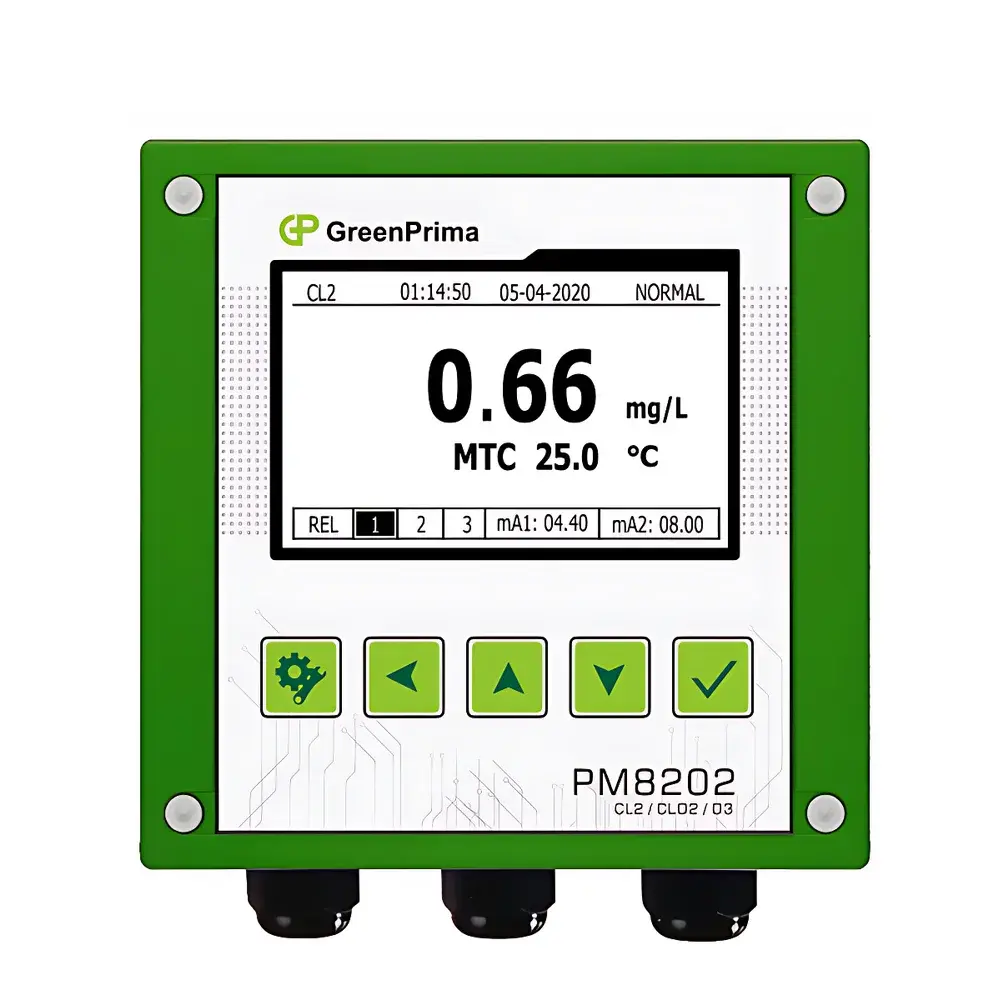
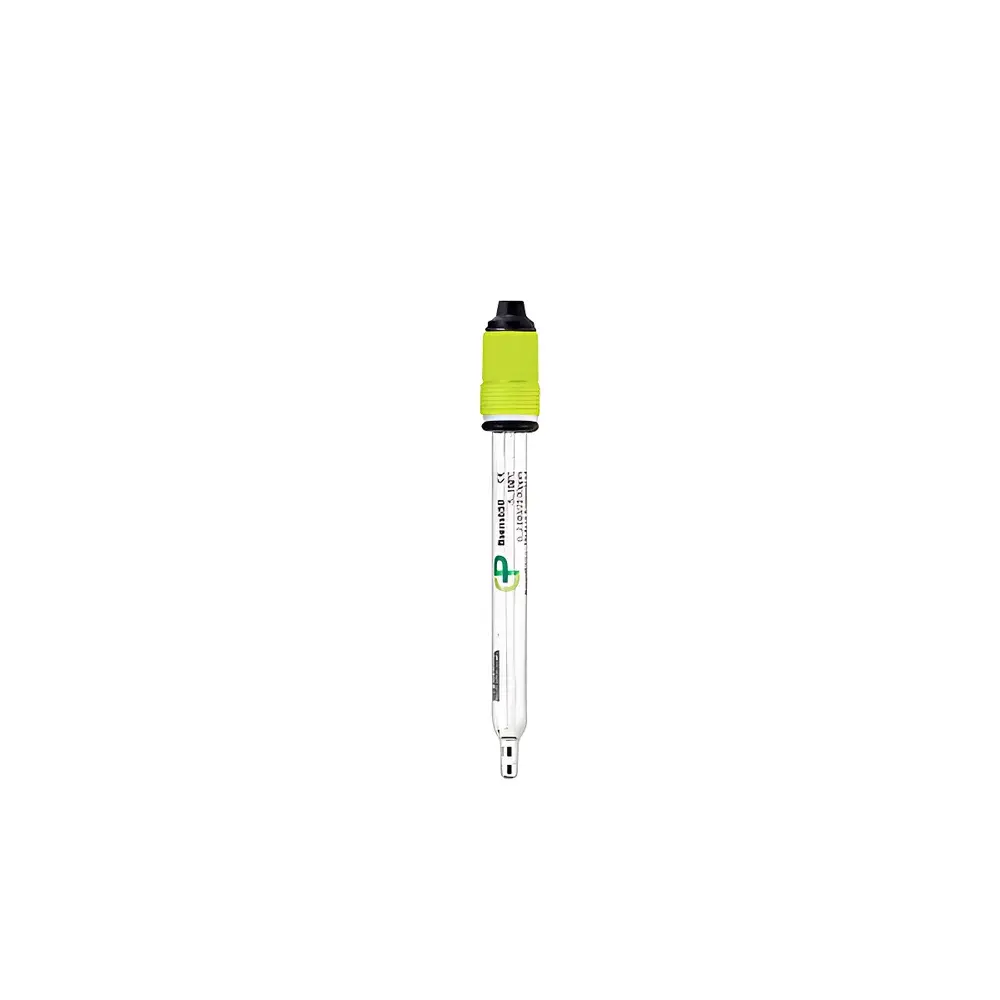
GreenPrima PM8202CL Residual Chlorine and Chlorine Dioxide Analyzer
| Brand | GreenPrima |
|---|---|
| Origin | Imported |
| Manufacturer Type | Manufacturer |
| Model | PM8202 CL |
| Instrument Type | Online Analyzer |
| Measurement Principle | Electrochemical Sensor (Constant Voltage Amperometry) |
| Measured Parameter | Free Residual Chlorine |
| Range | 0–2 ppm / 0–20 ppm |
| Accuracy | ±2% F.S. |
| Repeatability | ±2% F.S. |
| Resolution | 0.001 ppm / 0.01 ppm |
| Detection Limit | 0.001 ppm / 0.01 ppm |
Overview
The GreenPrima PM8202CL is a high-reliability online residual chlorine and chlorine dioxide analyzer engineered for continuous, real-time monitoring in demanding water treatment and process environments. It operates on the principle of constant-voltage amperometric electrochemistry—applying a stable polarization potential across a three-electrode sensor system (working, reference, and counter electrodes) to selectively oxidize free chlorine (HOCl/OCl⁻) at the platinum or gold working electrode surface. This method eliminates dependence on permeable membranes and liquid electrolytes, thereby avoiding common failure modes associated with membrane-based sensors—including fouling, clogging, and drift due to electrolyte depletion. The PM8202CL is designed for deployment in heterogeneous water matrices, from turbid hospital wastewater and industrial effluent to ultra-pure pharmaceutical process water and municipal distribution networks.
Key Features
- Triple-parameter capability: Configurable for simultaneous or selective measurement of free residual chlorine, chlorine dioxide, or ozone—without hardware modification.
- Swiss-engineered amperometric sensors: Platinum (Bsens650) and gold (Bsens660) electrodes manufactured to ISO 9001-certified precision; integrated grounding design ensures robust electromagnetic interference (EMI) immunity in electrically noisy plant environments.
- pH compensation algorithm: Real-time correction using an optional integrated pH sensor input, critical for accurate free chlorine quantification across variable pH conditions (e.g., 4.5–8.5), as HOCl/OCl⁻ speciation is pH-dependent.
- BAF615 flow-through cell: Precision-machined stainless-steel flow cell with laminar flow geometry and pressure-balanced inlet/outlet ports; minimizes velocity-induced signal noise and ensures consistent sample exposure time (<0.5 s residence time).
- Zero-reagent operation: No colorimetric reagents, no membrane replacements, no electrolyte refills—reducing total cost of ownership and enabling unattended operation over extended intervals.
- Dual analog outputs: Two isolated 4–20 mA current loops configurable for primary measurement and secondary parameter (e.g., temperature or pH); RS485 Modbus RTU interface for SCADA integration.
- Onboard data logging: Internal non-volatile memory stores up to 30 days of 1-minute interval measurements with timestamping, supporting GLP-compliant audit trails.
- Flexible mounting: Compatible with wall-mount, panel-mount (cutout: 92 × 92 mm), and pipe-clamp configurations; IP65-rated enclosure for indoor and sheltered outdoor use.
Sample Compatibility & Compliance
The PM8202CL is validated for use across diverse water quality classes per ISO 5667-3 and ASTM D1253 standards for residual disinfectant measurement. It maintains stable performance in samples containing suspended solids (<50 mg/L), organic load (COD < 100 mg/L), and moderate turbidity (<100 NTU), making it suitable for hospital wastewater discharge monitoring where membrane-based sensors frequently fail. Its electrochemical architecture complies with US EPA Method 334.0 principles for amperometric chlorine detection and supports regulatory reporting under EU Drinking Water Directive (98/83/EC) and China’s GB 5749-2022. Data integrity features—including write-protected event logs and user-access-level authentication—align with FDA 21 CFR Part 11 requirements for electronic records in GMP-regulated facilities.
Software & Data Management
The analyzer integrates seamlessly with industry-standard supervisory control systems via Modbus RTU. Local configuration and diagnostics are performed using the built-in 3.5-inch TFT LCD touchscreen with intuitive menu navigation. Firmware supports over-the-air updates via USB or serial connection. All measurement data, calibration events, sensor status flags (e.g., electrode passivation alerts), and system errors are time-stamped and exportable in CSV format. Optional cloud gateway modules enable remote monitoring, predictive maintenance alerts (based on electrode response decay trends), and automated report generation aligned with ISO/IEC 17025 documentation frameworks.
Applications
- Municipal drinking water treatment: Continuous verification of chlorine residual at clearwell outlets and distribution system endpoints per WHO and CDC guidelines.
- Hospital central sterile supply departments (CSSD): Monitoring of chlorine-based sterilant concentration in washer-disinfectors and endoscope reprocessing units.
- Pharmaceutical water systems: TOC- and conductivity-coupled validation of purified water (PW) and water for injection (WFI) loop disinfection cycles.
- Food & beverage processing: Sanitizer concentration control in CIP rinse stages and post-process equipment surface disinfection.
- Swimming pool & spa management: Real-time dosing feedback for automated chlorination systems.
- Electrolytic chlorine generator (ECG) integration: Closed-loop control of on-site hypochlorite production based on actual residual output.
FAQ
What distinguishes constant-voltage amperometry from membrane-based chlorine sensors?
Constant-voltage amperometry directly measures the faradaic current generated by chlorine oxidation at a polarized electrode surface—without requiring diffusion-limiting membranes. This eliminates membrane clogging, electrolyte leakage, and calibration drift caused by membrane aging.
Can the PM8202CL measure both free and total chlorine?
No—it is optimized for free residual chlorine (HOCl + OCl⁻). Total chlorine measurement requires chemical reduction (e.g., glycine quenching) prior to analysis, which is outside the scope of this online amperometric platform.
Is pH compensation mandatory for accurate readings?
Yes—free chlorine speciation shifts significantly between pH 5.5 and 7.5. The integrated pH compensation algorithm adjusts the measured current response to reflect true HOCl-equivalent concentration, ensuring metrological traceability across variable feedwater conditions.
How often does the sensor require recalibration?
Under stable operating conditions, field calibration is recommended every 30–90 days using NIST-traceable chlorine standard solutions (e.g., potassium iodide titration verified). Drift monitoring via zero-check (dechlorinated water) and span-check (calibrated standard) is supported daily via the instrument’s diagnostic menu.
Does the analyzer support alarm relay outputs?
Yes—two programmable SPDT dry-contact relays are provided for high/low limit alarms, sensor fault indication, or maintenance reminders, configurable via the local HMI or Modbus register mapping.
Related Products







