
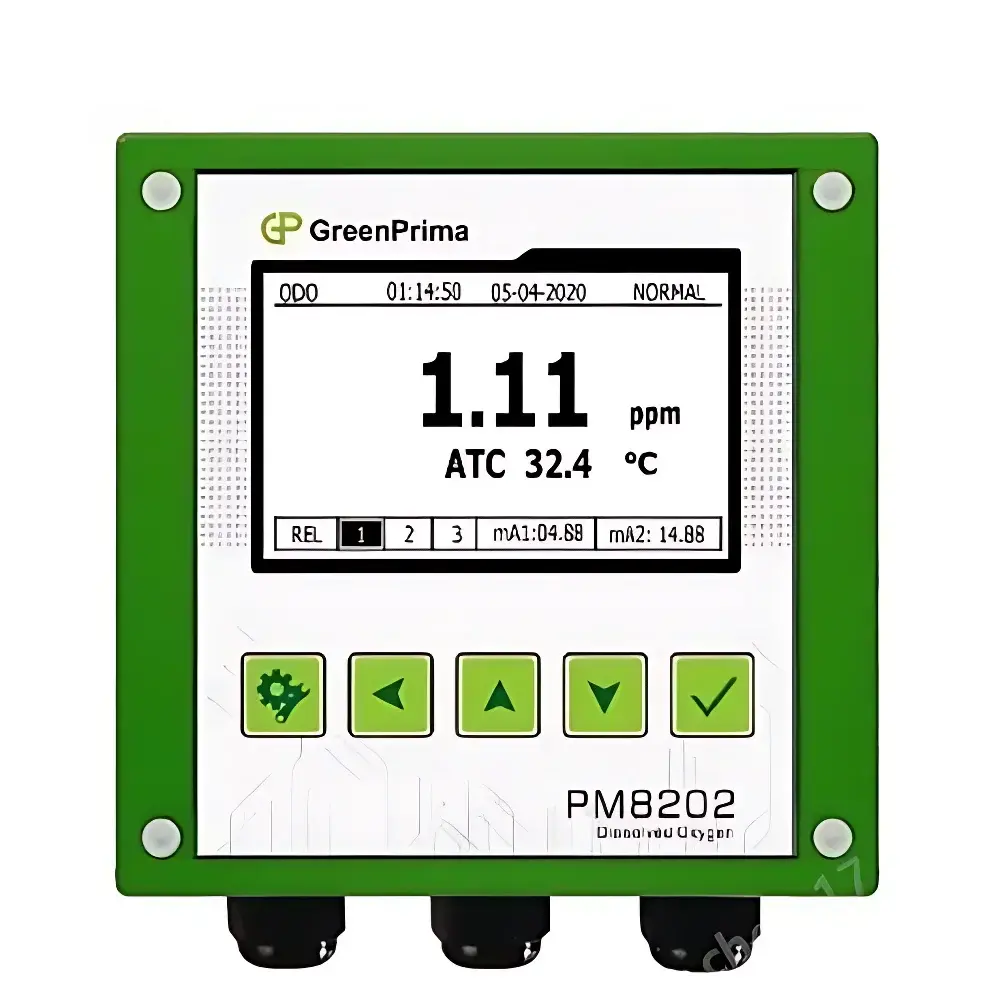
GreenPrima PM8202D Polarographic Dissolved Oxygen Analyzer for Pharmaceutical Applications
| Brand | GreenPrima |
|---|---|
| Origin | United Kingdom |
| Manufacturer Type | Original Equipment Manufacturer (OEM) |
| Product Category | Imported Instrument |
| Model | PM8202D |
| Instrument Type | Online Analyzer |
| Measurement Principle | Polarographic Electrochemical Sensor (Clark-type) |
| Measurement Range | 0.00–20.00 ppm / 0.00–200.00 ppb |
| Accuracy | ±0.02 ppm / ±0.02 ppb |
| Resolution | 0.001 ppm / 0.01 ppb |
| Temperature Compensation | -10 to 130 °C (manual or automatic, NTC10K/PT1000 selectable) |
| Operating Temperature | -10 to 70.0 °C |
| Storage Temperature | -20 to 70.0 °C |
| Display | Backlit large-dot-matrix LCD (bilingual: English/Chinese) |
| Data Storage | 600,000 records |
| Power Supply | 90–260 VAC, 50/60 Hz or optional 24 VDC |
| Analog Outputs | Two isolated 4–20 mA outputs (max. loop resistance 500 Ω, accuracy 0.1% FS, configurable for DO or temperature) |
| Communication | RS485 Modbus RTU |
| Cleaning Control | Adjustable cleaning interval (0.1–1000 h) and duration (1–1000 s) |
| Alarm Outputs | Two independent Hi/Lo relay outputs (5 A / 250 VAC / 30 VDC), with hysteresis setting |
| Enclosure Rating | IP65 |
| Mounting Options | Wall-mounted, panel-mounted, or in-line pipe installation |
| Dimensions (H×W×D) | 144 × 144 × 108 mm |
| Panel Cutout | 138 × 138 mm |
| Weight | 0.87 kg |
Overview
The GreenPrima PM8202D is an online polarographic dissolved oxygen (DO) analyzer engineered for continuous, high-stability measurement in regulated pharmaceutical water systems—including purified water (PW), water for injection (WFI), and clean steam condensate. It operates on the Clark-type polarographic principle: molecular oxygen diffuses through a gas-permeable membrane into an electrolyte-filled electrochemical cell, where it undergoes reduction at a cathode (typically gold or platinum) under a fixed polarizing voltage (e.g., −0.65 V vs. Ag/AgCl). The resulting diffusion-limited current is linearly proportional to the partial pressure of dissolved O₂, enabling quantitative determination across trace-level (ppb) to process-relevant (ppm) concentration ranges. Unlike optical (luminescence-based) sensors, polarographic sensors provide proven long-term stability in low-conductivity, low-organic-content pharmaceutical waters—where fouling resistance and calibration drift minimization are critical for GMP compliance.
Key Features
- Robust IP65-rated enclosure with full hermetic sealing—designed for humid, washdown-intensive environments common in pharmaceutical manufacturing suites and utility corridors.
- Dual-range measurement capability: 0.00–20.00 ppm (for bulk process streams) and 0.00–200.00 ppb (for WFI and sterile condensate monitoring), both with 0.001 ppm / 0.01 ppb resolution and ±0.02 ppm / ±0.02 ppb accuracy.
- Configurable temperature compensation using either NTC10K or PT1000 sensors, supporting operation from −10 °C to 130 °C—enabling integration upstream and downstream of heat exchangers and distillation units.
- Two fully isolated 4–20 mA analog outputs, independently assignable to DO concentration or temperature—compatible with DCS, SCADA, and PLC systems per IEC 61000-6-2/4 EMC standards.
- RS485 Modbus RTU interface for bidirectional communication, supporting remote configuration, real-time data polling, and firmware updates without physical access.
- Programmable cleaning control logic—user-defined cleaning intervals (0.1–1000 hours) and durations (1–1000 seconds)—to maintain sensor performance in low-flow or stagnant utility loops.
- Two independent relay outputs with adjustable hysteresis, rated for 5 A resistive load at 250 VAC or 30 VDC—suitable for triggering alarms, shutdown interlocks, or pump activation in accordance with ISA-84 SIS requirements.
Sample Compatibility & Compliance
The PM8202D is validated for use in non-sterile and sterile pharmaceutical water systems compliant with USP , EP 2.2.43, and JP 2.07. Its polarographic sensor design—paired with durable, low-fouling polytetrafluoroethylene (PTFE) or silicone membranes—exhibits minimal drift in ultrapure water matrices (<1 µS/cm conductivity) and resists interference from residual chlorine, hydrogen peroxide, or ozone used during system sanitization. The analyzer supports audit-ready operation under FDA 21 CFR Part 11 when integrated with compliant SCADA platforms: electronic signatures, change logs, and user-access controls (password-protected configuration menus) are implemented at the controller level. All materials in wetted contact—including sensor body, membrane cap, and electrolyte formulation—meet USP Class VI biocompatibility and EP 3.1.3 extractables requirements.
Software & Data Management
The embedded firmware provides local data logging of up to 600,000 timestamped records—including DO value, temperature, sensor status (e.g., membrane integrity flag), and calibration history—with automatic time stamping synchronized to NTP-enabled controllers. Data export is supported via Modbus register mapping for integration into LIMS or MES platforms. Calibration procedures follow ASTM D888-22 guidelines for dissolved oxygen in water: zero-point verification using sodium sulfite solution and span adjustment with air-saturated water or certified gas standards. Full calibration logs—including date, operator ID, reference values, and deviation metrics—are retained and exportable to support annual instrument qualification (IQ/OQ/PQ) documentation.
Applications
- Real-time monitoring of dissolved oxygen in Water for Injection (WFI) storage and distribution loops to prevent microbial proliferation and ensure compliance with pharmacopoeial limits (e.g., USP recommends ≤10 ppb for WFI).
- Post-purification verification in multiple-effect stills and vapor compression stills, where residual O₂ can accelerate corrosion of stainless-steel piping and promote endotoxin release.
- Monitoring of clean steam condensate quality prior to point-of-use sterilization cycles—critical for validating sterility assurance levels (SAL) in autoclaves and SIP systems.
- Process water surveillance in fermentation media preparation and bioreactor feed lines, where sub-ppm DO control directly impacts cell viability and product titer.
- Continuous verification of nitrogen sparging efficiency in API synthesis reactors and solvent recovery tanks.
FAQ
What maintenance is required for the polarographic sensor?
Electrolyte replenishment and membrane replacement are recommended every 3–6 months under continuous operation, depending on water purity and temperature. GreenPrima supplies OEM-certified electrolyte (KCl-based, pH-buffered) and PTFE membranes calibrated for reproducible response times (<60 s T₉₀).
Can the PM8202D be validated for GMP use?
Yes—the device supports IQ/OQ execution per Annex 15 and includes factory-provided calibration certificates traceable to NIST standards. Optional validation kits include documented test protocols, blank templates for deviation reporting, and raw data files for statistical analysis (e.g., RSD, linearity, repeatability).
Does it support automatic temperature compensation in low-conductivity water?
Yes—automatic compensation uses either built-in NTC10K or external PT1000 probes, with algorithmic correction for solubility changes across the full −10 °C to 130 °C range, validated per ISO 5814:2012.
How is sensor drift managed during extended unattended operation?
The controller performs periodic self-diagnostics—including cathode polarization stability checks and membrane impedance monitoring—and triggers maintenance alerts before measurement uncertainty exceeds ±0.05 ppm, ensuring uninterrupted compliance with ALCOA+ data integrity principles.







