
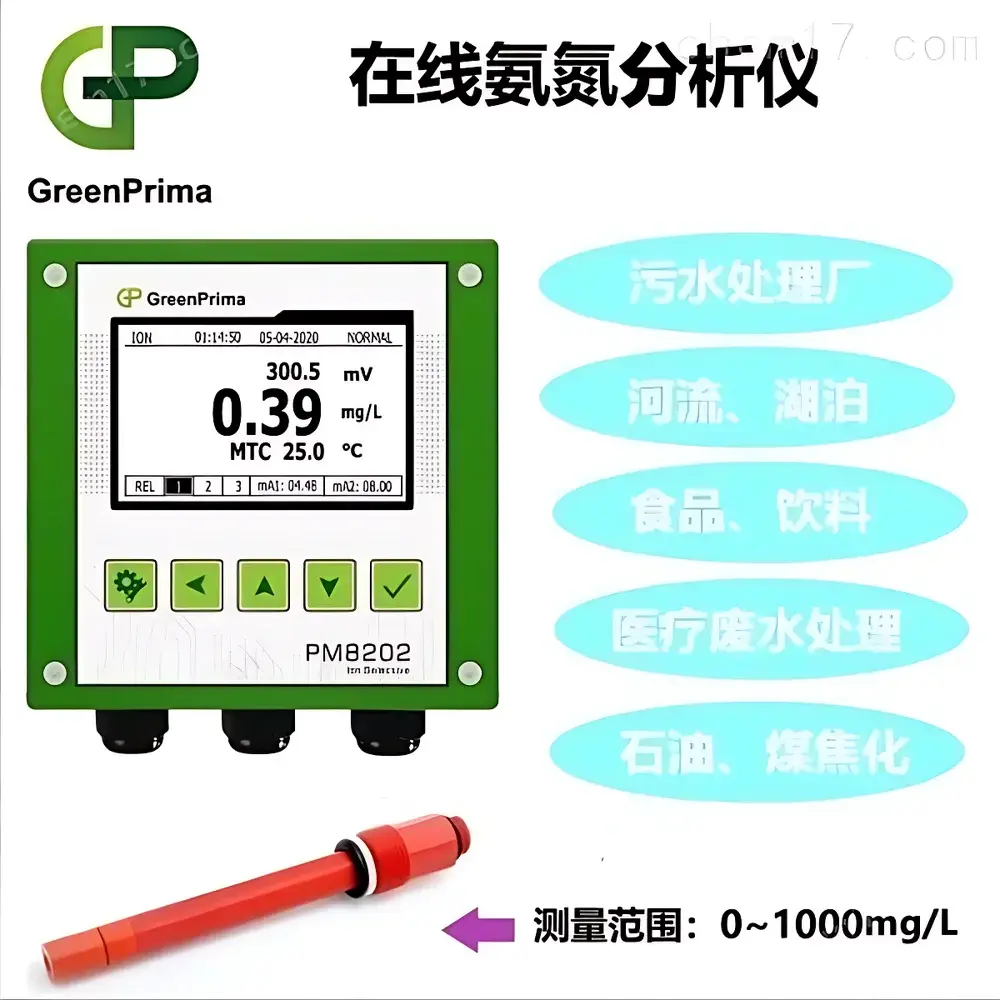
GreenPrima PM8202I Online Ammonia Nitrogen Analyzer
| Brand | GreenPrima |
|---|---|
| Origin | UK |
| Manufacturer Type | Manufacturer |
| Origin Category | Imported |
| Model | PM8202I |
| Instrument Type | Online |
| Measurement Principle | Ion-Selective Electrode (ISE) Method |
| Measurement Range | 0.00–20,000 ppm |
| Accuracy | ±0.01 / ±0.1 / ±1 ppm (dependent on range) |
| Resolution | 0.01 / 0.1 / 1 ppm |
| Temperature Compensation | -10 to 130 °C (manual/automatic |
| Operating Temperature | -10 to 70.0 °C |
| Storage Temperature | -20 to 70.0 °C |
| Display | Backlit large-dot-matrix LCD |
| Languages | English & Chinese |
| Data Storage | 600,000 records |
| Power Supply | 90–260 VAC, 50/60 Hz or optional 24 VDC |
| Output | Two isolated 4–20 mA outputs (max. loop resistance 500 Ω, accuracy 0.1% F.S.) |
| Communication | RS485 Modbus RTU |
| Cleaning Cycle | Adjustable from 0.1 to 1000 h |
| Alarm Outputs | Two independent Hi/Lo relay outputs (5 A / 250 VAC / 30 VDC) with hysteresis setting |
| Enclosure Rating | IP65 |
| Mounting Options | Wall-mounted, pipe-mounted, panel-mounted |
| Dimensions (H×W×D) | 144 × 144 × 108 mm |
| Panel Cutout | 138 × 138 mm |
| Weight | 0.87 kg |
Overview
The GreenPrima PM8202I Online Ammonia Nitrogen Analyzer is an industrial-grade, continuous-monitoring instrument engineered for reliable quantification of ammonia nitrogen (NH₃-N) in aqueous matrices using the ion-selective electrode (ISE) principle. Unlike optical or colorimetric methods, the ISE-based approach provides direct electrochemical detection of ammonium ions (NH₄⁺) in solution, enabling real-time measurement without reagent consumption or optical path fouling. The system comprises a robust controller unit and the Bsens730 ammonia-selective electrode — a solid-state, membrane-based sensor optimized for long-term stability in variable pH and ionic strength environments. Designed for unattended operation in municipal water supply networks, wastewater treatment plants, and process-critical industrial effluent streams, the PM8202I delivers stable output across a wide dynamic range (0.00–20,000 ppm NH₃-N), with selectable resolution and accuracy tiers calibrated to application-specific regulatory requirements.
Key Features
- IP65-rated, fully sealed enclosure with corrosion-resistant housing — suitable for outdoor installation and high-humidity industrial environments.
- Large backlit dot-matrix LCD display showing real-time NH₃-N concentration, temperature, timestamp, relay status, and system diagnostics.
- Dual-language (English/Chinese) menu interface with intuitive navigation — no specialized training required for routine calibration or maintenance.
- Two isolated 4–20 mA analog outputs configurable for NH₃-N concentration and/or temperature signals, compliant with standard PLC/SCADA integration protocols.
- RS485 Modbus RTU communication port supporting multi-device daisy-chaining and remote parameter configuration via host software or HMI.
- Programmable automatic electrode cleaning cycle — adjustable interval (0.1–1000 hours) and duration (1–1000 seconds) to mitigate biofouling and maintain signal fidelity.
- Two independent relay outputs with user-defined high/low alarm thresholds and adjustable hysteresis — compatible with emergency shutdown systems and audible/visual alert devices.
- Password-protected configuration mode prevents unauthorized changes to calibration constants, alarm logic, or communication settings — essential for ISO/IEC 17025 and GLP-aligned operations.
Sample Compatibility & Compliance
The PM8202I is validated for use in potable water, activated sludge effluent, industrial cooling water, and low-turbidity process streams. It accommodates moderate suspended solids (<50 mg/L) and operates reliably within pH 4.0–9.5 — outside this range, sample conditioning (e.g., pH adjustment or dilution) may be necessary to ensure accurate ISE response. While not a photometric method, its electrochemical architecture avoids interference from colored or turbid samples that commonly compromise spectrophotometric ammonia analyzers. The instrument meets CE marking requirements for electromagnetic compatibility (EMC Directive 2014/30/EU) and low-voltage safety (LVD Directive 2014/35/EU). Its data logging capability (600,000 records with timestamps) supports audit-ready traceability per EPA Method 350.1 and ISO 7888:2012 guidelines for ammonia determination in water.
Software & Data Management
Data integrity is maintained through non-volatile memory storage with time-stamped records (date, time, NH₃-N value, temperature, electrode mV reading, and calibration status). Optional PC-based configuration software enables firmware updates, historical trend export (CSV), and batch calibration report generation. The Modbus RTU protocol ensures seamless integration into existing DCS or environmental monitoring platforms. For regulated environments, the system supports manual calibration logs and operator ID tagging — consistent with FDA 21 CFR Part 11 principles when paired with secure network authentication and audit trail documentation practices.
Applications
- Real-time monitoring of ammonia breakthrough in granular activated carbon (GAC) or ion exchange units within drinking water treatment plants.
- Process control of nitrification/denitrification stages in biological nutrient removal (BNR) systems at municipal wastewater facilities.
- Effluent compliance verification for industries subject to discharge limits under EU Urban Wastewater Treatment Directive (91/271/EEC) or US Clean Water Act NPDES permits.
- Ammonia accumulation detection in recirculating aquaculture systems (RAS) and pharmaceutical clean-in-place (CIP) rinse validation loops.
- Leak detection in ammonia-based refrigeration systems where trace aqueous condensate analysis is required.
FAQ
What calibration frequency is recommended for optimal accuracy?
Daily single-point calibration is advised for critical applications; weekly two-point calibration (using 10 ppm and 1000 ppm standards) is sufficient for stable influent monitoring.
Can the Bsens730 electrode measure total ammonia (NH₃ + NH₄⁺) or only ammonium ion?
The electrode responds selectively to NH₄⁺; however, the controller applies temperature- and pH-compensated conversion to report total ammonia nitrogen (TAN) as NH₃-N, per standard practice in environmental reporting.
Is the PM8202I compatible with third-party SCADA systems?
Yes — via RS485 Modbus RTU, it integrates natively with Siemens Desigo, Schneider EcoStruxure, Honeywell Experion, and most open-architecture control platforms.
Does the analyzer require reagents or consumables beyond the electrode?
No — unlike colorimetric analyzers, the ISE method eliminates reagent dependency, reducing operational cost and waste disposal obligations.
How is temperature compensation implemented?
Automatic compensation uses either integrated NTC30K or external PT1000 sensors, applying the thermodynamic Nernst equation correction across –10 to 130 °C.







