
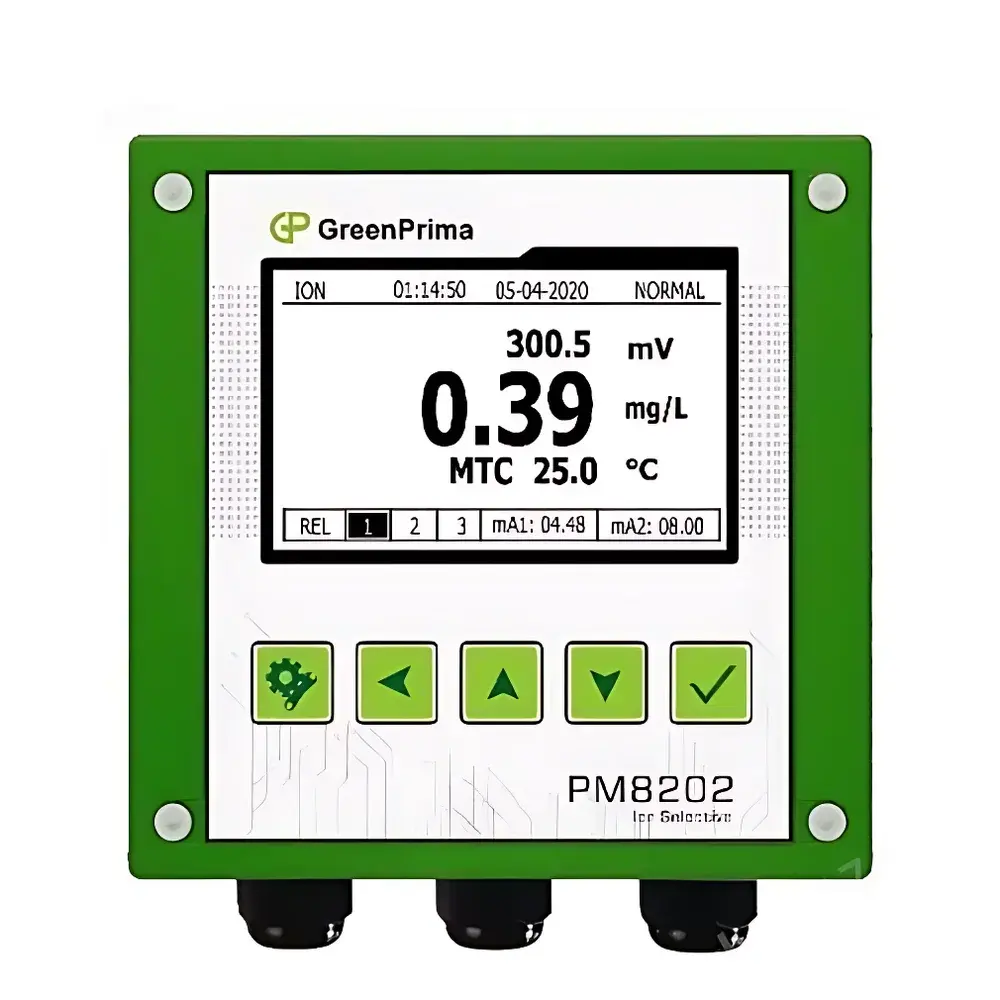
GreenPrima PM8202I Online Ammonia Nitrogen Analyzer
| Brand | GreenPrima |
|---|---|
| Origin | United Kingdom |
| Manufacturer Type | Original Equipment Manufacturer (OEM) |
| Product Category | Imported Instrument |
| Model | PM8202I |
| Instrument Type | Online Analyzer |
| Measurement Principle | Selective Ion Electrode (ISE) with Integrated Temperature Compensation |
| Measurement Range | 0.00–20,000 ppm (as NH₃-N) |
| Resolution | 0.01 / 0.1 / 1 ppm (user-selectable) |
| Accuracy | ±0.01 / ±0.1 / ±1 ppm (dependent on range) |
| Temperature Compensation | -10 to 130 °C (manual/automatic |
| Operating Temperature | 0–70.0 °C |
| Storage Temperature | -20 to 70.0 °C |
| Display | Backlit large-dot-matrix LCD |
| Language Support | English and Chinese menus |
| Data Storage Capacity | 600,000 records |
| Power Supply | 90–260 VAC, 50/60 Hz |
| Ingress Protection | IP65 |
| Communication Interface | RS485, MODBUS-RTU compliant |
| Analog Outputs | Two isolated 4–20 mA outputs (max. loop resistance 500 Ω, accuracy ±0.1% F.S.) |
| Cleaning Control | Adjustable cleaning interval (0.1–1000 h) and duration (1–1000 s) |
| Mounting Options | Wall-mount, pole-mount, panel-mount |
| Sensor Model | Bsen730 |
| Sensor Range | 0–1000 mg/L NH₃-N |
| Sensor Resolution | 0.01 mg/L |
| Sensor Accuracy | ±5% F.S. |
| Sensor Body Material | Polyphenylsulfone (PPS) |
| Sensor Operating Temperature | -5 to 70.0 °C |
| Maximum Pressure Rating | 3.5 bar |
| Connection Type | Fixed threaded |
| Thread Size | PG13.5 |
| Cable Length | 5 m |
Overview
The GreenPrima PM8202I Online Ammonia Nitrogen Analyzer is an industrial-grade, continuous-monitoring instrument engineered for real-time quantification of ammonia nitrogen (NH₃-N) in aqueous matrices—including raw water, wastewater effluent, drinking water distribution systems, and process streams in municipal and industrial treatment plants. It operates on the principle of selective ion electrode (ISE) potentiometry, utilizing a solid-state ammonium-selective membrane electrode (Bsen730) that delivers stable, interference-resistant response across a wide dynamic range. The analyzer integrates temperature-compensated signal conditioning, automatic self-diagnostic routines, and programmable electrochemical cleaning cycles—enabling long-term unattended operation with minimal drift. Its dual-range measurement capability (0.00–20,000 ppm as NH₃-N at controller level; 0–1000 mg/L at sensor level) supports both trace-level compliance monitoring and high-concentration process control applications.
Key Features
- Robust ISE-based sensing architecture with PPS-bodied Bsen730 electrode—chemically inert, pressure-rated up to 3.5 bar, and validated for continuous immersion in aggressive wastewater environments.
- Intelligent auto-calibration and self-diagnostics including electrode potential drift detection, reference junction status monitoring, and cleaning cycle verification.
- Programmable pneumatic or chemical cleaning sequence with independently adjustable interval (0.1–1000 hours) and duration (1–1000 seconds), minimizing biofouling and extending maintenance intervals.
- High-resolution backlit dot-matrix LCD with dual-language (English/Chinese) interface and intuitive menu navigation—designed for field technicians and plant operators without specialized instrumentation training.
- Dual isolated 4–20 mA analog outputs with full-scale accuracy of ±0.1%, supporting integration into DCS, SCADA, or PLC-based control systems without external signal conditioning.
- RS485 serial interface compliant with MODBUS-RTU protocol—enabling bidirectional communication for remote configuration, data retrieval, and firmware updates via standard industrial networks.
- IP65-rated enclosure with wall, pole, and panel mounting options—suitable for indoor control rooms or outdoor cabinet installations in humid, dusty, or chemically exposed environments.
Sample Compatibility & Compliance
The PM8202I is validated for use in municipal wastewater influent/effluent, activated sludge return lines, anaerobic digester supernatant, surface water intakes, and industrial cooling water circuits. It complies with core regulatory expectations for continuous emission monitoring systems (CEMS) under EU Directive 2000/60/EC (Water Framework Directive) and U.S. EPA Method 350.1 (ammonia nitrogen by ion-selective electrode). While not certified to ISO 5667-3 or ASTM D1426 directly (which pertain to laboratory grab-sample analysis), its performance characteristics—including ±5% F.S. electrode accuracy, <2% inter-day repeatability, and <0.5% zero drift over 72-hour periods—meet typical site-specific QA/QC requirements for online compliance reporting. Data integrity is reinforced through timestamped storage of 600,000 readings with embedded temperature and calibration metadata—supporting GLP-aligned recordkeeping practices.
Software & Data Management
Data logging is performed internally with non-volatile flash memory, retaining all measurements, calibration events, cleaning logs, and diagnostic flags with millisecond-level timestamps. Export is supported via MODBUS register polling or optional USB-to-serial adapter for CSV dump. The system does not include proprietary cloud software but provides full register mapping documentation for third-party SCADA integration. Audit trails are maintained per record, including operator ID (if configured via external authentication), calibration standard values, and electrode slope diagnostics—facilitating FDA 21 CFR Part 11 readiness when deployed with compliant access controls and electronic signature workflows.
Applications
- Real-time ammonia breakthrough detection in nitrification/denitrification basins to optimize aeration energy consumption.
- Effluent compliance monitoring at wastewater treatment plant outfalls per local discharge permits (e.g., ≤1.0 mg/L NH₃-N).
- Process control of ammoniacal nitrogen in aquaculture recirculating systems to prevent fish toxicity.
- Monitoring ammonia slip across tertiary denitrification filters or ion exchange units.
- Early warning of septic conditions in combined sewer overflows (CSOs) or pump station wet wells.
- Validation support for biological nutrient removal (BNR) model calibration and adaptive control algorithms.
FAQ
What measurement principle does the PM8202I employ?
It uses potentiometric detection via a solid-state ammonium-selective ion electrode (ISE), with integrated temperature compensation using either NTC10K or PT1000 sensors.
Is the Bsen730 electrode suitable for high-solids or abrasive wastewater?
Yes—the PPS housing and fixed-thread PG13.5 connection provide mechanical durability and chemical resistance; however, upstream filtration or vortex sampling is recommended where suspended solids exceed 100 mg/L.
Can the analyzer operate on 24 VDC power?
Yes—24 VDC is available as an optional power input, making it compatible with solar-powered telemetry stations or explosion-proof enclosures requiring intrinsically safe supply.
How frequently must the electrode be calibrated?
Initial two-point calibration is required at installation; subsequent verification frequency depends on application severity—typically every 7–30 days in stable municipal effluent, or daily in high-fouling industrial streams.
Does the system support MODBUS TCP or only MODBUS RTU?
The standard interface is RS485 MODBUS-RTU; MODBUS TCP requires an external protocol converter or gateway device.







