
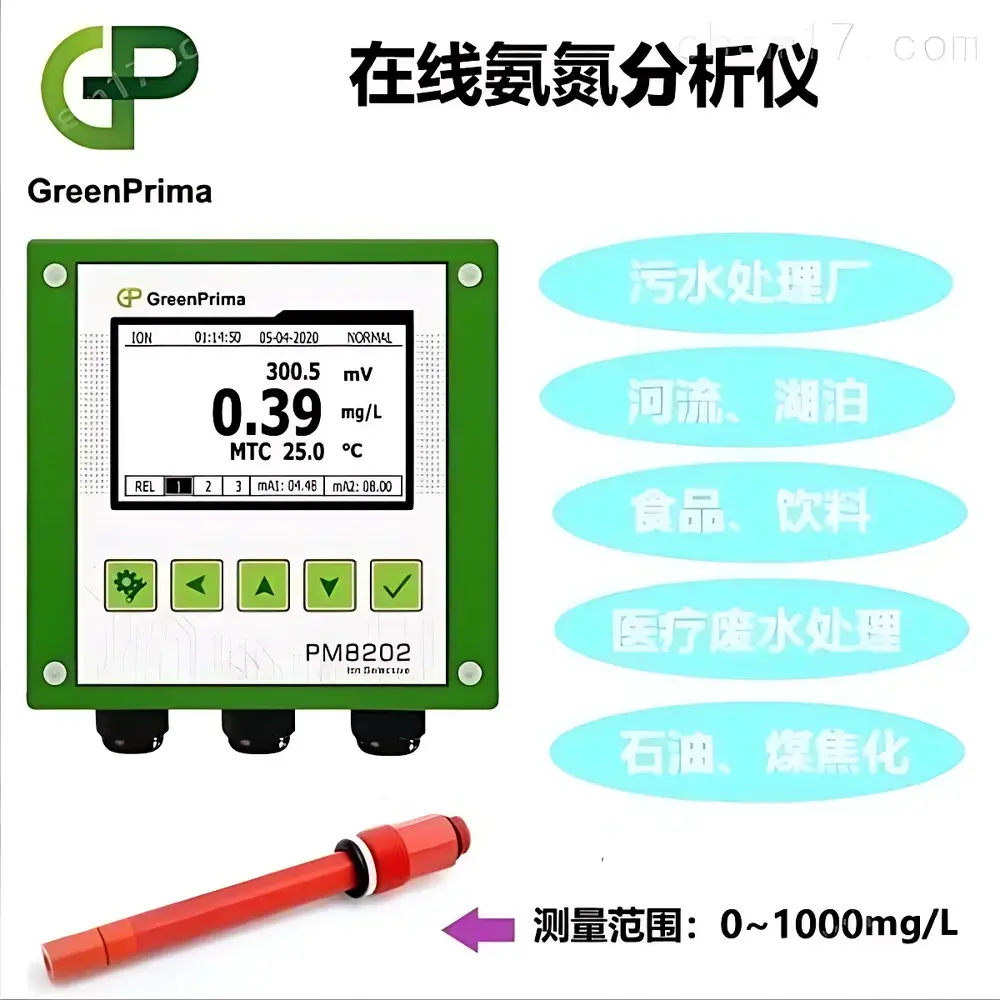
GreenPrima PM8202I Online Ammonia Nitrogen Analyzer
| Brand | GreenPrima |
|---|---|
| Origin | UK |
| Manufacturer Type | Manufacturer |
| Origin Category | Imported |
| Model | PM8202I |
| Instrument Type | Online |
| Measurement Principle | Ion-Selective Electrode (ISE) Method |
| Measurement Range | 0.00–20,000 ppm |
| Resolution | 0.0 / 0.1 / 1 ppm |
| Accuracy | ±0.01 / ±0.1 / ±1 ppm |
| Temperature Compensation | –10 to 130 °C (manual/automatic |
| Operating Temperature | –10 to 70.0 °C |
| Storage Temperature | –20 to 70.0 °C |
| Display | Backlit large-dot-matrix LCD |
| Language | Chinese/English |
| Data Storage | 600,000 records |
| Power Supply | 90–260 VAC, 50/60 Hz or optional 24 VDC |
| Analog Outputs | Two isolated 4–20 mA outputs (max. loop resistance 500 Ω, accuracy 0.1% FS, configurable for concentration or temperature) |
| Communication | RS485 Modbus RTU |
| Cleaning Output | Adjustable cleaning interval (0.1–1000 h) and duration (1–1000 s) |
| Alarm Outputs | Two independent Hi/Lo relay alarms (5 A / 250 VAC / 30 VDC, with hysteresis setting) |
| Mounting Options | Wall-mounted, pipe-mounted, panel-mounted |
| Enclosure Rating | IP65 |
| Dimensions (H×W×D) | 144 × 144 × 108 mm |
| Panel Cutout | 138 × 138 mm |
| Weight | 0.87 kg |
Overview
The GreenPrima PM8202I Online Ammonia Nitrogen Analyzer is an industrial-grade, continuous-monitoring instrument engineered for real-time quantification of ammonia nitrogen (NH₃-N) in aqueous matrices using the ion-selective electrode (ISE) principle. Unlike colorimetric or photometric methods, the ISE-based measurement relies on the potentiometric response of a selectively permeable membrane to ammonium ions (NH₄⁺) under controlled pH conditions—typically achieved via inline pH adjustment or buffer addition upstream. This electrochemical approach delivers rapid response times (< 60 s), minimal reagent consumption, and stable operation across wide dynamic ranges—making it especially suitable for unattended deployment in municipal water treatment plants, wastewater effluent streams, cooling tower circuits, and process water loops where regulatory compliance (e.g., EU Urban Wastewater Treatment Directive, US EPA Method 350.1) mandates frequent or continuous NH₃-N verification.
Key Features
- Robust IP65-rated enclosure with fully sealed, gas-tight housing—designed for humid, corrosive, or splash-prone environments typical of pump stations and outdoor metering kiosks.
- Intuitive dual-language (English/Chinese) interface on a backlit dot-matrix LCD—supporting real-time display of NH₃-N concentration, measured temperature, system time, and relay status without menu navigation overhead.
- High-resolution data logging: internal non-volatile memory stores up to 600,000 timestamped records—including concentration values, temperature readings, calibration timestamps, and alarm events—for traceability and audit readiness.
- Flexible analog and digital connectivity: two isolated 4–20 mA outputs (configurable per channel for NH₃-N or temperature) and RS485 Modbus RTU protocol enable seamless integration into SCADA, DCS, or PLC-based control infrastructures.
- Programmable maintenance automation: scheduled electrode cleaning cycles (interval: 0.1–1000 hours; duration: 1–1000 seconds) reduce manual intervention while preserving electrode surface integrity and measurement reproducibility.
- Security-conscious operation: password-protected configuration mode prevents unauthorized parameter changes—a requirement aligned with GLP and ISO/IEC 17025 documentation integrity standards.
Sample Compatibility & Compliance
The PM8202I is validated for use in clarified, low-turbidity water samples with suspended solids < 50 mg/L and chloride concentrations < 5,000 ppm to avoid interference from competing ions. It complies with fundamental performance criteria outlined in ISO 7888 (water quality — determination of ammonium — ion-selective electrode method) and supports adherence to operational limits defined by national discharge permits (e.g., China’s GB 3838–2002 Class IV/V, US Clean Water Act NPDES monitoring requirements). Optional NTC30K or PT1000 temperature sensors ensure accurate automatic temperature compensation across the full operating range (–10 to 70 °C ambient), critical for maintaining ISE Nernstian slope stability.
Software & Data Management
Data export is supported via USB mass storage emulation or Modbus polling—enabling direct ingestion into LIMS or historian platforms such as OSIsoft PI or Ignition SCADA. All stored records include UTC timestamps, measurement units, sensor ID, and calibration metadata. The device maintains a full audit trail of configuration changes and calibration events—consistent with FDA 21 CFR Part 11 expectations for electronic records when deployed in regulated utilities or pharmaceutical water systems. Firmware updates are performed via secure offline binary upload, eliminating remote access vulnerabilities.
Applications
- Continuous monitoring of influent and effluent ammonia levels at municipal wastewater treatment plants (WWTPs) for nitrification/denitrification process control.
- Real-time tracking of NH₃-N breakthrough in activated carbon or ion exchange polishing stages of drinking water production.
- Surveillance of recirculating cooling water systems to prevent microbiologically influenced corrosion (MIC) linked to elevated ammonia.
- Compliance reporting for industrial dischargers subject to ammonia limits under local environmental permits (e.g., UK EA, German LAWA, or Singapore PUB guidelines).
- Integration into smart water networks for predictive maintenance alerts based on trend analysis of long-term NH₃-N drift.
FAQ
What sample pretreatment is required prior to analysis?
No filtration or chemical digestion is needed. However, pH must be maintained above 10.5 (typically via inline NaOH dosing) to convert NH₄⁺ to volatile NH₃, enabling selective detection by the gas-permeable membrane electrode.
How often does the Bsens730 ammonia electrode require calibration?
Initial two-point calibration is recommended at installation; subsequent verification intervals depend on application severity—typically every 7–30 days for clean water, or daily in high-fouling industrial effluents.
Can the PM8202I measure other ions besides ammonia nitrogen?
The analyzer hardware supports interchangeable ISE modules; with appropriate electrode and firmware configuration, it can be adapted for chloride or fluoride monitoring—but each requires dedicated sensor and calibration protocol.
Is the device compatible with hazardous area classifications?
The standard PM8202I is rated for general-purpose industrial use (IP65). For Zone 1/2 or Class I Div 1 environments, an ATEX/IECEx-certified variant with intrinsic safety barriers must be specified at order stage.
Does the unit support remote diagnostics or cloud connectivity?
Native cloud integration is not embedded; however, third-party IoT gateways (e.g., Siemens Desigo CC, Bently Nevada System 1) can collect Modbus data for remote visualization and alerting via MQTT or HTTPS APIs.
Related Products







