
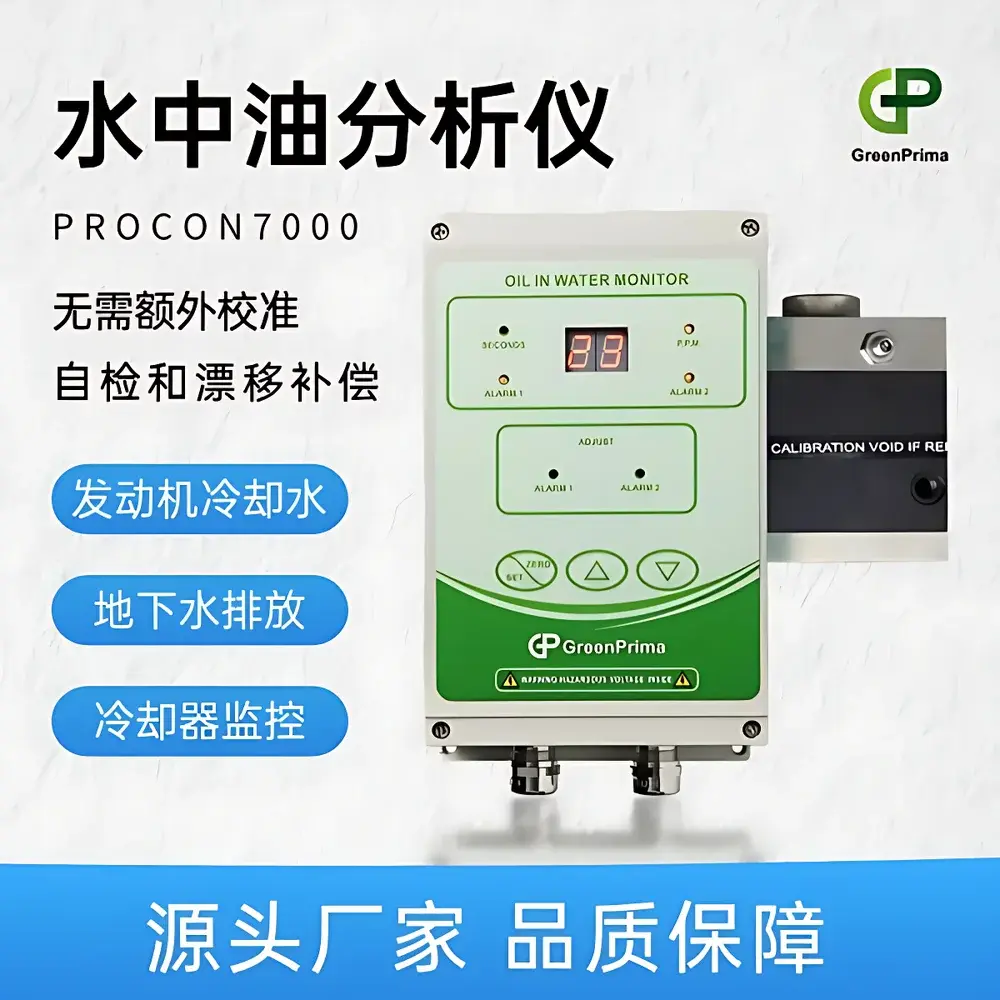
GreenPrima PROC ON7000 Online Oil-in-Water Analyzer
| Brand | GreenPrima |
|---|---|
| Origin | United Kingdom |
| Manufacturer Type | Manufacturer |
| Origin Category | Imported |
| Model | PROC ON7000 |
| Instrument Type | Online |
| Measurement Principle | Fluorescence-based Detection (Non-Extractive, UV-Excited) |
| Measurement Range | 0–99 ppm |
| Accuracy | ±2 ppm |
| Alarm Setpoint Range | 1–98 ppm (adjustable) |
| Alarm Delay 1 | 0–60 s (adjustable) |
| Alarm Delay 2 | 10–240 s (adjustable) |
| Display | 240×128 pixel touchscreen |
| Analog Outputs | 0/4–20 mA (min. load 820 Ω), 0–5 V / 1–5 V DC (min. load 50 kΩ) |
| Sample Flow Rate | 0.1–2 L/min |
| Sample Temperature | 1–40 °C |
| Sample Pressure | 0.1–10 bar |
| Ambient Operating Temperature | 1–60 °C |
| Relative Humidity | ≤90% RH at 55 °C |
| Enclosure Rating | IP55 |
| Electrical Safety | EN 61010-1 / IEC 61000-6-2, Overvoltage Category II |
| Power Supply | 230 V / 115 V AC or 24 V AC |
| Power Consumption | ≤10 VA |
| Weight | 2.25 kg |
| Dimensions (H×W×D) | 215 × 242 × 73 mm |
Overview
The GreenPrima PROC ON7000 Online Oil-in-Water Analyzer is an industrial-grade, continuous monitoring instrument engineered for real-time detection and quantification of hydrocarbon contamination in aqueous process streams. It employs a robust, non-extractive fluorescence detection principle: oil compounds—particularly aromatic hydrocarbons such as benzene, toluene, xylene, and polycyclic aromatic hydrocarbons (PAHs)—are excited by ultraviolet light (typically 254 nm or 280 nm), and the resulting native fluorescence intensity is measured at characteristic emission wavelengths (e.g., 320–400 nm). This method eliminates solvent extraction, reagent consumption, and sample pre-treatment, delivering rapid, interference-resistant measurements with high specificity for free and dispersed oil phases. Designed for integration into closed-loop cooling water systems, boiler condensate return lines, and wastewater effluent channels, the PROC ON7000 operates reliably under variable flow, pressure, and temperature conditions typical of power generation, petrochemical refining, and marine engine applications.
Key Features
- True online operation with continuous, unattended measurement—no manual sampling or lab turnaround required.
- Integrated self-diagnostic routine and automatic zero drift compensation ensure long-term stability without periodic recalibration.
- Configurable dual-stage alarm logic with independently adjustable setpoints and time-delayed activation (0–60 s for Alarm 1; 10–240 s for Alarm 2) to suppress transient spikes and confirm persistent exceedances.
- Intuitive 240×128-pixel resistive touchscreen interface with multilingual support (English, German, French, Spanish) and context-sensitive soft keys.
- Programmable analog outputs (0/4–20 mA, 0–5 V, 1–5 V DC) compliant with standard DCS/PLC input specifications and minimum load requirements.
- IP55-rated enclosure suitable for indoor industrial environments; optional IP65 external terminal block kit available for field-mounted relay and control signal interfacing.
- Flexible analysis interval—from continuous (1-second updates) to user-defined intervals up to 24 hours—optimized for data logging bandwidth and maintenance scheduling.
- External start/stop trigger capability via dry-contact input, enabling synchronization with pump cycles or maintenance windows.
- USB port (optional) supports firmware updates and local data export in CSV format for offline trend analysis and audit compliance.
Sample Compatibility & Compliance
The PROC ON7000 is validated for use with freshwater, demineralized water, glycol-diluted coolants, and low-salinity wastewater streams (TDS < 5,000 ppm). It is insensitive to common inorganic ions (Ca²⁺, Mg²⁺, Cl⁻, SO₄²⁻) and stable across pH 5.5–9.0. While not intended for emulsified or surfactant-stabilized oil-in-water systems (e.g., metalworking fluids), it reliably detects free-phase mineral oils, diesel, lubricating oils, and crude oil traces. The analyzer meets EN 61010-1 for electrical safety and EN 61326-1 for electromagnetic compatibility. Its measurement protocol aligns with ASTM D7622–19 (Standard Test Method for Determination of Oil Content in Water by Fluorescence) and supports GLP/GMP documentation workflows through timestamped event logs and configurable audit trails.
Software & Data Management
The embedded firmware includes a full-featured configuration manager accessible via touchscreen or optional USB-connected PC utility. All operational parameters—including calibration offset, alarm thresholds, output scaling, and sample interval—are stored in non-volatile memory with write-protection options. Event logs record every alarm activation, sensor fault, power cycle, and user-initiated action with ISO 8601 timestamps. For enterprise integration, the device supports Modbus RTU over RS-485 (optional module) and is compatible with SCADA historians (e.g., Siemens Desigo, Honeywell Experion, ABB Ability) using standard tag mapping. Data integrity complies with FDA 21 CFR Part 11 requirements when paired with validated third-party data acquisition software that enforces electronic signatures and audit trail retention.
Applications
- Monitoring lube oil leakage in shell-and-tube heat exchangers and lubricating oil coolers within gas turbine and steam turbine installations.
- Early detection of fuel oil ingress into engine jacket cooling water circuits aboard marine vessels and stationary diesel generators.
- Boiler feedwater and condensate return surveillance—especially where condensate coolers are installed to lower sample temperature prior to analysis.
- Effluent compliance monitoring at industrial outfalls, particularly for facilities subject to local discharge permits referencing EPA Method 1664 or ISO 9377-2.
- Groundwater remediation sites requiring continuous verification of oil skimmer or coalescer performance before discharge to municipal sewers.
FAQ
What measurement principle does the PROC ON7000 use, and why is it preferred for online monitoring?
It uses UV-induced fluorescence detection—a physical, reagent-free method that responds selectively to aromatic hydrocarbons in water. Unlike gravimetric or infrared methods, it requires no sample extraction, delivers sub-minute response times, and exhibits minimal fouling in low-turbidity streams.
Does the analyzer require regular calibration or consumables?
No routine calibration is required. The system performs automatic zero tracking and compensates for optical path degradation using internal reference LEDs. Only periodic visual inspection of the flow cell window is recommended.
Can the PROC ON7000 be installed in hazardous areas?
The base unit is rated for Zone 2/Class I Div 2 environments when installed with appropriate barrier systems. An ATEX-certified version (PROC ON7000-ATEX) is available upon request.
How is sample conditioning handled for high-temperature or high-pressure applications?
An inline thermostatic cooler (optional) reduces sample temperature to ≤40 °C; pressure is managed via integrated needle valve and back-pressure regulator—no external bypass loop needed.
Is the device compatible with existing plant asset management (PAM) systems?
Yes—via Modbus RTU or analog outputs, it integrates directly into Emerson DeltaV, Yokogawa CENTUM VP, and Rockwell FactoryTalk AssetCentre for predictive maintenance alerts and KPI dashboards.
Related Products







