
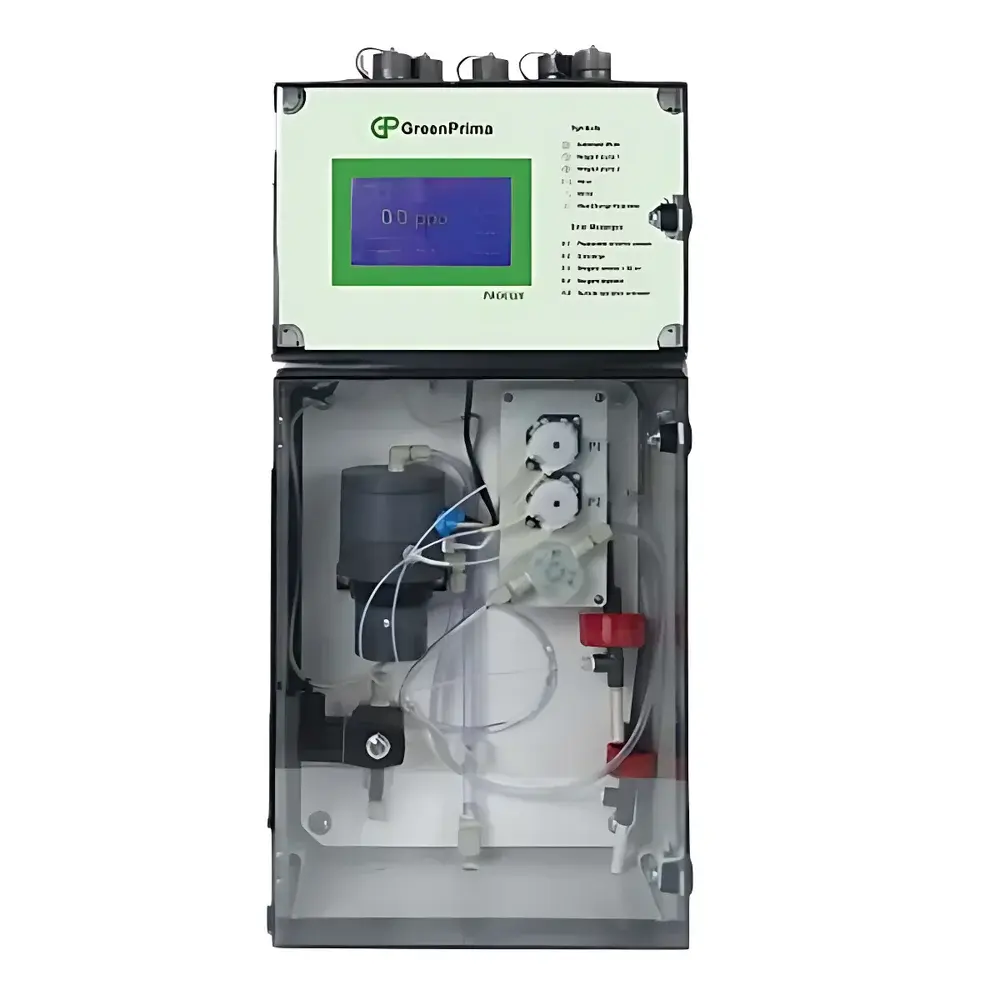
GreenPrima PROCON6000 Online Silicate Analyzer
| Brand | GreenPrima |
|---|---|
| Origin | United Kingdom |
| Manufacturer Type | Original Equipment Manufacturer (OEM) |
| Product Category | Imported Instrument |
| Model | PROCON6000 |
| Instrument Type | Online Analyzer |
| Measurement Principle | Photometric Determination of Soluble Silica via Molybdenum Blue Reduction Method |
| Measurement Ranges | 1–100 ppb, 4–999 ppb, 0.02–3 ppm SiO₂ |
| Resolution | 0.1 ppb / 1 ppb / 0.01 ppm |
| Accuracy | ±2% of full scale |
| Repeatability | ±0.5 ppb / ±4 ppb / ±0.02 ppm |
| Zero Stability | Auto-zero compensation |
| Analysis Cycle | 13 min (standard), adjustable from 1–99 min or externally triggered |
| Dimensions (H×W×D) | 640 × 315 × 190 mm |
| Display | 240 × 128 pixel monochrome touchscreen |
| Analog Output | 0/4–20 mA (max. load 500 Ω) |
| Digital Interface | USB data logging (optional) |
| Relay Outputs | 3× SPDT zero-potential relays (alarm, limit, analysis), rated 230 V AC / 3 A |
| Environmental Operating Range | 5–45 °C |
| Power Supply | 110–230 V AC, 50/60 Hz |
| Enclosure Rating | IP65 |
| Power Consumption | ~16 VA |
Overview
The GreenPrima PROCON6000 is a fully automated, online silicate analyzer engineered for continuous, high-precision measurement of dissolved silica (SiO₂) in ultra-pure water streams. It employs the standardized photometric molybdenum blue reduction method—compliant with ASTM D859 and ISO 10523—where soluble silicic acid reacts with ammonium molybdate under acidic conditions to form heteropoly-molybdosilicic acid, which is subsequently reduced to an intensely colored blue complex (β-silicomolybdate). The absorbance of this complex at 815 nm is linearly proportional to silica concentration across three user-selectable ranges. Designed specifically for critical thermal cycle monitoring, the PROCON6000 delivers trace-level detection (down to 0.1 ppb) without manual intervention, making it integral to steam purity assurance in fossil and nuclear power plants, as well as high-purity water systems in pharmaceutical, semiconductor, and fine chemical manufacturing.
Key Features
- Fully autonomous operation: integrated microprocessor controls sample aspiration, reagent dosing, reaction timing, optical measurement, and system flushing—eliminating need for operator-initiated calibration or maintenance between scheduled service intervals.
- Triple-range measurement architecture: configurable sensitivity settings (1–100 ppb, 4–999 ppb, 0.02–3 ppm SiO₂) ensure optimal signal-to-noise ratio across diverse process conditions—from condensate polishing to boiler feedwater monitoring.
- Intelligent zero-point stabilization: real-time baseline correction compensates for optical drift, particulate interference, and reagent aging, maintaining long-term measurement integrity without external reference standards.
- Industrial-grade human-machine interface: 240 × 128 pixel resistive touchscreen with intuitive icon-driven navigation, multilingual firmware support (English, German, French, Chinese), and context-sensitive help overlays.
- Configurable analog and digital I/O: isolated 4–20 mA output supports integration into DCS/SCADA systems with HART-compatible configuration; optional USB port enables local data export in CSV format for trend validation and audit readiness.
- Ruggedized enclosure: IP65-rated front panel and terminal compartment withstand humid, chemically aggressive environments typical of turbine halls and utility corridors.
Sample Compatibility & Compliance
The PROCON6000 accepts inlet water samples with conductivity < 1 µS/cm and suspended solids < 1 mg/L. It is validated for use with deionized, reverse-osmosis-treated, and mixed-bed polished water. All wetted components—including peristaltic pump tubing, flow cells, and reagent manifolds—are constructed from PFA, PTFE, and quartz to prevent leaching or adsorption artifacts. The analyzer conforms to IEC 61000-6-2 (EMC immunity) and IEC 61000-6-4 (EMC emissions), and its operational logic supports ALCOA+ data integrity principles. When configured with audit-trail-enabled firmware (v3.2+), it satisfies FDA 21 CFR Part 11 requirements for electronic records and signatures in GMP-regulated facilities.
Software & Data Management
Embedded firmware v4.1 provides programmable analysis scheduling, event-triggered sampling, and configurable alarm escalation (visual, relay, and analog output). Internal non-volatile memory stores up to 30 days of 1-minute averaged data (timestamped, with QC flagging for out-of-range events). USB data export includes raw absorbance values, reagent consumption logs, and diagnostic timestamps—enabling root-cause analysis during regulatory inspections. Optional GreenPrima Connect software (Windows-based) allows remote configuration, historical data visualization, and automated report generation aligned with ISO/IEC 17025 laboratory documentation standards.
Applications
- Power generation: continuous monitoring of silica in turbine condensate, boiler feedwater, and steam drum blowdown to prevent silica deposition on turbine blades and heat exchanger surfaces.
- Pharmaceutical water systems: verification of silica compliance in Purified Water (PW) and Water for Injection (WFI) per USP <1231> and EP 2.2.45 specifications.
- Semiconductor fab ultrapure water (UPW): detection of sub-ppb silica breakthrough in final polishing loops to safeguard wafer etch uniformity.
- Chemical process water: control of silica carryover in ion exchange regeneration effluents and demineralizer backwash streams.
- Research laboratories: reference-grade silica quantification in method development studies supporting ASTM D4195 and ISO 11929 uncertainty frameworks.
FAQ
What measurement principle does the PROCON6000 use?
It applies the standardized photometric molybdenum blue reduction method for soluble silica, following ASTM D859 and ISO 10523 protocols.
Does the analyzer require daily calibration?
No—zero-point auto-compensation and factory-calibrated optical path eliminate routine calibration; annual verification with NIST-traceable silica standards is recommended.
Can it be integrated into a plant DCS?
Yes—via isolated 4–20 mA analog output (HART-compatible) and dry-contact relay signals for alarm, limit, and analysis status.
Is the instrument suitable for outdoor installation?
The IP65-rated enclosure permits indoor or sheltered outdoor deployment; ambient temperature must remain within 5–45 °C, and direct solar exposure should be avoided.
What reagents are consumed during operation?
Ammonium molybdate, oxalic acid, and ascorbic acid solutions—supplied in pre-filled, pressure-stabilized cartridges with RFID-tagged lot traceability.







