
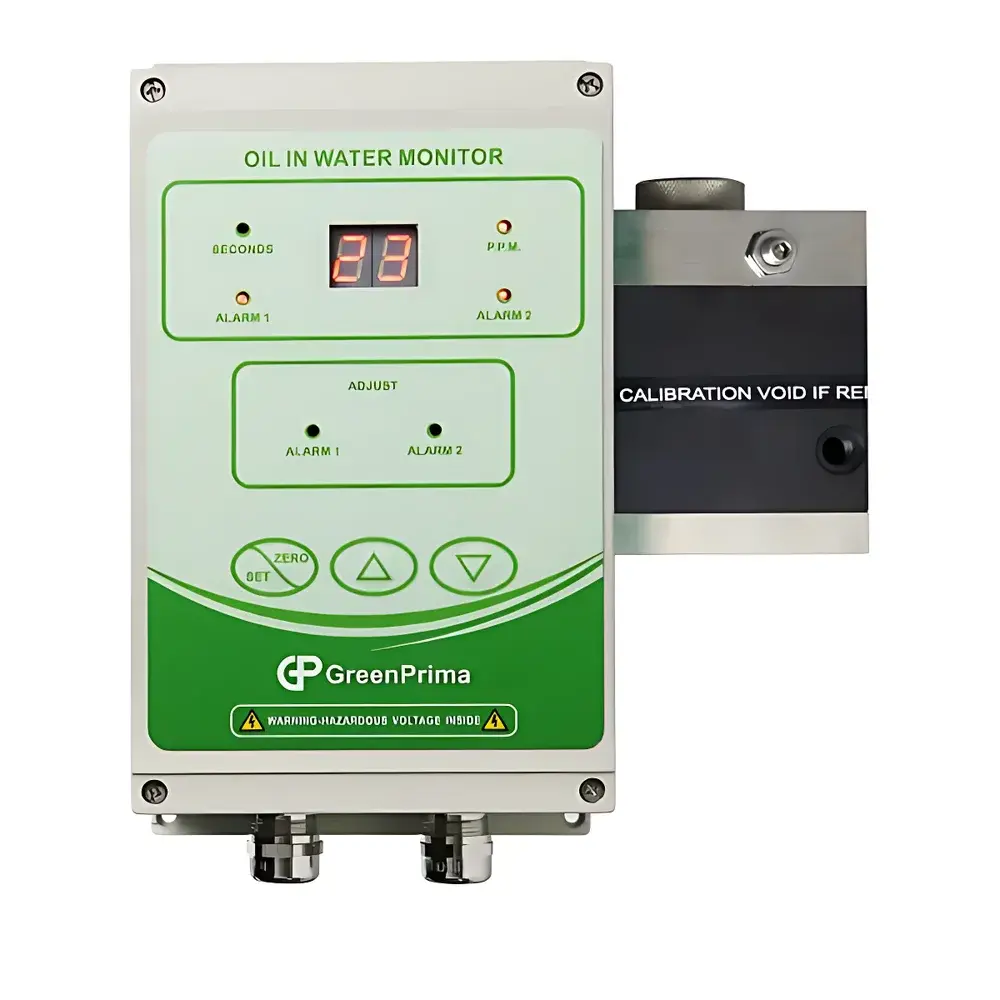
GreenPrima PROCON7000 Online Oil-in-Water Analyzer
| Brand | GreenPrima |
|---|---|
| Origin | United Kingdom |
| Manufacturer Type | Original Equipment Manufacturer (OEM) |
| Product Origin | Imported |
| Model | PROCON7000 |
| Instrument Type | Online Analyzer |
| Measurement Principle | Fluorescence-based Optical Detection (Non-Extractive, Solvent-Free) |
| Measurement Range | 0–99 ppm |
| Accuracy | ±2 ppm |
| Alarm Setpoint Range | 1–98 ppm (adjustable) |
| Alarm Delay | Alarm 1: 0–60 s |
| Alarm 2 | 10–240 s (both adjustable) |
| Display | 240 × 128 pixel resistive touchscreen |
| Analog Outputs | 0/4–20 mA (min. load 820 Ω), 0–5 V / 1–5 V DC (min. load 50 kΩ) |
| Environmental Operating Temperature | 1–60 °C |
| Relative Humidity | ≤90% RH at 55 °C |
| Sample Temperature Range | 1–40 °C |
| Sample Flow Rate | 0.1–2 L/min |
| Sample Pressure | 0.1–10 bar |
| Weight | 2.25 kg |
| Dimensions (H×W×D) | 215 × 242 × 73 mm |
| Power Supply | 230 V / 115 V AC or 24 V AC |
| Max. Power Consumption | 10 VA |
| Enclosure Rating | IP55 |
| Electrical Safety | Compliant with EN 61010-1 and IEC 664 Category II |
Overview
The GreenPrima PROCON7000 Online Oil-in-Water Analyzer is an industrial-grade, fluorescence-based optical instrument engineered for continuous, real-time monitoring of hydrocarbon contamination in aqueous streams. Unlike solvent-extraction or gravimetric methods, the PROCON7000 employs a stable UV-excited fluorescence detection principle—optimized for aromatic and aliphatic hydrocarbons commonly found in lubricating oils, diesel, fuel oil, and hydraulic fluids. Its non-contact, flow-through measurement cell eliminates reagent consumption, sample preparation, and cross-contamination risks. Designed specifically for harsh utility and process environments, the analyzer delivers trace-level sensitivity (0–99 ppm) with ±2 ppm absolute accuracy—validated under ISO 9377-2 (Water quality — Determination of hydrocarbon oil index) reference conditions. It operates without chemical solvents or consumables, making it compliant with EPA Method 1664A principles for total recoverable petroleum hydrocarbons (TRPH), while supporting long-term unattended operation in cooling water circuits, condensate return lines, and effluent discharge points.
Key Features
- True online, real-time analysis with programmable measurement intervals (1–240 minutes)
- Integrated self-diagnostics and automatic zero drift compensation—no manual recalibration required during routine operation
- Resistive touchscreen interface (240 × 128 pixels) with intuitive menu navigation and on-device data review
- Dual independent alarm outputs with fully configurable setpoints (1–98 ppm), delay timers (Alarm 1: 0–60 s; Alarm 2: 10–240 s), and relay contact rating up to 8 A @ 240 V AC
- Configurable analog outputs: isolated 4–20 mA (min. 820 Ω load), 0–5 V / 1–5 V DC (min. 50 kΩ load) for integration into DCS, PLC, or SCADA systems
- External start/stop trigger capability via dry-contact input for synchronized sampling or maintenance bypass
- IP55-rated enclosure with IP65-rated external connector panel for field wiring of alarms, relays, and analog signals
- Low power consumption (≤10 VA) and dual-voltage compatibility (230 V / 115 V AC or 24 V AC) for global deployment flexibility
Sample Compatibility & Compliance
The PROCON7000 is validated for use with clear to mildly turbid aqueous samples including engine cooling water, boiler condensate (when cooled to ≤40 °C), freshwater circulation loops, and pre-treated industrial wastewater. It tolerates suspended solids up to 50 ppm without signal interference—enabling robust operation in mechanically filtered or cartridge-filtered streams. The analyzer complies with EN 61010-1 for electrical safety and meets IEC 664 Category II insulation requirements for industrial control environments. While not certified to ATEX or IECEx, its design conforms to general-purpose hazardous area installation guidelines when deployed outside Zone 1/2 boundaries. Data integrity aligns with GLP and GMP expectations through timestamped internal logging (optional USB export), though full 21 CFR Part 11 compliance requires integration with validated third-party data acquisition software.
Software & Data Management
The PROCON7000 embeds firmware-driven operational logic with no external PC dependency. All configuration—including alarm thresholds, output scaling, sampling frequency, and delay parameters—is managed locally via the touchscreen interface. Internal event logging records alarm activations, sensor faults, and power cycles with UTC timestamps. Optional USB data dump (via standard USB-A port) exports CSV-formatted time-series concentration data, system status flags, and diagnostic logs for offline QA review. No proprietary drivers or cloud connectivity are implemented; data export remains fully offline and audit-trail compatible. For centralized monitoring, the 4–20 mA output supports direct integration into existing asset management platforms without middleware.
Applications
- Lubricating oil cooler leak detection in marine propulsion and power generation systems
- Engine jacket water and auxiliary cooling circuit surveillance in refineries and combined-cycle plants
- Boiler feedwater and condensate return line monitoring—when used with inline heat exchangers to maintain sample temperature ≤40 °C
- Pretreated industrial wastewater streams prior to biological treatment or municipal discharge
- Groundwater remediation outflow verification at containment sites and spill response zones
- Monitoring of closed-loop heat transfer fluids where early hydrocarbon ingress indicates seal failure or cross-contamination
FAQ
Does the PROCON7000 require periodic calibration with standard oil solutions?
No. The analyzer performs automatic zero tracking and thermal drift compensation during idle periods. Factory calibration is stable for ≥12 months under normal operating conditions; field verification using certified mineral oil standards (e.g., ISO 8767) is recommended annually per ISO/IEC 17025 QA protocols.
Can it measure emulsified or dispersed oil fractions?
Yes—the fluorescence detection method responds to both free and stable micro-emulsified hydrocarbons, provided droplet size remains below ~10 µm and sample turbidity does not exceed 50 NTU. For highly surfactant-laden or polymer-stabilized emulsions, validation against GC-FID is advised.
Is the flow cell resistant to fouling in high-solids applications?
The quartz optical path is designed for low-fouling operation in filtered streams. For unfiltered or high-sediment applications, optional stainless-steel flow cells with ultrasonic anti-fouling modules (sold separately) are available.
What maintenance intervals are recommended?
Visual inspection every 3 months; cleaning of optical windows and flow path every 6 months; annual verification of analog output linearity and alarm relay function per manufacturer’s service checklist.
Can the device be integrated into Modbus RTU or Ethernet/IP networks?
Not natively—the PROCON7000 lacks embedded serial or Ethernet communication. Integration with industrial networks requires external protocol converters interfacing with its 4–20 mA or relay outputs.
Related Products







