
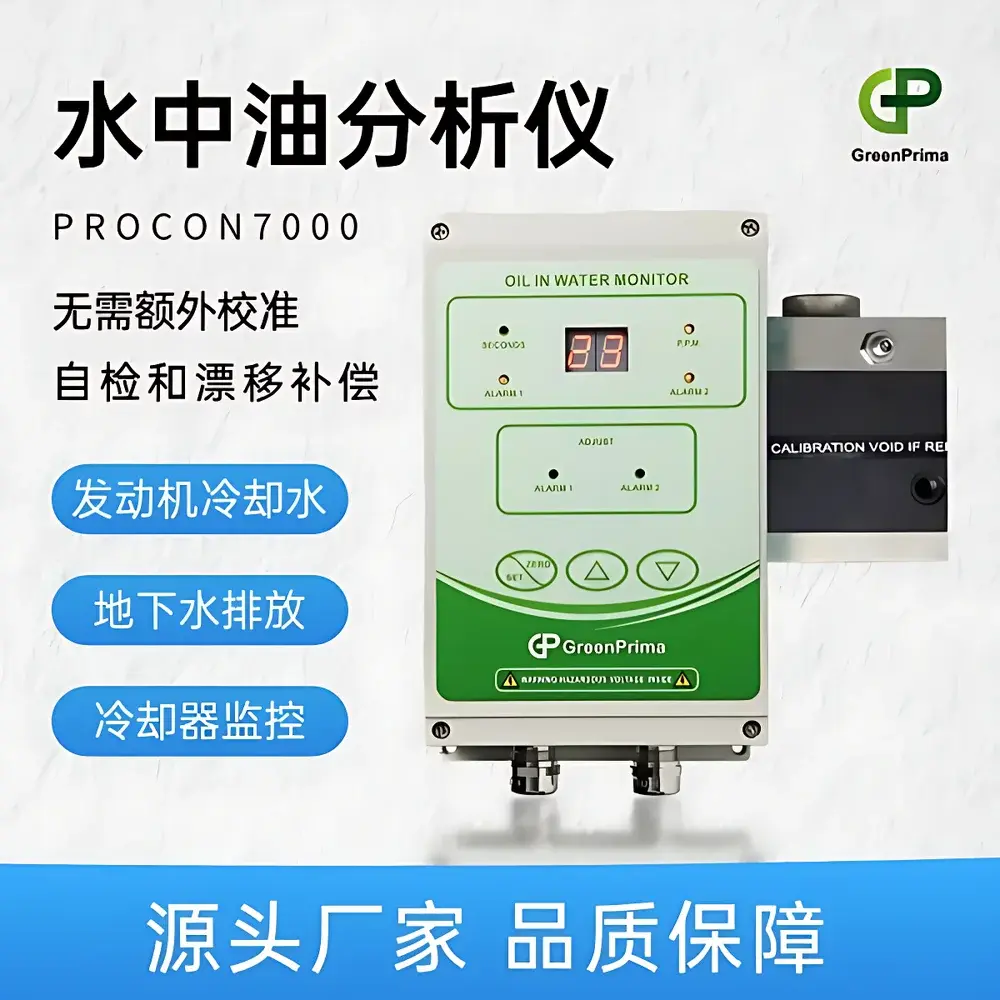
GreenPrima PROCON7000 Online Oil-in-Water Analyzer for Groundwater Discharge Monitoring
| Brand | GreenPrima |
|---|---|
| Origin | United Kingdom |
| Manufacturer Type | Original Equipment Manufacturer (OEM) |
| Product Category | Imported Instrument |
| Model | PROCON7000 |
| Instrument Type | Online Analyzer |
| Measurement Principle | Fluorescence-based Optical Detection (Non-Extractive, Solvent-Free) |
| Measurement Range | 0–99 ppm |
| Accuracy | ±2 ppm |
| Alarm Setpoint Range | 1–98 ppm (adjustable) |
| Alarm Delay | Alarm 1: 0–60 s |
| Alarm 2 | 10–240 s (both adjustable) |
| Display | 240 × 128 pixel resistive touchscreen |
| Analog Outputs | 0/4–20 mA (min. load 820 Ω), 0–5 V / 1–5 V DC (min. load 50 kΩ) |
| Sample Flow Rate | 0.1–2 L/min |
| Sample Temperature | 1–40 °C |
| Sample Pressure | 0.1–10 bar |
| Ambient Operating Temperature | 1–60 °C |
| Relative Humidity | ≤90% RH at 55 °C |
| Enclosure Rating | IP55 |
| Electrical Safety | EN 61010-1 / IEC 61010-1, Overvoltage Category II |
| Power Supply | 230 V AC / 115 V AC or 24 V AC, max. 10 VA |
| Weight | 2.25 kg |
| Dimensions (H×W×D) | 215 × 242 × 73 mm |
Overview
The GreenPrima PROCON7000 is a dedicated online oil-in-water analyzer engineered for continuous, real-time monitoring of hydrocarbon contamination in groundwater discharge streams and industrial water circuits. It employs a solvent-free, non-extractive fluorescence detection principle optimized for aliphatic and aromatic hydrocarbons—including mineral oils, diesel, lubricants, and hydraulic fluids—within aqueous matrices. Unlike gravimetric or infrared methods requiring extraction or sample conditioning, the PROCON7000 utilizes an integrated optical flow cell with UV excitation and selective emission filtering to quantify dissolved and dispersed oil concentrations without reagents or consumables. Its design targets regulatory compliance requirements for effluent discharge reporting (e.g., EU Water Framework Directive Annex V, US EPA Method 1664B equivalents), while maintaining operational simplicity for unattended deployment in remote or hazardous locations such as pump stations, containment sumps, and outfall monitoring points.
Key Features
- Automated self-calibration and drift compensation algorithm ensures long-term measurement stability without manual recalibration.
- Adjustable analysis interval (1–60 minutes) enables optimization between data resolution and maintenance cycle planning.
- Configurable dual-stage alarm system with independently programmable delay timers (Alarm 1: 0–60 s; Alarm 2: 10–240 s) supports tiered response protocols for early warning and critical event escalation.
- IP55-rated enclosure with external terminal block (IP65-rated connector interface) accommodates field wiring for relay outputs (8 A @ 240 V AC), analog signals, and external start/stop triggers.
- Resistive touchscreen interface (240 × 128 pixels) provides intuitive local configuration, real-time trend visualization, and event log access without external software.
- Multiple analog output options (0/4–20 mA, 0–5 V, 1–5 V DC) ensure seamless integration into existing SCADA, DCS, or PLC architectures with configurable scaling and fault signaling.
- Zero-reagent operation eliminates chemical handling, waste disposal liabilities, and associated OSHA or CLP compliance overhead.
Sample Compatibility & Compliance
The PROCON7000 is validated for use with clarified, low-turbidity aqueous samples typical of groundwater discharge, boiler condensate (when cooled to ≤40 °C), engine cooling water, and pre-treated industrial wastewater. It tolerates suspended solids up to 50 ppm (as verified per ISO 7027 turbidity equivalence) but requires optional inline filtration (e.g., 50 µm stainless steel strainer) for high-silt applications. The analyzer complies with EN 61010-1 for electrical safety in industrial environments and meets electromagnetic compatibility (EMC) requirements per EN 61326-1. While not certified to IECEx or ATEX, its Class II overvoltage rating and non-incendive signal architecture support installation in Zone 2 classified areas when installed per IEC 60079-14. Data integrity aligns with ALCOA+ principles, supporting GLP-compliant recordkeeping when paired with timestamped USB data export (optional module).
Software & Data Management
Local data logging retains up to 30 days of 1-minute averaged concentration values, alarm timestamps, and system diagnostics (flow status, temperature deviation, lamp intensity). USB export generates CSV-formatted files compatible with LIMS, statistical process control (SPC) platforms, or regulatory submission templates (e.g., UK Environment Agency WFD reporting formats). No proprietary software is required for basic operation; advanced configuration (e.g., custom alarm logic trees, multi-point calibration verification logs) is accessible via embedded web server (HTTP) on default port 80 — accessible only via local network segment to meet ICS cybersecurity best practices (ISA/IEC 62443-3-3 Level 1). Audit trails record all parameter changes with user ID, timestamp, and prior/post values — satisfying FDA 21 CFR Part 11 read-only archival requirements when exported.
Applications
- Continuous monitoring of groundwater discharge from remediation sites to verify compliance with site-specific hydrocarbon action levels (e.g., UK CLR11, Netherlands BGS standards).
- Early leak detection in lubricating oil cooler circuits within thermal power plants and marine propulsion systems.
- Effluent quality assurance at industrial pretreatment facilities discharging to municipal sewer networks (e.g., meeting local POTW limits for total recoverable oil and grease).
- Boiler feedwater protection where condensate return may be contaminated by turbine oil ingress — especially when deployed with optional air-cooled heat exchanger for sample temperature control.
- Regulatory-mandated outfall monitoring under ISO 5667-16 (water quality sampling — guidance on oil and grease determination) and ASTM D7066 (fluorescence-based oil quantification).
FAQ
Does the PROCON7000 require periodic calibration with standard oil solutions?
No. It uses factory-characterized optical response curves and internal reference photodiodes for automatic gain stabilization. Field verification against traceable mineral oil standards (e.g., NIST SRM 2781) is recommended annually or after sensor replacement.
Can it distinguish between diesel and lubricating oil?
It reports total fluorescent hydrocarbons (TFH) as ppm-equivalents of a primary calibration standard (typically white mineral oil). Compound-specific identification requires GC-MS; however, consistent spectral response enables trending of source-specific contamination events when baseline profiles are established.
Is the analyzer suitable for seawater applications?
Not without modification. High chloride content causes accelerated quartz flow cell fouling and quenching effects. A dedicated seawater variant (PROCON7000-SW) with corrosion-resistant wetted materials and salinity compensation firmware is available upon request.
What maintenance intervals are recommended?
Optical window cleaning every 3 months (or per visual inspection); annual lamp intensity verification; biannual review of flow path integrity and gasket condition. No consumables beyond standard O-rings (included in maintenance kit).
How is sample flow controlled and verified?
An integrated gear-type flowmeter (0.1–2 L/min range) provides real-time flow telemetry. Low-flow alarms trigger if rate falls below 0.08 L/min for >30 seconds, ensuring valid measurement conditions per ISO 5667-16 sampling protocol requirements.
Related Products







