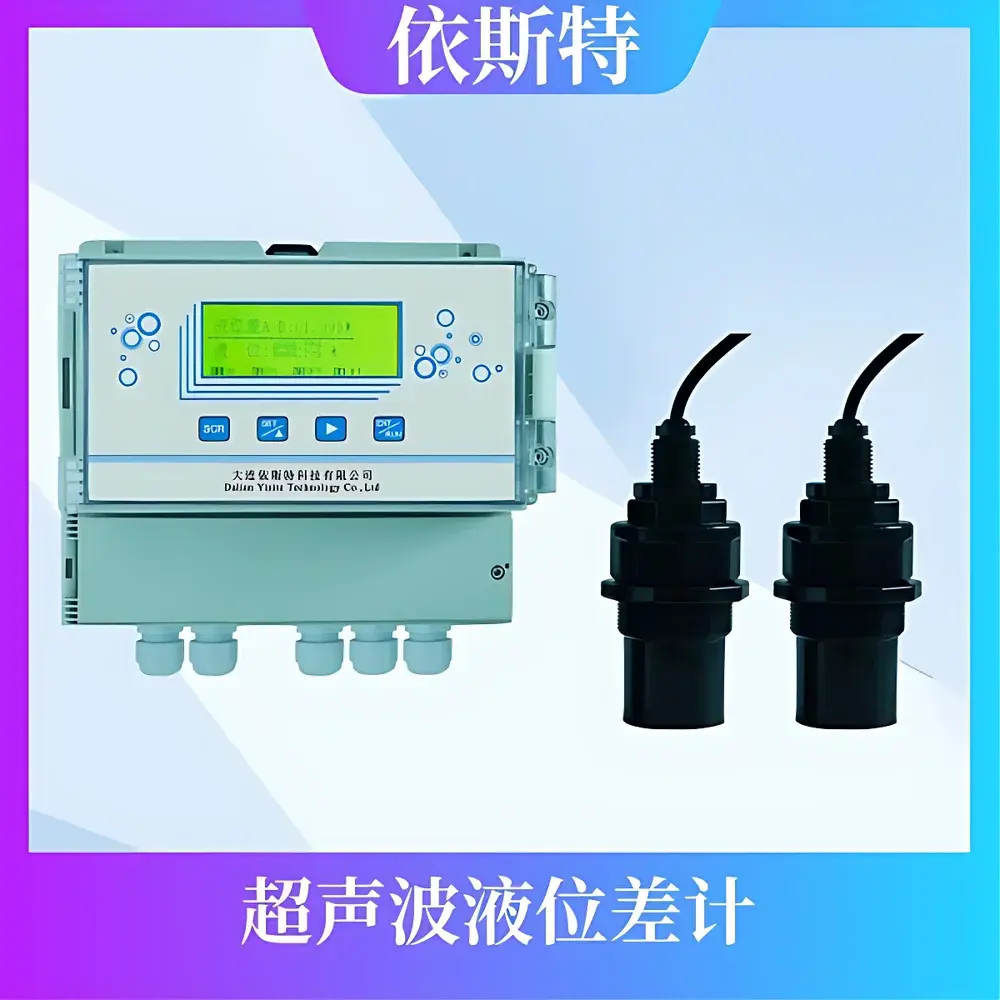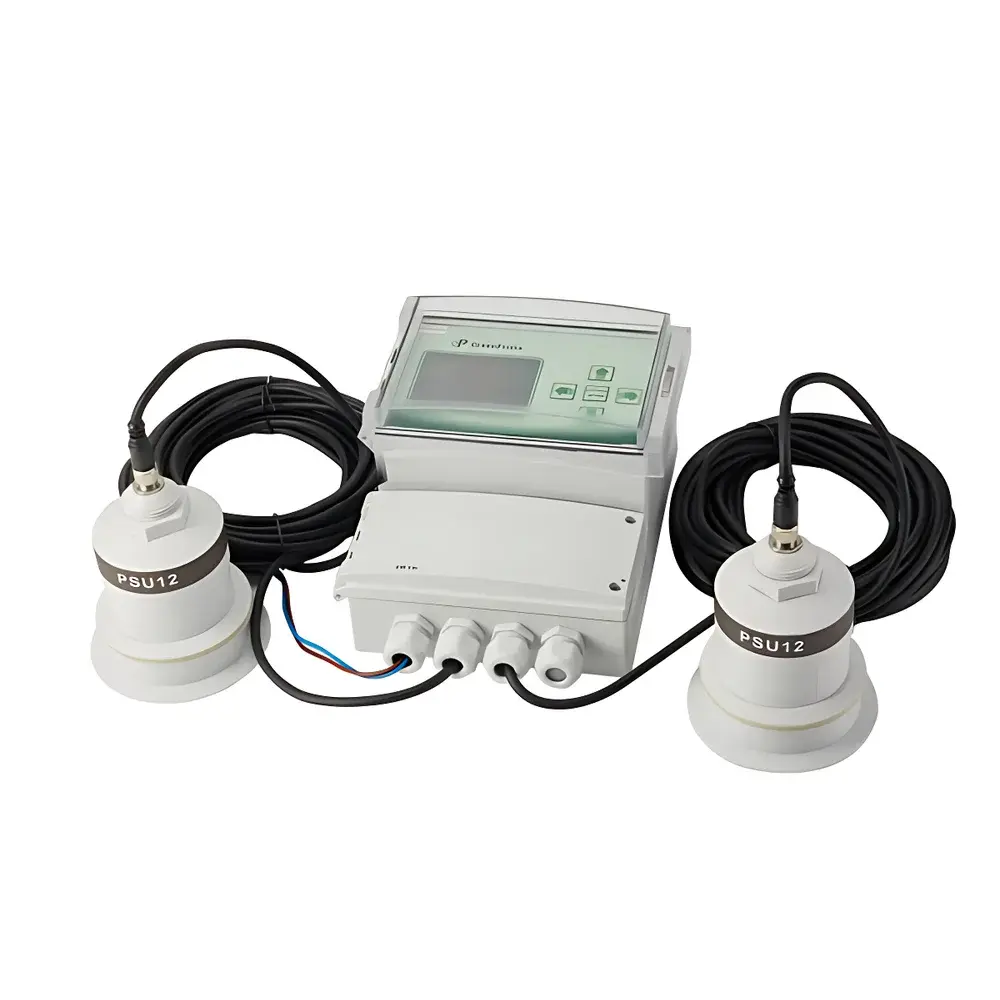
GreenPrima PROLEV 500D Split-Type Ultrasonic Level Differential Meter
| Brand | GreenPrima |
|---|---|
| Origin | Germany |
| Manufacturer Type | Manufacturer |
| Origin Category | Imported |
| Model | PROLEV 500D |
| Product Type | Level Meter |
| Controller Housing Material | ABS |
| Display | 320×240 matrix color LCD with backlight |
| Operating Temperature (Controller) | −20 to +60.0 °C |
| Output | 2 × 4–20 mA + Modbus RTU (RS-485) + 2 relays |
| Output Variant | 2 × 4–20 mA + Modbus RTU (RS-485) + 5 relays |
| Power Supply | 85–230 V AC or 24 V DC |
| Enclosure Rating (Controller) | IP66 |
| Mounting | Wall, pipe, or DIN rail |
| Dimensions (Controller) | 184 × 223 × 130 mm |
| Sensor Model | PSU06 / PSU12 |
| Measuring Range | 0.3–6 m / 0.5–12 m |
| Accuracy | ±0.2 % FS |
| Resolution | 1 mm |
| Max. Process Pressure | 1.0 bar |
| Operating Temperature (Sensor) | −30 to +70.0 °C |
| Sensor Housing Material | PC/PP |
| Cable Length | 10 m |
| Sensor IP Rating | IP68 |
| Process Connection | G1" |
| Sensor Diaphragm Material | ETFE or PVDF |
| Application Scope | Solids and liquids |
Overview
The GreenPrima PROLEV 500D is a split-type ultrasonic level differential meter engineered for continuous, non-contact measurement of liquid or bulk solid levels in industrial process environments. Based on time-of-flight (ToF) ultrasonic principle, the device emits high-frequency acoustic pulses from a transducer mounted above the medium surface; the elapsed time between emission and echo return is precisely measured and converted into distance using the speed of sound in air—compensated dynamically for ambient temperature. As a differential configuration, the PROLEV 500D supports dual-sensor deployment (e.g., upstream/downstream or primary/backup), enabling real-time level difference calculation critical for flow estimation in open channels, weirs, flumes, and effluent monitoring stations. Its microprocessor-based architecture integrates adaptive signal processing—including automatic gain control, dynamic power adjustment, and intelligent echo discrimination—to maintain measurement integrity under challenging conditions such as foam, vapor, dust, condensation, or turbulent surfaces.
Key Features
- True split architecture: physically decoupled sensor and controller units facilitate flexible installation in confined, hazardous, or thermally extreme locations—sensor mounts directly at the vessel or channel, while the controller resides in a safe, accessible area.
- Advanced waveform analysis engine employs digital signal processing (DSP) algorithms to suppress false echoes from tank walls, agitators, ladders, or surface turbulence—ensuring robust detection of the true material interface.
- Integrated temperature compensation via built-in sensor (−30 to +70 °C operating range) ensures stable speed-of-sound calibration across varying ambient conditions—critical for maintaining ±0.2 % FS accuracy over full scale.
- Dual analog outputs (4–20 mA) configurable independently for level and differential value, plus Modbus RTU (RS-485) protocol support for seamless integration into DCS, SCADA, or PLC-based control systems.
- High-reliability relay outputs (2 or 5 configurable contacts) provide local alarm, pump control, or interlock signaling without external I/O modules—fully programmable for hysteresis, delay, and fail-safe behavior.
- Chemically resistant sensor housings (PC/PP) with ETFE or PVDF diaphragms ensure long-term stability in aggressive media including caustic solutions, acids, wastewater, and food-grade slurries.
Sample Compatibility & Compliance
The PROLEV 500D is suitable for both liquid and solid bulk materials—including water, sewage, sludge, lime milk, grain, plastic pellets, and fly ash—provided the surface exhibits sufficient acoustic reflectivity. It complies with electromagnetic compatibility standards EN 61326-1 (industrial environment) and safety standard EN 61010-1. The IP66-rated controller and IP68-rated sensors meet ingress protection requirements for outdoor, washdown, and submerged-mount applications. While not intrinsically safe certified, its low-power design and optional 24 V DC supply make it compatible with barrier-protected zones in ATEX/IECEx Class II installations when deployed per system-level risk assessment. The device supports audit-ready operation under GLP/GMP frameworks through configurable event logging and Modbus-accessible diagnostic registers.
Software & Data Management
Configuration and diagnostics are performed via the intuitive on-device color LCD (320 × 240 pixels, backlight adjustable) or remotely via Modbus register mapping. All operational parameters—including damping, empty/ full calibration points, echo threshold, relay logic, and temperature compensation offset—are stored in non-volatile memory. Firmware updates are supported via USB port on the controller. Data logging capability includes timestamped level/differential values, temperature readings, and status flags (e.g., “signal loss”, “overrange”, “relay activated”)—exportable via Modbus master polling for trend analysis in historian systems. No proprietary software is required; standard Modbus-compatible tools (e.g., ModScan, Ignition, WinCC) enable full commissioning and monitoring.
Applications
- Wastewater treatment: differential level measurement across Parshall flumes, Palmer-Bowlus flumes, and rectangular weirs for open-channel flow rate calculation per ISO 1438 and ASTM D1941.
- Drinking water facilities: reservoir level monitoring with redundant sensor pairs to validate integrity and detect drift or obstruction.
- Industrial process tanks: interface level control in chemical dosing, neutralization, and blending vessels where contact probes risk corrosion or fouling.
- Food & beverage production: non-invasive level verification in silos storing flour, sugar, or dried yeast—avoiding contamination and meeting FDA 21 CFR Part 11 traceability expectations via Modbus event logs.
- Power plant ash handling: continuous monitoring of fly ash hopper fill level with resistance to dust-laden atmospheres and thermal cycling.
FAQ
Can the PROLEV 500D measure level differences in pressurized vessels?
No—the sensor is rated for maximum process pressure of 1.0 bar (gauge); it is intended for open or vented applications only. For pressurized tanks, consider guided wave radar or differential pressure alternatives.
Is temperature compensation automatic or user-adjustable?
Fully automatic: an integrated Pt1000-class temperature sensor continuously feeds ambient air temperature data to the DSP core, recalculating sound velocity in real time. No manual input is required.
What is the minimum measurable distance with PSU06 sensor?
The blind zone is 0.15 m; reliable measurement begins at 0.3 m. This limitation arises from pulse recovery time and is inherent to ultrasonic ToF physics—not a calibration constraint.
Does the device support HART communication?
No—only 4–20 mA analog output with superimposed Modbus RTU over RS-485. HART requires separate hardware and is not implemented in this model series.
How is sensor alignment verified during commissioning?
The controller displays real-time echo profile amplitude and distance histogram. Field technicians use this live feedback to adjust mounting angle until the strongest, most stable echo originates from the target surface—not sidewalls or internal structures.