
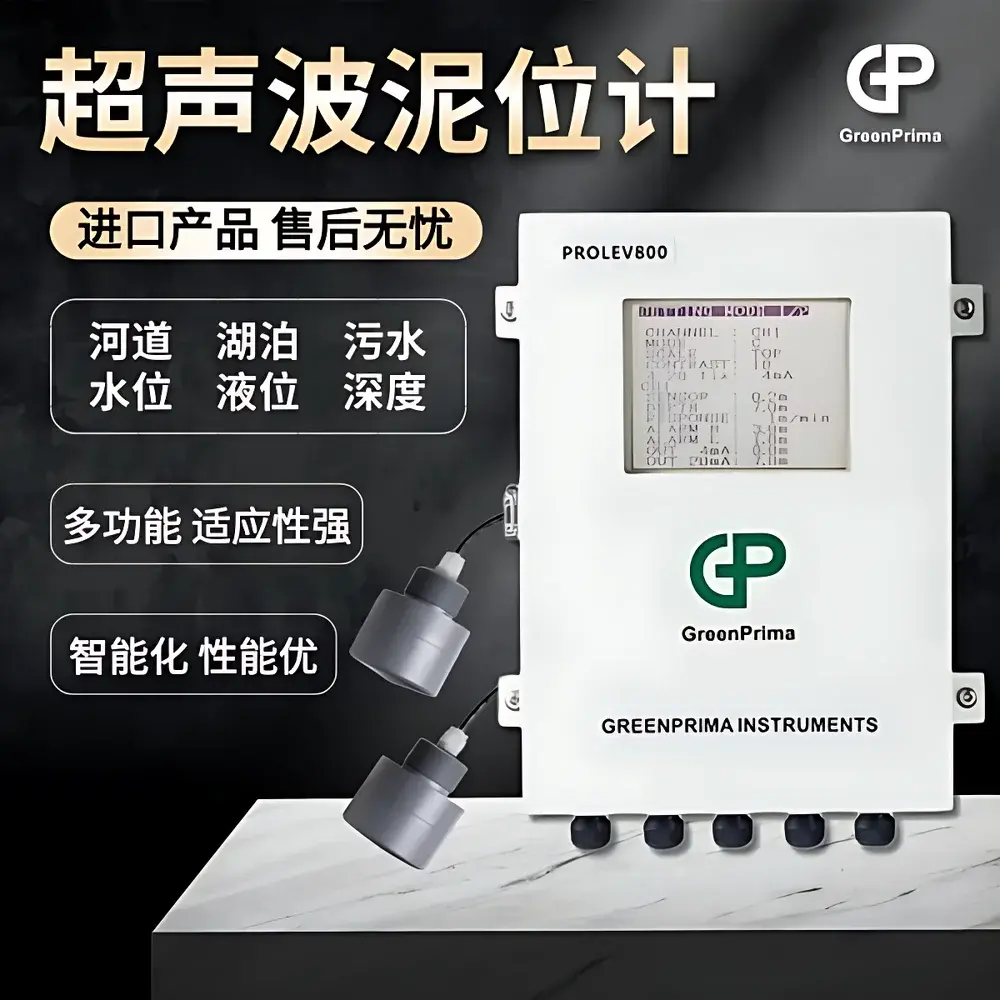
GreenPrima PROLEV800 Sludge Interface Level Monitor
| Brand | GreenPrima |
|---|---|
| Origin | United Kingdom |
| Manufacturer Type | Original Equipment Manufacturer (OEM) |
| Product Origin | Imported |
| Model | PROLEV800 |
| Pricing | Upon Request |
| Measurement Range | 0.4–10 m |
| Sensor Capacity | Up to 2 independent ultrasonic transducers |
| Accuracy | ±1 cm |
| Response Time | 1 s |
| Operating Ambient Temperature | −20 to +60 °C |
| Display | Large-backlit LCD with graphical interface (numeric readout, trend plot, echo waveform) |
| Enclosure Rating | IP68 |
| Weight | 3.6 kg (transmitter), 3 kg per probe |
| Output Signal | 4–20 mA analog (isolated), dual high/low level alarms |
| Communication Interface | RS-232C (cable length ≤ 10 m) |
| Power Supply | 85–264 VAC, 10 VA |
| Cable Length | 20 m |
| Brightness Adjustment | Yes |
| Trend Storage | 5 minutes to 48 hours on-screen history |
Overview
The GreenPrima PROLEV800 Sludge Interface Level Monitor is an industrial-grade ultrasonic interface detection system engineered for continuous, non-invasive monitoring of sludge blanket depth and settling dynamics in wastewater treatment sedimentation tanks. It operates on the principle of time-of-flight ultrasonic pulse-echo measurement: a high-frequency transducer emits short-duration acoustic pulses downward into the liquid column; the instrument precisely calculates the distance to the sludge–liquid interface by measuring the elapsed time between pulse emission and return echo from the density discontinuity at the suspended solids boundary. This method enables real-time quantification of both sludge blanket height (distance from sensor to interface) and sludge layer thickness (by differential measurement between upper and lower interfaces, when dual probes are deployed). Unlike optical or conductivity-based methods, ultrasonic sensing remains unaffected by turbidity, color, chemical composition, or surface scum—making it uniquely suited for primary clarifiers, secondary settling tanks, gravity thickeners, and anaerobic digester feed tanks where heterogeneous, variable-density sludge layers dominate process behavior.
Key Features
- Large backlit LCD display supporting simultaneous numeric depth values, real-time ultrasonic echo waveform visualization, and dynamic trend graphs (configurable from 5-minute to 48-hour history)
- Dual-sensor architecture: single transmitter unit supports two independently mounted ultrasonic probes—enabling comparative interface profiling or redundant measurement validation
- Embedded microprocessor with adaptive signal averaging and noise suppression algorithms ensures stable operation under fluctuating hydraulic loads and variable sludge rheology
- No moving parts or immersed electronics: transducers feature stainless steel housings and PTFE diaphragms rated for continuous submersion in aggressive wastewater environments
- Configurable alarm thresholds with two programmable relay outputs (high/low level) for integration into SCADA or PLC control systems
- RS-232C serial interface (up to 10 m cable length) for local configuration, firmware updates, and raw data export via terminal emulation or custom host software
- Adjustable screen brightness and contrast for optimal readability under varying ambient lighting conditions in control rooms or outdoor kiosks
Sample Compatibility & Compliance
The PROLEV800 is validated for use across municipal and industrial wastewater streams containing mixed liquor suspended solids (MLSS), activated sludge, primary sludge, waste-activated sludge (WAS), and thickened sludge with total suspended solids (TSS) concentrations ranging from 0.5 g/L to >50 g/L. Its ultrasonic frequency and pulse energy profile minimize attenuation in high-viscosity, gas-entrained, or fibrous sludge matrices. The system complies with IEC 60529 (IP68 ingress protection), EN 61000-6-2/6-4 (EMC immunity and emissions), and meets general requirements for hazardous area suitability per ATEX Directive 2014/34/EU when installed with appropriate barrier configurations. While not intrinsically safe certified out-of-the-box, its low-power design and galvanically isolated 4–20 mA output facilitate safe deployment in Zone 2 classified areas when paired with approved safety barriers.
Software & Data Management
Configuration and diagnostics are performed locally via the onboard keypad and LCD menu system—no external PC required for routine setup. The device stores timestamped depth measurements internally at user-defined intervals (default: 1 Hz), enabling retrieval of up to 48 hours of trend history directly on-screen. For long-term data archiving and analysis, raw serial output can be logged using third-party SCADA platforms (e.g., Ignition, Siemens Desigo, or Schneider EcoStruxure) or custom Python/Node-RED scripts. Although the PROLEV800 does not include cloud connectivity or native FDA 21 CFR Part 11 compliance features, its analog output and deterministic response time make it suitable for GMP-aligned wastewater monitoring workflows when integrated with audit-trail-capable DCS systems that maintain electronic record integrity per ALCOA+ principles.
Applications
- Real-time optimization of return activated sludge (RAS) and waste activated sludge (WAS) pumping rates in secondary clarifiers
- Early detection of sludge bulking or rising sludge events through deviation analysis of interface velocity and settling rate trends
- Monitoring of pre-thickening efficiency in dissolved air flotation (DAF) units and lamella settlers
- Interface tracking in coal preparation plant tailings thickeners and power station ash settling basins
- Supporting adaptive control logic for automatic weir adjustment, scraper speed modulation, and overflow diversion strategies
- Performance verification of gravity thickeners during commissioning and routine maintenance audits
FAQ
Can the PROLEV800 measure sludge thickness directly?
Yes—when two ultrasonic probes are installed at different vertical positions (e.g., top-mounted and mid-tank), the system computes sludge layer thickness as the difference between their respective interface depth readings.
Is calibration required after installation?
No field calibration is needed; the device is factory calibrated for sound velocity in water at 20 °C. For applications involving significant temperature or salinity variation (>±5 °C or >5 g/L TDS), optional temperature compensation input can be enabled via RS-232.
What is the maximum recommended submersion depth for the probe?
The IP68-rated probe is designed for permanent submersion up to 10 meters depth, with full operational reliability confirmed at 2 bar static pressure.
Does the system support Modbus RTU or Profibus communication?
No—the PROLEV800 uses only RS-232C for configuration and ASCII-based data streaming. Protocol conversion to Modbus RTU requires an external gateway.
How often does maintenance need to be performed?
Under normal wastewater conditions, inspection and mechanical cleaning of the transducer face are recommended every 6–12 months; no internal servicing or recalibration is required during standard operation.
Related Products







