
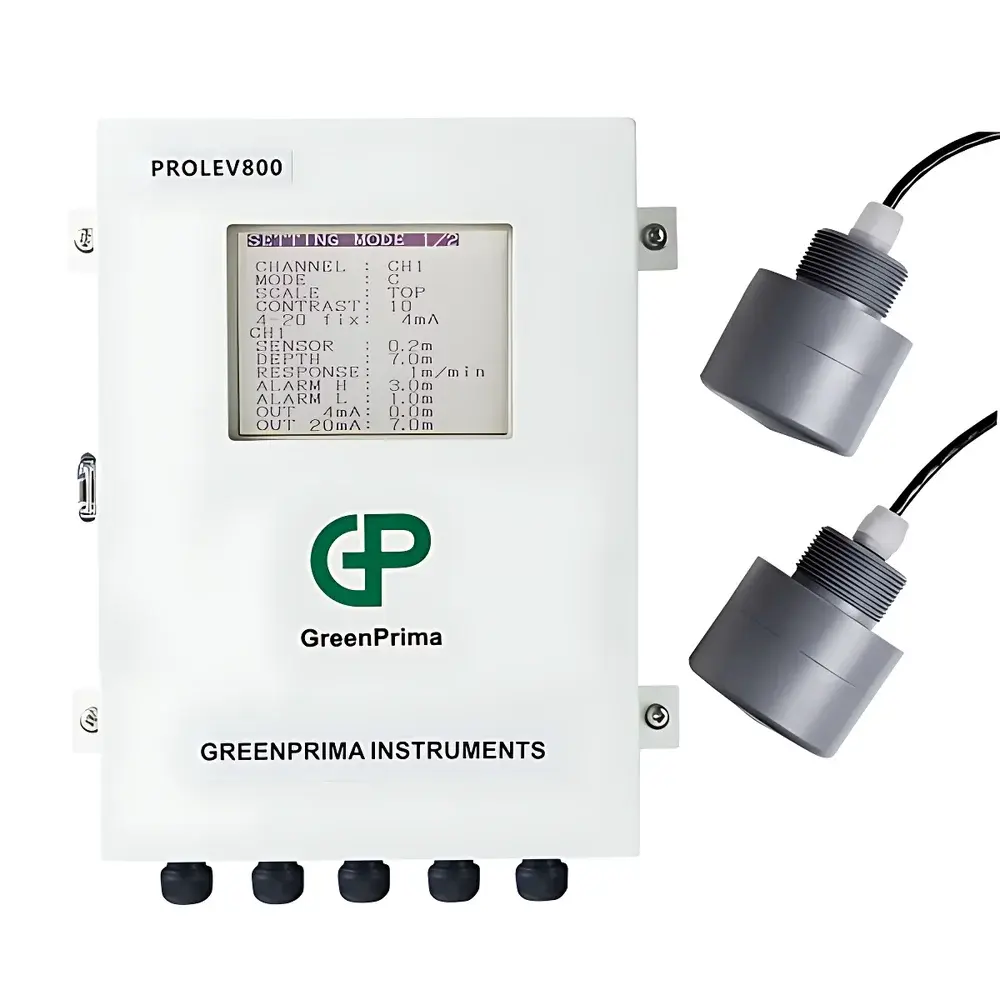
GreenPrima ProLev800 Ultrasonic Sludge Level Interface Gauge
| Brand | GreenPrima |
|---|---|
| Origin | United Kingdom |
| Manufacturer Type | Original Equipment Manufacturer (OEM) |
| Product Category | Imported Instrument |
| Model | ProLev800 |
| Measurement Range | 0.4–10 m |
| Sensor Capacity | Up to 2 independent transducers |
| Accuracy | ±1 cm |
| Response Time | 1 s |
| Operating Temperature | −20 °C to +60 °C |
| Display | Large-backlit LCD with graphical interface (numeric, trend plot, echo waveform) |
| Output | 4–20 mA analog signal |
| Alarms | Dual programmable Hi/Lo relay outputs |
| Communication | RS232C (cable length ≤10 m) |
| Power Supply | 85–264 VAC, 10 VA |
| Enclosure Rating | IP68 |
| Cable Length | 20 m |
| Weight | 3.6 kg (transmitter), 3.0 kg (per transducer) |
Overview
The GreenPrima ProLev800 Ultrasonic Sludge Level Interface Gauge is an industrial-grade, non-contact level measurement instrument engineered for continuous, real-time monitoring of sludge blanket depth and interface position in sedimentation and thickening basins. It operates on the principle of time-of-flight ultrasonic pulse-echo measurement: a high-frequency transducer emits short-duration acoustic pulses downward into the liquid column; the elapsed time between emission and reception of the reflected signal from the sludge–liquid interface is precisely measured and converted into distance using the speed of sound in water (adjusted for temperature). This method enables robust, maintenance-free detection of dynamic sludge layers without mechanical contact or immersion—critical for applications where fouling, abrasion, or chemical corrosion compromise traditional contact sensors. Designed specifically for wastewater treatment infrastructure, the ProLev800 delivers stable interface tracking under variable hydraulic loading, suspended solids concentration gradients, and turbulent flow conditions typical in primary clarifiers, secondary settling tanks, gravity thickeners, and ash slurry ponds.
Key Features
- Large backlit LCD display supporting simultaneous numeric readout, real-time echo waveform visualization, and multi-scale trend graphs (5-minute to 48-hour history)
- Embedded microprocessor architecture enabling adaptive signal filtering, automatic gain control, and statistical averaging of echo amplitude—ensuring stable output even during transient surface turbulence or foam formation
- Advanced interface tracking algorithm with dynamic threshold adjustment, capable of resolving subtle shifts in sludge compaction and settling velocity without manual recalibration
- Modular design permitting connection of up to two independent ultrasonic transducers to a single transmitter unit—reducing hardware footprint and total cost of ownership
- No moving parts or submerged electronics; transducer housing rated IP68 for continuous submersion in aggressive wastewater environments
- Configurable 4–20 mA analog output with linear or square-root scaling options, plus dual programmable relay outputs for process alarms (e.g., blanket rise above setpoint, sensor fault detection)
- Front-panel parameter configuration via intuitive menu navigation; adjustable screen brightness for optimal readability under varying ambient lighting
Sample Compatibility & Compliance
The ProLev800 is validated for use across diverse municipal and industrial wastewater matrices—including activated sludge, anaerobic digester supernatant, coal washery effluent, fly ash slurry, and potable water pre-sedimentation basins. Its ultrasonic operation remains effective in media with turbidity up to 5,000 NTU and suspended solids concentrations exceeding 20 g/L, provided the sludge–water interface exhibits sufficient acoustic impedance contrast. The device complies with IEC 61000-6-2 (immunity) and IEC 61000-6-4 (emissions) standards. Its analog output and relay interfaces support integration into PLC-based SCADA systems conforming to IEC 61131-3. While not intrinsically safe, optional ATEX-certified variants are available for Zone 2 hazardous area deployment per EN 60079-0 and EN 60079-15.
Software & Data Management
Data logging and remote diagnostics are facilitated via the RS232C serial interface (up to 10 m cable length), compatible with standard terminal emulation software or custom HMI drivers. Raw echo data, timestamped interface height values, and alarm status logs can be exported for post-processing in MATLAB, Python (Pandas), or industry-standard historian platforms (e.g., OSIsoft PI System, Ignition). Firmware updates are performed offline using vendor-provided utility tools. Audit trails for configuration changes are retained in non-volatile memory, supporting GLP-aligned operational documentation requirements. No cloud connectivity or proprietary cloud platform is embedded—ensuring full data sovereignty and compatibility with air-gapped facility networks.
Applications
- Optimization of return activated sludge (RAS) and waste activated sludge (WAS) pumping schedules based on real-time blanket elevation
- Early detection of sludge bulking or septic conditions via abnormal interface drift rate analysis
- Monitoring separation efficiency in dissolved air flotation (DAF) units and lamella settlers
- Control logic input for automated scraper bridge speed modulation in circular clarifiers
- Performance validation of polymer dosing systems by correlating interface stability with coagulant dosage
- Regulatory compliance reporting for sludge blanket depth limits mandated under local discharge permits (e.g., EPA NPDES, EU Urban Wastewater Treatment Directive Annex I)
FAQ
Can the ProLev800 distinguish between multiple sludge layers (e.g., floating scum, intermediate floc, compacted sludge)?
No—the device is optimized for detection of the dominant liquid–sludge interface. Multi-layer resolution requires advanced broadband echo analysis beyond its fixed-frequency transduction architecture.
Is temperature compensation applied automatically?
Yes—integrated PT100 sensor in the transducer housing provides real-time water temperature feedback to correct sound velocity assumptions.
What maintenance intervals are recommended for long-term reliability?
Annual visual inspection of transducer face for biofilm accumulation and verification of mounting integrity; no routine calibration required due to factory-traceable acoustic reference.
Does the device support Modbus RTU or other industrial fieldbus protocols?
Not natively—only RS232C ASCII protocol is supported; Modbus conversion requires external protocol gateway hardware.
How does the system handle foam or surface scum interference?
The firmware employs echo envelope analysis and adaptive thresholding to suppress false triggers from low-density surface layers while retaining sensitivity to the denser underlying interface.
Related Products







