
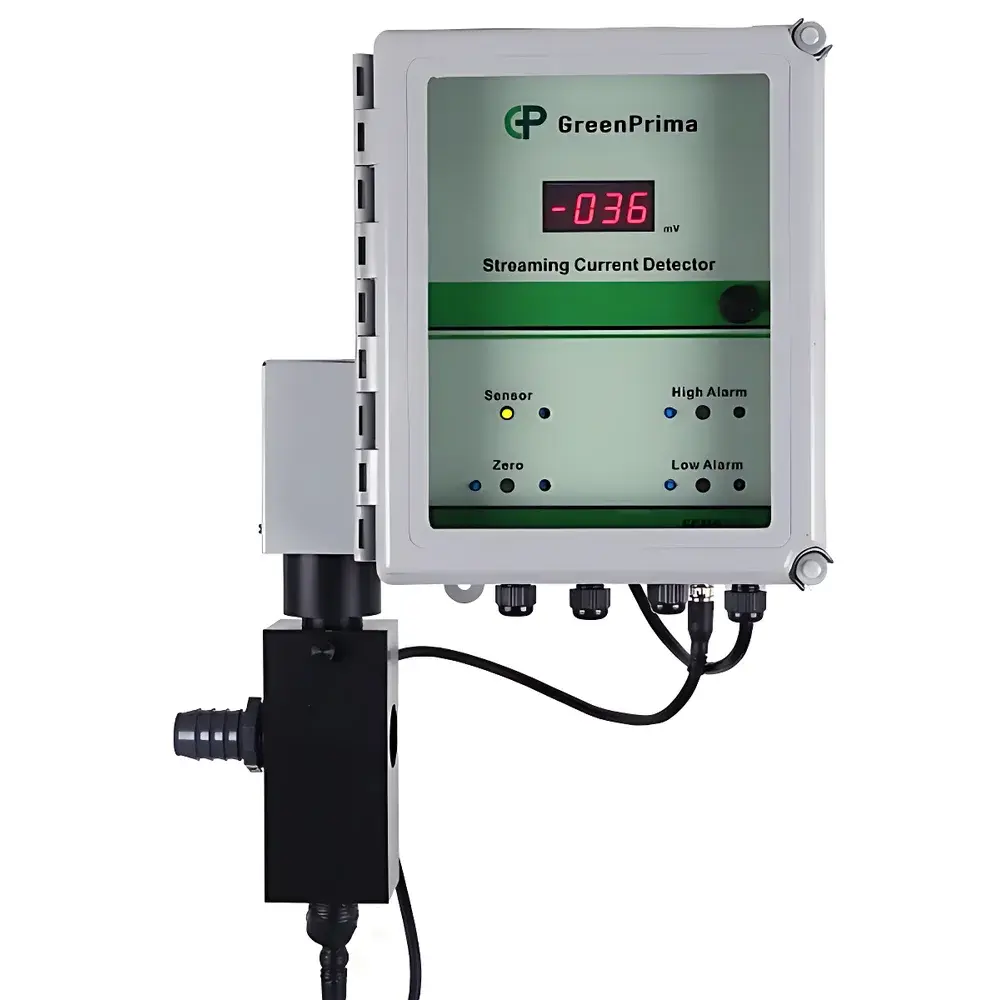
GreenPrima SCD-8200 Streaming Current Detector
| Brand | GreenPrima |
|---|---|
| Origin | USA |
| Manufacturer Type | Manufacturer |
| Origin Category | Imported |
| Model | 8200SCD |
| Price Range | USD 6,800 – 13,600 |
| Power Supply | 100–240 VAC, 50/60 Hz |
| Measurement Range | −1000 to +1000 mV |
| Accuracy | ±0.1% of full scale |
| Response Time | 1 second |
| Sample Flow Rate | 1 US gallon per minute (3.785 L/min) |
| Inlet Connection | 1/2" barbed quick-connect |
| Outlet Connection | 3/4" barbed quick-connect |
| Enclosure Rating | NEMA 4X / IP65 |
| Output Signals | 4–20 mA, ±10 V, 0–10 V |
| Communication Protocol | MODBUS RTU (optional) |
| Alarm Outputs | Dual SPDT relays (high/low) |
| Sensor Materials | Delrin®, 316 stainless steel, PTFE |
| Weight | 9 kg |
| Display | LED-based local interface |
| Auto-zero Calibration | Yes |
| Diagnostic Indicators | Integrated sensor LED status |
Overview
The GreenPrima SCD-8200 Streaming Current Detector is an industrial-grade online analytical instrument engineered for real-time monitoring and control of coagulant dosing in water and wastewater treatment processes. It operates on the principle of streaming current measurement—a well-established electrokinetic technique that quantifies the net surface charge of colloidal particles and dissolved ionic species in aqueous suspension. As a piston-driven flow cell passes sample water across two parallel electrodes, controlled shear forces liberate counter-ions from the electrical double layer surrounding suspended colloids. The resulting oscillating current—generated by the directional migration of these free ions under applied hydraulic shear—is measured as a voltage potential (mV) across the electrode pair. This streaming current value correlates directly with the residual charge imbalance post-coagulation, providing a dynamic, process-relevant indicator of coagulant efficacy—not merely chemical dosage.
Key Features
- Continuous, real-time streaming current measurement with 1-second response time for closed-loop coagulant dosing control
- Self-contained NEMA 4X non-metallic enclosure rated IP65, suitable for outdoor or harsh industrial environments
- Integrated auto-zero calibration routine eliminating manual drift correction and reducing operator dependency
- Dual analog outputs (4–20 mA and ±10 V) plus optional MODBUS RTU protocol for seamless integration into DCS, SCADA, or PLC systems
- Robust sensor construction using chemically inert materials: Delrin® housing, 316 stainless steel wetted components, and PTFE seals
- Diagnostic LED indicators on both sensor head and transmitter provide immediate visual feedback on operational status and fault conditions
- Quick-connect barbed fittings (1/2″ inlet, 3/4″ outlet) enable rapid installation and maintenance without specialized tools or pipe cutting
Sample Compatibility & Compliance
The SCD-8200 is validated for use across municipal drinking water plants, industrial pretreatment facilities, membrane filtration pre-treatment (e.g., RO and UF), sludge dewatering operations, and tertiary effluent polishing. It accommodates turbidities up to 500 NTU and suspended solids concentrations ≤ 500 mg/L without clogging or signal attenuation. The instrument complies with key regulatory frameworks governing automated process control in regulated utilities, including EPA Guidance for Coagulant Optimization (2017), ISO 5667-3:2018 (water sampling—preservation and handling), and supports audit-ready data integrity when paired with compliant SCADA historians. Its analog and digital outputs meet IEC 61000-6-2/6-4 immunity and emission standards for industrial environments.
Software & Data Management
While the SCD-8200 operates as a standalone transmitter with local LED display, its 4–20 mA and MODBUS outputs facilitate integration into enterprise-level data acquisition platforms. When connected to a validated historian system, the streaming current signal can be time-stamped, trended, and correlated with upstream coagulant pump speed, downstream turbidity, and filter differential pressure—enabling multivariate process optimization. The instrument supports configurable alarm thresholds with relay outputs for high/low excursions, supporting GLP-aligned event logging. Though it does not embed FDA 21 CFR Part 11-compliant software locally, its analog and MODBUS interfaces are fully compatible with third-party validation packages used in GMP-regulated pharmaceutical water systems.
Applications
- Optimization of polyaluminum chloride (PACl), ferric chloride, and cationic polymer dosing in conventional clarification
- Real-time control of coagulant feed in direct filtration and low-turbidity surface water treatment
- Monitoring charge neutralization efficiency prior to ultrafiltration or reverse osmosis membrane trains
- Supporting adaptive dosing strategies during seasonal raw water quality shifts (e.g., NOM spikes, algal blooms)
- Reducing coagulant overfeed in sludge conditioning applications—lowering polymer consumption and improving dewaterability
- Providing early-warning detection of coagulant underdose events that precede turbidity breakthrough in final effluent
FAQ
How does the SCD-8200 differ from traditional jar testing or offline zeta potential analyzers?
Unlike batch-based methods, the SCD-8200 delivers continuous, in-line streaming current data at process-relevant flow rates and shear conditions—eliminating sampling delay, operator variability, and representativeness errors.
Can the SCD-8200 be installed in pressurized pipelines?
Yes—when used with an external pressure regulator and flow restrictor, it accepts inlet pressures up to 100 psi; the internal flow cell operates at ambient pressure.
Is field calibration required?
No routine calibration is needed beyond periodic verification using certified zero-current standard solutions (e.g., deionized water); auto-zero functionality maintains baseline stability over extended periods.
What maintenance intervals are recommended?
Sensor cleaning every 3–6 months depending on feed water quality; no consumables or reagents required—only periodic inspection of O-rings and quick-connect seals.
Does the SCD-8200 support remote diagnostics?
Via MODBUS, live sensor status, output values, and diagnostic flags (e.g., flow fault, electrode contamination warning) can be polled remotely through compatible control systems.







