
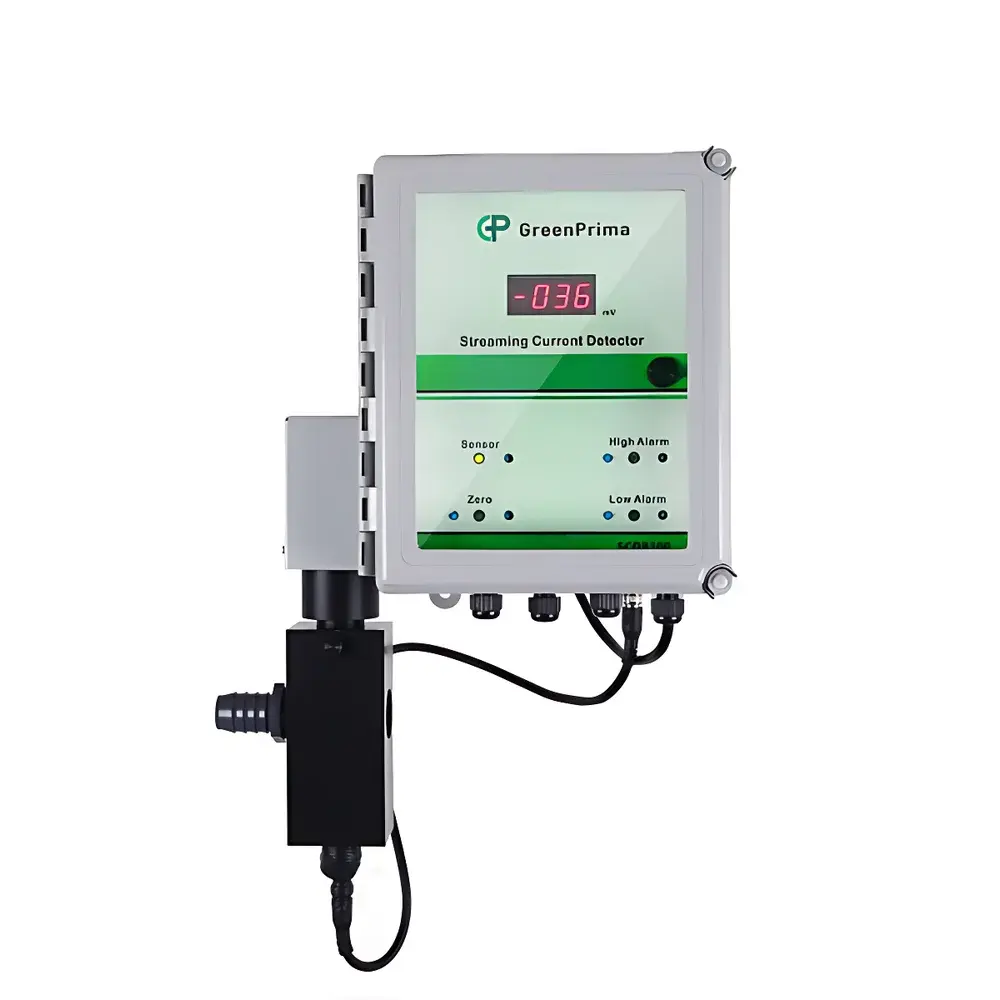
GreenPrima SCD8200 Streaming Current Detector for Real-Time Coagulant Control in Water Treatment Plants
| Brand | GreenPrima |
|---|---|
| Origin | USA |
| Manufacturer | GreenPrima, Inc. |
| Model | SCD8200 |
| Measurement Principle | Streaming Current Detection via Piston-Driven Shear Flow |
| Output Signal | 4–20 mA / ±10 V / 0–10 V |
| Power Supply | 230 VAC |
| Measurement Range | –1000 to +1000 mV |
| Accuracy | ±0.1% of full scale |
| Response Time | 1 second |
| Sample Flow Rate | 1 US gallon per minute (3.785 L/min) |
| Inlet/Outlet | 1/2″ and 3/4″ barbed quick-connect fittings |
| Enclosure Rating | NEMA 4X / IP65 |
| Dimensions | 11″ × 6″ × 6″ (W×H×D) |
| Weight | 9 kg |
| Diagnostic Indicators | Sensor LED status |
| Communication Option | Modbus RTU (optional) |
| Alarm Outputs | Dual SPDT relays (Hi/Lo) |
| Zero & Gain Adjustment | Manual potentiometer-based calibration |
Overview
The GreenPrima SCD8200 Streaming Current Detector is an industrial-grade, online electrokinetic analyzer engineered for real-time coagulant dosing control in municipal and industrial water treatment facilities. It operates on the principle of streaming current measurement—a well-established electrophoretic technique that quantifies the net charge density at the shear plane of colloidal particles suspended in aqueous solution. As a piston-driven reciprocating flow system, the SCD8200 subjects the sample stream to controlled hydrodynamic shear, displacing counter-ions from the Stern layer and generating a measurable alternating current across precision platinum electrodes embedded in the sensor chamber. This signal—expressed in millivolts (mV)—correlates directly with the zeta potential trend of the influent water, providing a dynamic, process-relevant proxy for optimal coagulant dosage. Unlike offline jar testing or turbidity-based feedback loops, the SCD8200 delivers sub-second response times and continuous, drift-resistant measurement under variable flow and temperature conditions—making it a foundational instrument for closed-loop coagulation control compliant with modern utility automation standards.
Key Features
- Piston-actuated shear mechanism ensures consistent, pulse-free flow conditioning—eliminating dependence on external pump pressure or flow rate fluctuations
- NEMA 4X non-metallic enclosure with gasketed latch design enables reliable outdoor deployment in humid, corrosive, or splash-prone environments
- Field-adjustable zero and gain calibration via front-panel potentiometers—no software or PC required for routine maintenance
- Dual analog outputs (4–20 mA and ±10 V) support integration with PLCs, DCS systems, or SCADA networks without signal conversion hardware
- Integrated diagnostic LED provides immediate visual confirmation of sensor health, power status, and signal saturation
- Modbus RTU option enables bidirectional communication for remote configuration, data logging, and firmware updates over RS-485
- SPDT relay outputs configurable for high/low alarm thresholds—suitable for initiating chemical feed pump interlocks or SCADA event triggers
Sample Compatibility & Compliance
The SCD8200 is validated for continuous operation with raw surface water, pre-chlorinated influent, clarified effluent, and low-turbidity filtered streams typical of conventional and membrane-based treatment trains. It maintains stable performance across pH ranges of 5.5–9.0 and temperatures from 2°C to 40°C. While not certified to ISO/IEC 17025 for laboratory accreditation, the instrument’s measurement traceability aligns with ASTM D5893 (Standard Test Method for Streaming Current Detection) and supports compliance with EPA Guidance for Coagulant Optimization (EPA 815-R-00-002). Its analog output architecture and relay logic are compatible with utilities operating under FDA 21 CFR Part 11-compliant control systems when paired with appropriate audit-trail-capable SCADA platforms. The device meets UL 508A for industrial control equipment and carries CE marking for EMC and Low Voltage Directive conformity.
Software & Data Management
The SCD8200 operates as a standalone, firmware-based transmitter—requiring no embedded OS or user-installed software. Configuration is performed manually via front-panel controls, ensuring deterministic behavior and immunity to cybersecurity vulnerabilities associated with networked controllers. For data acquisition, the 4–20 mA output is compatible with standard 16-bit analog input modules used in Allen-Bradley CompactLogix, Siemens S7-1200, or Schneider Modicon M340 PLCs. When equipped with the optional Modbus RTU interface, the unit reports real-time streaming current value, sensor status flags, and internal diagnostics—including electrode contamination warning and motor stall detection—to upstream historians such as OSIsoft PI or Ignition SCADA. All analog outputs include built-in galvanic isolation (1500 Vrms) and ESD protection per IEC 61000-4-2 Level 4.
Applications
- Real-time coagulant dosing control in rapid mix basins of municipal drinking water plants
- Optimization of polyaluminum chloride (PACl), ferric chloride, or alum feed rates in response to seasonal source water variability
- Monitoring charge neutralization efficiency prior to dissolved air flotation (DAF) or sedimentation units
- Pre-treatment monitoring for reverse osmosis (RO) and nanofiltration (NF) systems to prevent fouling from colloidal carryover
- Sludge dewatering optimization by tracking cationic polymer demand in thickening and centrifuge feed streams
- Process validation during plant upgrades or regulatory compliance audits requiring documented coagulation control
FAQ
What physical parameter does the SCD8200 actually measure?
It measures streaming current (in mV), a direct electrophoretic indicator of net colloidal surface charge under shear—functionally equivalent to zeta potential trend in coagulated water matrices.
Can the SCD8200 replace jar testing entirely?
No—it does not substitute for initial coagulant selection or bench-scale optimization; however, it replaces continuous jar testing for day-to-day dosage adjustment and serves as the primary feedback signal in automated control loops.
Is sensor cleaning required? How often?
Yes—electrode fouling from organic or mineral scaling may occur; recommended cleaning interval is every 2–4 weeks depending on raw water quality, using dilute citric acid or 0.1N HCl followed by deionized water rinse.
Does the unit require a constant flow source?
No—the integrated piston pump generates its own defined 1 GPM (3.785 L/min) flow path; inlet pressure requirements are minimal (<5 psi), and the sensor tolerates intermittent flow interruptions up to 30 seconds without recalibration.
How is calibration verified in the field?
Using standardized reference solutions (e.g., 100 ppm kaolin suspension with known coagulant dose), users verify linearity and zero offset against historical baseline data—not absolute mV values—since streaming current is inherently comparative and process-dependent.
Related Products







