
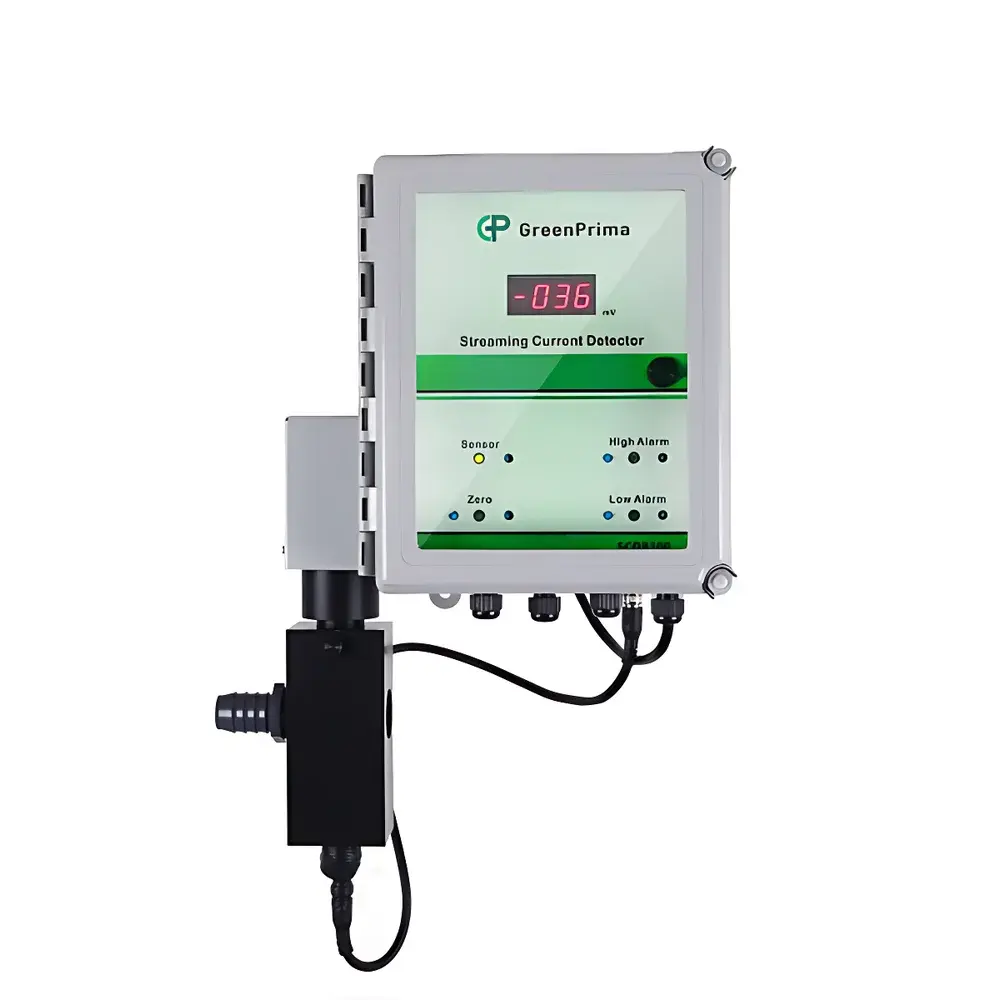
GreenPrima SCD8200 Streaming Current Detector
| Brand | GreenPrima |
|---|---|
| Origin | USA |
| Manufacturer Type | Manufacturer |
| Origin Category | Imported |
| Model | SCD8200 |
| Power Supply | 230 VAC |
| Measurement Range | −1000 to +1000 mV |
| Accuracy | ±0.1% of full scale |
| Flow Rate | 1 L/min (≈0.264 GPM) |
| Inlet/Outlet | 1/2″ and 3/4″ barbed quick-connect fittings |
| Response Time | 1 s |
| Output Signals | 4–20 mA, −10 to +10 V, 0–10 V |
| Communication | Modbus RTU (optional) |
| Alarm Outputs | Hi/Lo relay contacts |
| Enclosure Rating | NEMA 4X / IP65 |
| Display | LED |
| Self-Diagnostic | Sensor status LED |
| Dimensions | 11″ × 6″ × 6″ (W×H×D) |
| Weight | 9 kg |
Overview
The GreenPrima SCD8200 Streaming Current Detector is an industrial-grade, real-time electrokinetic analyzer engineered for continuous optimization of coagulant dosing in potable water treatment, wastewater clarification, and membrane pre-treatment systems. It operates on the principle of streaming current measurement—a well-established electrokinetic technique that quantifies the net surface charge density of colloidal particles suspended in flowing water. As water passes through a precision-machined flow cell under controlled laminar conditions, the movement of counter-ions adjacent to charged particle surfaces generates a measurable streaming potential. This analog voltage signal—ranging from −1000 mV to +1000 mV—is directly proportional to the degree of charge neutralization achieved by coagulants such as aluminum sulfate, ferric chloride, or polyaluminum chloride (PACl). Unlike turbidity or zeta potential analyzers, the SCD8200 provides a process-relevant, dynamic indicator of coagulation efficacy with sub-second response time, enabling closed-loop feedback control in compliance with modern water utility automation standards.
Key Features
- Real-time streaming current measurement with 1-second response time and ±0.1% full-scale accuracy for high reproducibility in fluctuating influent conditions
- NEMA 4X/IP65 non-metallic enclosure with latch-mounted design, rated for permanent outdoor installation in humid, corrosive, or splash-prone environments
- Dual analog outputs (4–20 mA and ±10 V) plus optional Modbus RTU serial communication for seamless integration into SCADA, DCS, or PLC-based control architectures
- Field-adjustable zero offset and signal gain calibration—no software tools required—supporting routine verification and sensor drift compensation
- Robust flow cell with 1/2″ inlet and 3/4″ outlet barbed quick-connect fittings; designed for stable 1 L/min flow without external pump or pressure regulation
- Integrated self-diagnostic LED indicator providing immediate visual confirmation of sensor operational status and fault detection
- Hi/Lo relay alarm outputs configurable for coagulant underdose (positive deviation) or overdosing (negative deviation), supporting automated process safeguarding
Sample Compatibility & Compliance
The SCD8200 is validated for use across raw surface water, settled effluent, filtered water, and low-turbidity distribution system samples typical of municipal drinking water facilities. Its flow cell geometry and electrode materials are chemically inert to common oxidants (e.g., chlorine residuals ≤5 mg/L), pH ranges 5.5–8.5, and suspended solids concentrations up to 100 NTU. The instrument complies with NEMA 4X environmental protection requirements and meets IEC 61326-1 (EMC for industrial environments). While not certified to ISO/IEC 17025, its measurement methodology aligns with ASTM D5892–22 (“Standard Test Method for Streaming Current Detection”) and supports GLP/GMP-aligned process validation when deployed with documented calibration and maintenance logs per US EPA Guidance Manual for Coagulation Control (EPA 815-R-04-005).
Software & Data Management
The SCD8200 operates as a stand-alone transmitter with no embedded firmware or proprietary software dependency. All configuration—including zero/gain adjustment, alarm thresholds, and output scaling—is performed via front-panel DIP switches and trim-potentiometers. Analog outputs feed directly into existing plant historians or data acquisition systems. When equipped with the optional Modbus RTU interface, it supports register-level readout of streaming current value, diagnostic status, and relay states—enabling traceability in FDA 21 CFR Part 11-compliant environments when paired with validated SCADA platforms. Calibration records, maintenance logs, and trended streaming current data may be archived externally to satisfy audit requirements under AWWA Standard G300 and ISO 9001:2015 Clause 8.5.2.
Applications
- Optimization of coagulant dosage in rapid mix basins at municipal water treatment plants, reducing chemical consumption by 15–30% while maintaining turbidity <0.1 NTU
- Feedback control of polymer dosing in sludge dewatering centrifuges and belt filter presses, improving cake solids content and reducing polymer cost
- Early detection of coagulation breakthrough in dual-media filtration systems, triggering automatic backwash or dose ramp-up protocols
- Monitoring charge reversal during PACl titration in low-alkalinity source waters, preventing overcoagulation and floc carryover
- Process validation support for NSF/ANSI 60-certified coagulant feed systems in regulated drinking water service areas
FAQ
What is the recommended maintenance interval for the SCD8200 flow cell electrodes?
Electrode cleaning is advised every 7–14 days in high-turbidity applications; monthly in low-turbidity finished water streams. Use only deionized water and non-abrasive lint-free wipes—no solvents or acids.
Can the SCD8200 replace jar testing in routine coagulant optimization?
No—it does not replace bench-scale jar testing for initial coagulant selection or pH sweep studies. However, it continuously validates and refines jar-test-derived setpoints in real time.
Is the 1 L/min flow rate adjustable?
No—the internal orifice and motor-driven flow path are fixed to ensure laminar flow profile repeatability. Deviations from nominal flow invalidate the streaming current correlation.
Does the SCD8200 require temperature compensation?
Not explicitly—the instrument’s accuracy specification accounts for ambient operating temperatures from 0°C to 50°C. For applications with >5°C/hour water temperature swings, consider pairing with a PT100 input module in the control system.
How is sensor drift verified in-situ?
Use the front-panel zero adjust while bypassing sample flow with deionized water; a stable reading within ±5 mV confirms electrode integrity and grounding continuity.







