
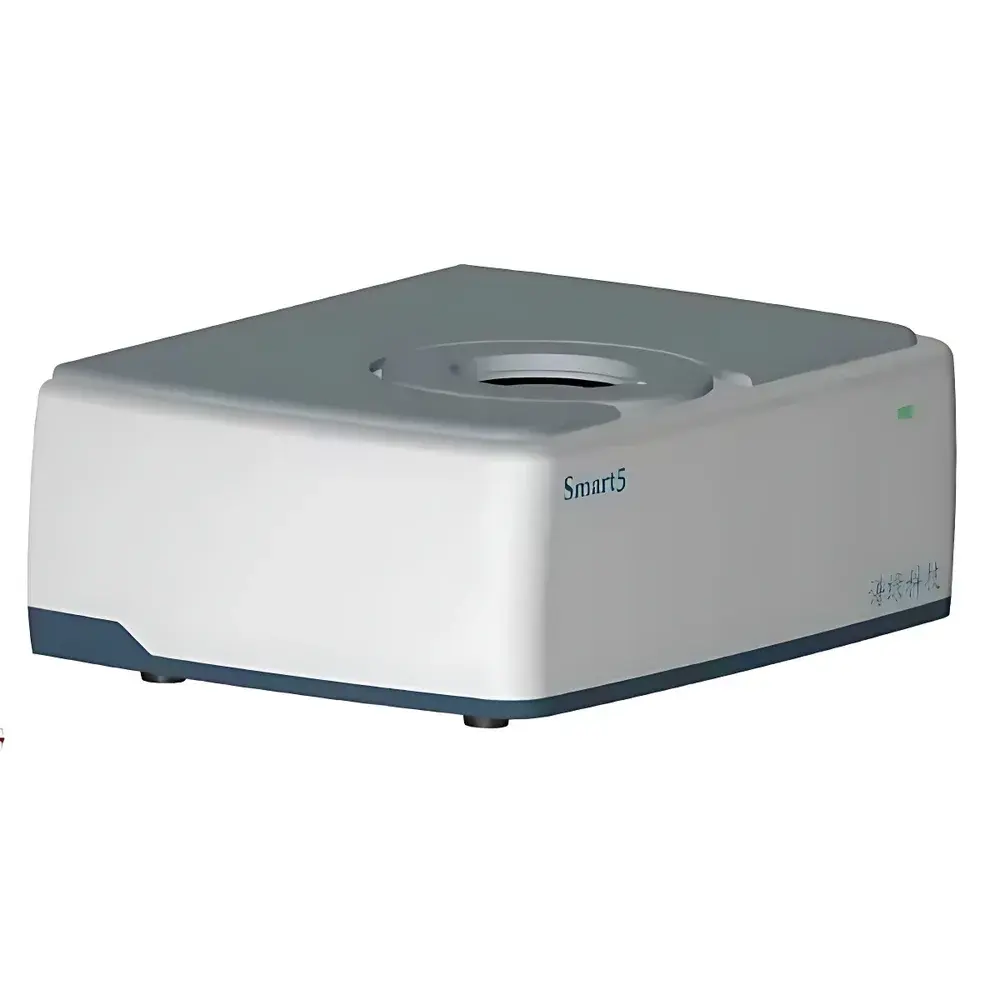
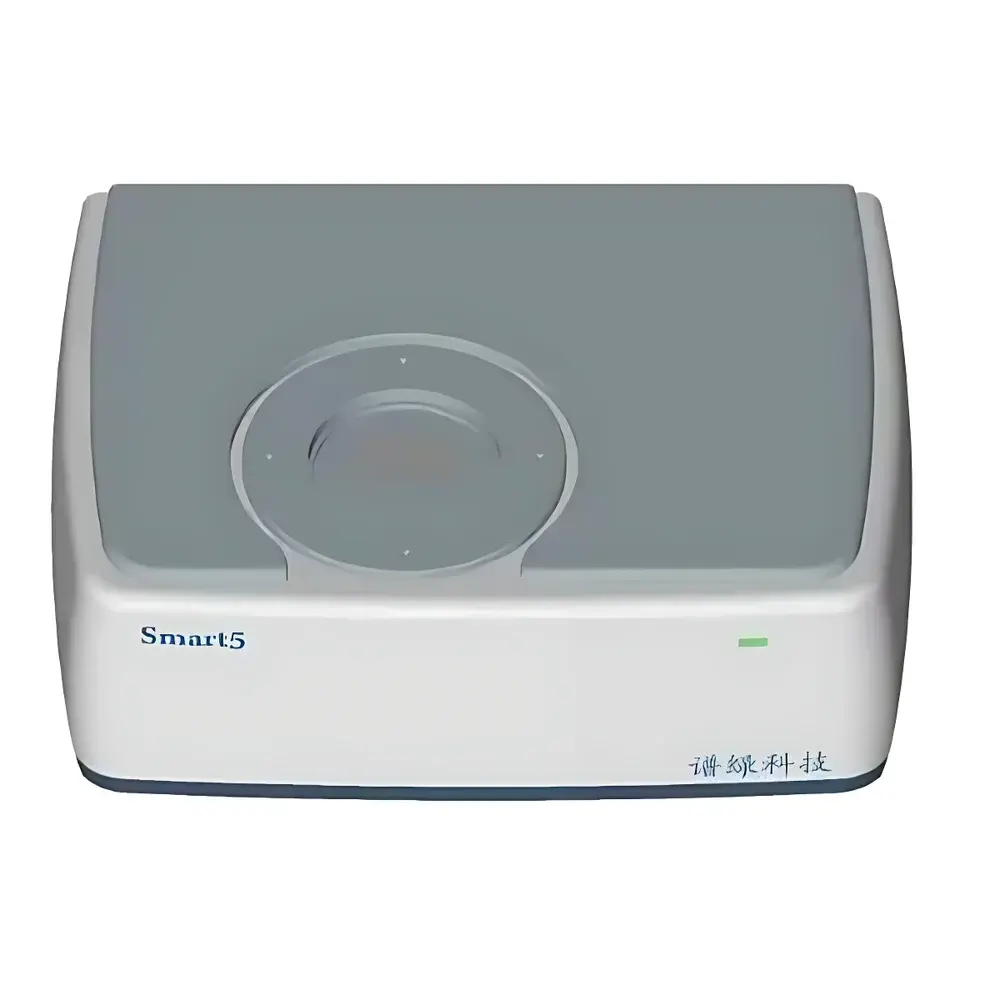
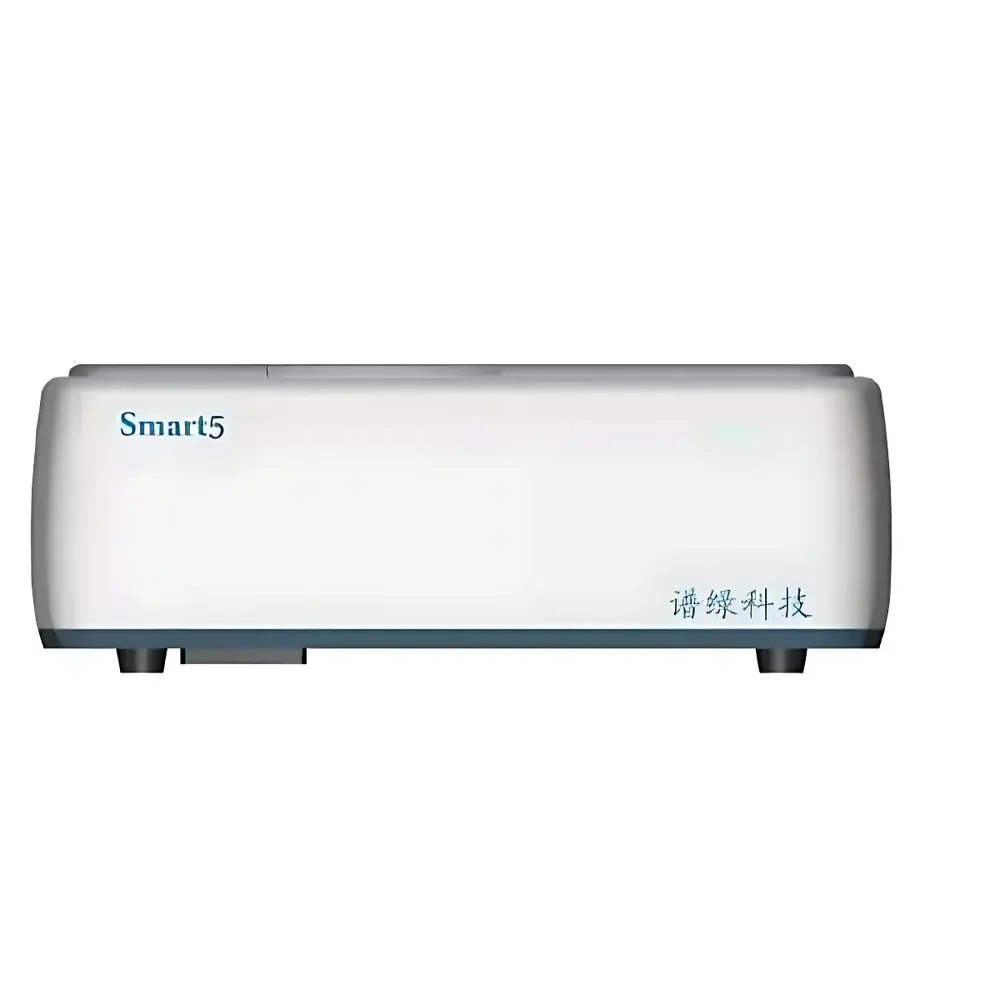
GreenSpectrum NIR SMART5 Multi-Application Intelligent Near-Infrared Spectrometer
| Brand | GreenSpectrum NIR |
|---|---|
| Origin | Shanghai, China |
| Manufacturer Type | Original Equipment Manufacturer (OEM) |
| Instrument Type | Laboratory Benchtop NIR Spectrometer |
| Optical Design | Grating Scanning System |
| Wavelength Range | 700–2500 nm |
| Sampling Mode | Integrating Sphere Diffuse Reflectance Unit |
| Data Output Modes | Absorbance (A), Reflectance (R), Spectral Radiant Energy (E) |
| Calibration Traceability | NIST-traceable standard materials with uniform wavelength calibration points across full spectral range |
| Model Transfer Capability | Verified inter-instrument model portability under ASTM E1655 and ISO 12099 protocols |
| Software Compliance | SmartScan (local control), SmartNet (networked LIMS/ERP integration) supporting audit trail, user access control, and 21 CFR Part 11–ready data integrity features |
| Regulatory Alignment | Designed for GLP/GMP-aligned workflows |
Overview
The GreenSpectrum NIR SMART5 Multi-Application Intelligent Near-Infrared Spectrometer is a laboratory-grade grating-scanning dispersive spectrometer engineered for high-reproducibility quantitative and qualitative analysis of heterogeneous solid, liquid, and semi-viscous samples. Operating on the fundamental principle of near-infrared absorption spectroscopy—where molecular overtones and combination vibrations (primarily C–H, O–H, and N–H bonds) generate characteristic spectral signatures—the SMART5 delivers rapid, non-destructive, and reagent-free measurements across the physiologically and industrially critical 700–2500 nm spectral window. Its optical architecture integrates a thermally stabilized tungsten-halogen light source, precision Czerny-Turner monochromator, InGaAs photodiode array detector (extended range), and a 150-mm integrating sphere with calibrated BaSO₄-coated interior for diffuse reflectance measurement. Unlike filter-based or diode-array systems, the grating-scanning design ensures superior spectral resolution (< 8 nm FWHM at 1550 nm), minimal stray light (< 0.05% at 1800 nm), and long-term photometric stability—key requirements for method transfer and regulatory-compliant routine testing.
Key Features
- Grating-scanning optical engine with real-time wavelength calibration using NIST-traceable ceramic standards at ≥12 uniformly distributed points across 700–2500 nm, ensuring inter-unit spectral accuracy ≤ ±0.5 nm (ASTM E1655 Section 7.3)
- Integrating sphere sampling unit with dual-beam referencing, motorized shutter, and temperature-compensated detector electronics to minimize drift during extended acquisition sequences
- SmartPower™ source management system: adaptive current regulation suppresses thermal shock during lamp ignition; low-power sleep mode (< 3 W) enables < 5-second wake-up without warm-up delay
- Multi-mode spectral output: simultaneous acquisition and export of absorbance (A), reflectance (R), and spectral radiant energy (E) matrices—enabling compatibility with both classical chemometric models and emerging deep-learning spectral architectures
- Hardware-level spectral preprocessing: onboard real-time dark-current subtraction, reference-beam normalization, and Savitzky-Golay smoothing (3rd-order, 15-point window) prior to data export
Sample Compatibility & Compliance
The SMART5 accommodates diverse physical sample forms—including powders, granules, pastes, slurries, films, and clear-to-turbid liquids—via its standardized 30-mm-diameter integrating sphere port (ISO 12099 Annex B compliant). Sample presentation accessories include reusable quartz cuvettes (1–5 mm pathlength), rotating sample cups for bulk solids, and fiber-optic probes (optional) for in-line process monitoring. All optical components comply with IEC 61000-4 electromagnetic immunity standards. The instrument’s firmware and SmartScan software are validated per GAMP5 guidelines and support full 21 CFR Part 11 compliance when deployed with SmartNet server authentication, electronic signature enforcement, and immutable audit trails. Calibration records, maintenance logs, and user activity history are stored in encrypted SQLite databases with SHA-256 hashing and automatic daily backup to network shares.
Software & Data Management
SmartScan is a Windows-native application providing intuitive workflow-driven operation: method setup, spectral acquisition, real-time baseline correction, and PCA-based outlier detection—all accessible without scripting. SmartNet extends functionality into enterprise environments: it enables centralized instrument monitoring, cross-laboratory model synchronization, and bidirectional data exchange with LIMS (e.g., LabVantage, Thermo Fisher SampleManager) and ERP platforms (e.g., SAP QM, Oracle Quality). Raw spectra (.spc, .jdx) and processed results (.csv, .xlsx) are tagged with ISO/IEC 17025-required metadata (operator ID, timestamp, environmental conditions, instrument serial number). Version-controlled PLS, PCR, and SVM regression models can be exported as portable .nirs files compatible with Unscrambler X, Pirouette, and Python-based scikit-learn pipelines.
Applications
The SMART5 serves as a primary analytical tool in R&D and QC laboratories across regulated and non-regulated sectors. In agricultural science, it quantifies crude protein, moisture, starch, and fiber in feedstuffs per AOAC 2011.02 and ISO 12099. In pharmaceutical manufacturing, it verifies excipient composition and blend uniformity in tablet formulations (USP <1119>). In food processing, it monitors sugar content in juice concentrates (ICUMSA Method GS3/4-12), fat oxidation in dairy powders (AOCS Cd 14d-92), and ethanol concentration in fermentation broths (OIV-MA-AS313-01B). Additional validated use cases include soil organic carbon estimation (ISO 14235), polymer identification (ASTM D7590), and biofuel blend verification (EN 14078).
FAQ
Does the SMART5 support method validation per ICH Q2(R2)?
Yes—its spectral stability, linearity (R² > 0.9999 over 0–3.0 AU), and repeatability (RSD < 0.3% for water peak at 1450 nm, n = 10) meet ICH Q2(R2) criteria for specificity, accuracy, and precision.
Can calibration models developed on one SMART5 be deployed directly on another unit?
Yes—inter-instrument model transfer has been verified across ≥20 units using ASTM E1655 Annex A protocols; mean prediction error increase is < 8% relative to single-instrument performance.
Is SmartNet compatible with existing LIMS infrastructure?
SmartNet provides RESTful API endpoints and HL7 v2.x message mapping; certified connectors are available for LabWare LIMS, Thermo Fisher SampleManager, and Waters Empower.
What maintenance is required for long-term spectral fidelity?
Annual wavelength and photometric calibration using GreenSpectrum-certified standards is recommended; no optical alignment or detector replacement is required within first 5 years under normal usage (≤8 hrs/day).
Does the system support remote diagnostics and firmware updates?
Yes—SmartNet includes secure TLS 1.3–encrypted remote session capability; firmware updates are digitally signed and validated pre-installation.
Related Products





