
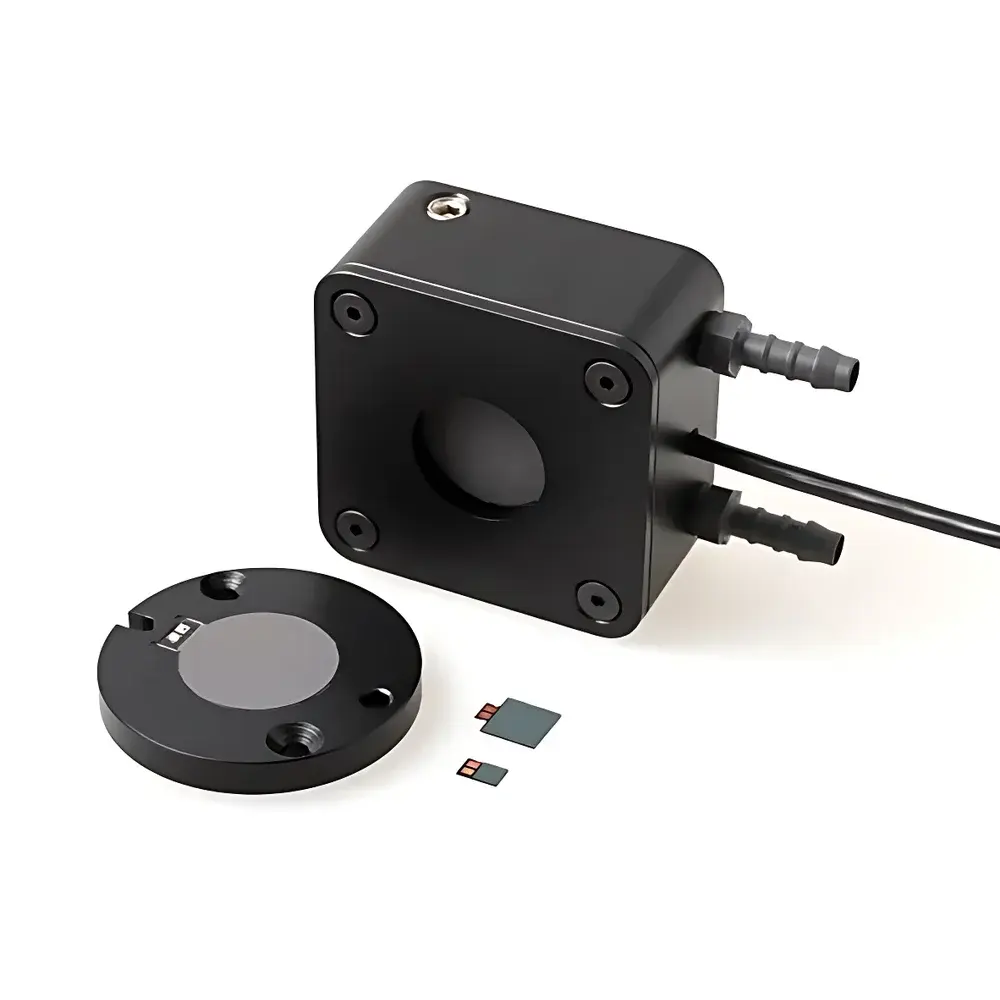
greenTEG gRAY Laser Power Detector
| Brand | greenTEG |
|---|---|
| Origin | Switzerland |
| Model | gRAY |
| Detection Principle | Thermoelectric (Thin-Film Thermopile) |
| Spectral Range | 200 nm – 12 µm |
| Rise Time | ≤ 200 ms |
| Active Area | 4.4 × 4.4 mm² |
| Compliance | CE, RoHS |
| Mounting | Standard SM1 (1.035"-40) threaded housing |
Overview
The greenTEG gRAY Laser Power Detector is a high-fidelity, thermoelectric-based optical power measurement instrument engineered for precision, stability, and broad-spectrum compatibility in demanding R&D, industrial laser processing, and metrology environments. Unlike photodiode-based sensors—whose responsivity varies significantly across wavelengths—the gRAY leverages a thin-film thermopile architecture originally developed at ETH Zurich. This solid-state thermal detection principle ensures flat spectral responsivity from deep ultraviolet (200 nm) through visible and near-infrared up to mid-infrared (12 µm), eliminating the need for wavelength-specific calibration factors or correction curves. Its measurement mechanism relies on the Seebeck effect: incident laser radiation is absorbed by a blackened, thermally isolated absorber layer; the resulting temperature gradient across integrated thermocouple junctions generates a proportional voltage output linearly related to incident power (in watts). This fundamental thermal transduction provides inherent DC-coupled response, insensitivity to beam polarization or spatial profile, and immunity to saturation effects common in semiconductor detectors.
Key Features
- Ultra-Broad Spectral Coverage: Validated responsivity across 200 nm – 12 µm enables single-sensor characterization of excimer lasers (193 nm), Ti:sapphire ultrafast systems (700–1000 nm), CO₂ lasers (10.6 µm), and quantum cascade lasers—without filter swaps or recalibration.
- Fast Thermal Response: Engineered thermal mass and optimized heat sinking achieve ≤ 200 ms rise time (10%–90%), supporting real-time monitoring of pulsed laser systems with repetition rates up to 5 Hz and quasi-CW modulation.
- Miniaturized Active Area: 4.4 × 4.4 mm² detector aperture accommodates tight optical layouts while maintaining uniform spatial responsivity—critical for Gaussian beam profiling and M² measurements when used in conjunction with scanning slit or camera-based systems.
- Passive & Self-Powered Operation: No external bias voltage or cooling required. Output signal is intrinsically proportional to absorbed power, minimizing electronic noise sources and enabling integration into embedded OEM platforms.
- Traceable Metrological Integrity: Factory calibration performed against primary standards at PTB (Physikalisch-Technische Bundesanstalt) or NIST-traceable reference detectors, with full uncertainty budget documentation supplied per unit.
Sample Compatibility & Compliance
The gRAY detector is compatible with continuous-wave (CW), modulated, and repetitively pulsed laser sources operating within its damage threshold (≥ 5 kW/cm² for nanosecond pulses, ≥ 100 W/cm² for CW at 1064 nm—derated per wavelength and pulse duration). It requires no beam attenuation for most industrial and scientific lasers below 10 W average power. The detector housing conforms to standard SM1 (1.035″-40) threading for direct integration into lens tubes, kinematic mounts, and optical breadboards. All units comply with EU Directive 2014/30/EU (EMC), 2014/35/EU (LVD), and Regulation (EU) 2017/2102 (RoHS 3). Calibration certificates include ISO/IEC 17025:2017 accreditation statements where applicable, supporting GLP/GMP-aligned validation protocols.
Software & Data Management
The gRAY outputs an analog voltage signal (typically 0–10 V or ±10 V, scalable via external amplifier) directly proportional to incident power. For digital acquisition, it integrates seamlessly with industry-standard DAQ systems (National Instruments, Keysight, Dewesoft) and supports synchronization via TTL trigger inputs for gated averaging of pulsed sources. greenTEG provides open-source Python and LabVIEW drivers under MIT license, enabling automated calibration loading, temperature-compensated power calculation, and timestamped data logging. Raw voltage readings are traceable to SI watt units using the certified responsivity factor (V/W) and associated uncertainty (k = 2). Audit trails, user-defined metadata tagging, and CSV/HDF5 export formats meet requirements for FDA 21 CFR Part 11 compliance when deployed with validated software environments.
Applications
- Laser diode and fiber laser output power stabilization and long-term drift monitoring in manufacturing test stands
- Calibration transfer between primary radiometric standards and secondary field instruments in national metrology institutes
- Real-time feedback control in laser welding, cladding, and additive manufacturing systems
- Characterization of ultrafast amplifier chains (e.g., chirped-pulse amplification systems) where photodiode saturation or nonlinearities compromise accuracy
- UV curing lamp intensity mapping and lifetime degradation studies in semiconductor photolithography tooling
- Mid-IR laser safety interlock verification per IEC 60825-1:2014 Edition 3.0
FAQ
Is the gRAY detector suitable for measuring femtosecond laser pulses?
Yes—provided average power remains within specification and pulse energy does not exceed the single-shot damage threshold (typically >100 µJ for 100 fs pulses). Its thermal response integrates energy over time; peak power estimation requires independent pulse duration measurement.
Does it require periodic recalibration?
greenTEG recommends annual recalibration for applications requiring ISO/IEC 17025 traceability. Long-term drift is typically <±0.5% per year under stable environmental conditions.
Can it be used in vacuum environments?
Standard gRAY units are rated for ambient operation only. Vacuum-compatible variants with hermetically sealed housings and outgassing-certified materials are available upon request (model suffix “-VAC”).
How is temperature sensitivity compensated?
Each unit includes an integrated NTC thermistor. Compensation algorithms—provided in driver libraries—correct for ambient temperature-induced responsivity shifts (±0.02 %/°C typical).
What mounting accessories are included?
All units ship with SM1-threaded retaining rings, protective dust caps, and a calibration certificate. Optional accessories include water-cooled heat sinks, beam dump adapters, and collimated input apertures for high-power applications.





