
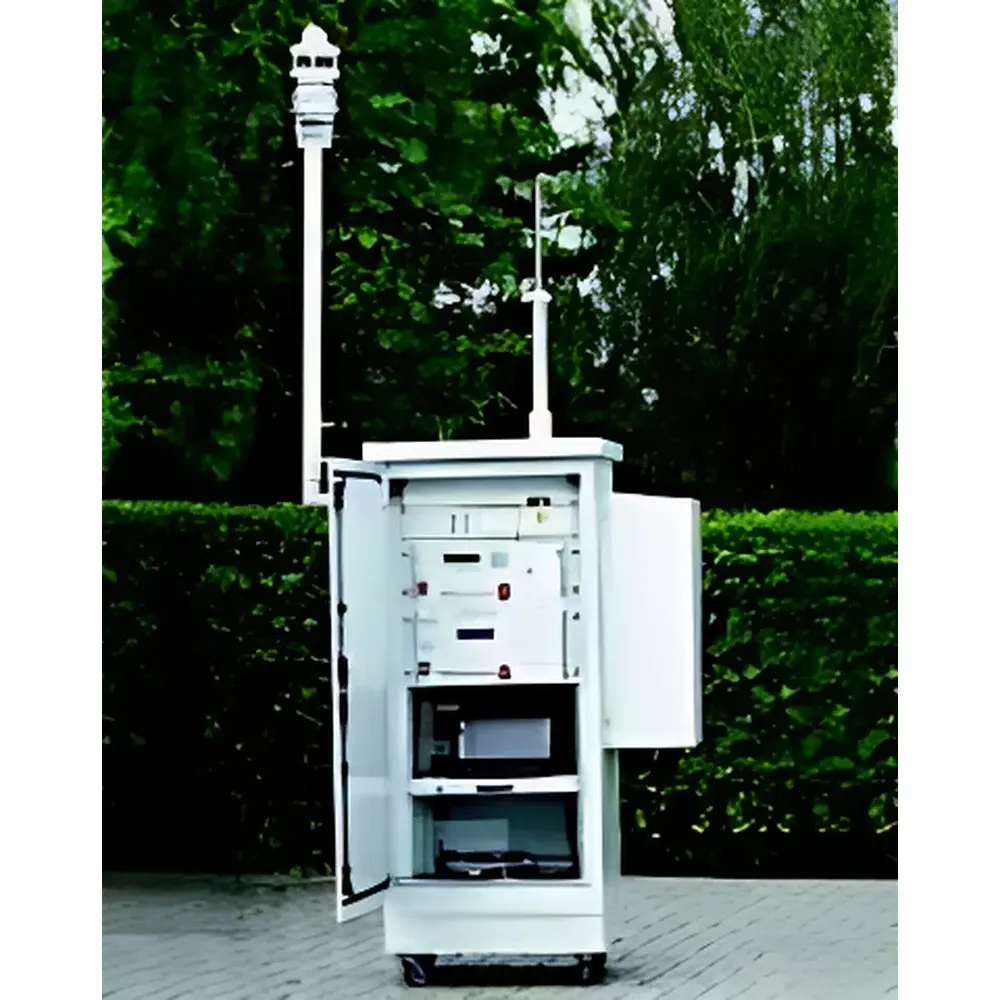
GRIMM EDM665 WRAS Wide-Range Aerosol Particle Size Spectrometer
| Brand | GRIMM |
|---|---|
| Origin | Germany |
| Model | EDM665 |
| Principle | Combined Scanning Mobility Particle Sizer + Optical Particle Counter (SMPS+C + OPC) |
| Sample Flow Rate | 1.2 L/min (OPC), 0.3 L/min (SMPS) |
| Particle Size Range | 5.5 nm – 32 µm |
| Counting Concentration Range | 1 – 10⁷ particles/cm³ |
| Size Channels | 71 total (44 SMPS + 31 OPC) |
| Repeatability | ±3% |
| Operating Temperature | −20 °C to +55 °C |
| Power Supply | 110/220 VAC, 50/60 Hz, 750 W |
| Dimensions | 60 × 60 × 120 cm |
| Weight | 120 kg (incl. power unit) |
| Sampling Inlet | 1.5 m standard (3 m optional), with isothermal dehumidification system |
| Enclosure | Weatherproof outdoor cabinet with active air conditioning |
Overview
The GRIMM EDM665 WRAS (Wide-Range Aerosol System) is a dual-technology, field-deployable particle size spectrometer engineered for high-fidelity, continuous measurement of atmospheric aerosols across an exceptionally broad size spectrum—from nucleation-mode nanoparticles to coarse-mode dust particles. It integrates two complementary analytical modules into a single robust platform: a Scanning Mobility Particle Sizer with Condensation Particle Counter (SMPS+C) for high-resolution sizing and quantification of particles from 5.5 nm to 350 nm, and an Optical Particle Counter (OPC) optimized for rapid, real-time detection of particles from 250 nm to 32 µm. This hybrid architecture eliminates the need for manual instrument switching or data stitching, enabling seamless, gap-free size distribution acquisition over 71 logarithmically spaced channels. The system operates on the fundamental principles of electrical mobility classification (for sub-350 nm particles) and light-scattering cross-section calibration (for supermicron particles), ensuring metrological traceability to SI units when operated under controlled environmental conditions. Designed for long-term unattended operation in ambient monitoring networks, research stations, and industrial emission compliance sites, the EDM665 WRAS meets the functional requirements of ISO 27891:2019 (aerosol instrumentation performance verification) and supports data integrity frameworks aligned with EU Directive 2008/50/EC (ambient air quality assessment).
Key Features
- Dual-sensor architecture: Simultaneous, synchronized operation of SMPS+C and OPC modules ensures full coverage from 5.5 nm to 32 µm without size-range discontinuities.
- High channel resolution: 71 discrete size bins—44 from SMPS (5.5–350 nm) and 31 from OPC (250 nm–32 µm)—with overlapping channels enabling cross-validation at the 250–350 nm transition zone.
- Automated fluid management: Integrated butanol saturation system with self-refilling reservoir and continuous condensate extraction via micro-pump minimizes operator intervention and maintains stable CPC efficiency.
- Environmental resilience: IP55-rated outdoor enclosure with active climate control maintains internal thermal stability (±1.5 °C) across −20 °C to +55 °C ambient conditions, critical for consistent electrostatic classifier performance.
- Isokinetic sampling interface: Standard 1.5 m heated, isothermal inlet line with integrated dehumidification prevents hygroscopic growth artifacts and preserves native particle morphology during transport.
- Modular I/O architecture: Two RS-232 ports (9-pin D-sub), dual PCMCIA memory card slots, and dedicated analog inputs for co-located meteorological sensors (T, RH, P, wind) and gas analyzers (NO₂, O₃, SO₂).
Sample Compatibility & Compliance
The EDM665 WRAS is validated for ambient air, stack emissions, indoor environments, and controlled laboratory aerosols—including combustion-generated soot, secondary organic aerosols (SOA), mineral dust, sea salt, and bioaerosols (e.g., fungal spores, pollen fragments). Its dual-method design inherently accommodates particle composition-dependent refractive index variability: SMPS+C provides mobility-equivalent diameter (independent of optical properties), while OPC yields optical-equivalent diameter (sensitive to RI and shape). This enables discrimination between particle types in mixed populations—a capability leveraged in source apportionment studies compliant with EPA PMF 5.0 protocols. The system supports audit-ready data logging per GLP/GMP standards, with timestamped metadata, instrument status flags, and configurable audit trails. Firmware complies with IEC 61508 SIL2 for safety-related functions, and raw data output formats (ASCII, CSV, netCDF) are compatible with EEA AirBase, US EPA AQS, and WHO Global Ambient Air Quality Database ingestion pipelines.
Software & Data Management
GRIMM’s proprietary GRIMMsoft WRAS v4.x software provides real-time visualization of differential and integral size distributions, time-series concentration heatmaps, and dynamic mode analysis (DMA scanning profiles). All data are stored with embedded calibration certificates, flow sensor diagnostics, and temperature/humidity compensation logs. The software enforces 21 CFR Part 11-compliant user access control (role-based permissions), electronic signatures for method changes, and immutable audit trails for all data export and report generation events. Raw binary files are archived with SHA-256 checksums; processed outputs include ISO/IEC 17025-aligned uncertainty budgets calculated per GUM (JCGM 100:2018) using manufacturer-provided sensitivity coefficients and in-field flow/temperature drift corrections. Export options support direct integration with Python (via PyGRIMM API), MATLAB, and R statistical environments for advanced clustering (e.g., k-means on log-normal modes) and machine learning–assisted source identification.
Applications
- Ambient air quality monitoring networks requiring compliance with EU Directive 2008/50/EC and US EPA PM2.5/PM10 monitoring guidelines.
- Indoor air quality assessment in healthcare facilities, cleanrooms, and educational buildings per ISO 16814 and ASHRAE Standard 62.1.
- Emission characterization from combustion sources (diesel engines, biomass burners, industrial kilns) in accordance with ISO 8503-3 and VDI 2066.
- Nanomaterial occupational exposure assessment per EN 482 and ISO/TR 12885, supporting Tier 2 and Tier 3 exposure modeling.
- Atmospheric science campaigns studying new particle formation (NPF), cloud condensation nuclei (CCN) activation, and aerosol–radiation interactions.
- Pharmaceutical inhaler plume characterization and dry powder aerosol delivery validation under USP <1207> and Ph. Eur. 2.9.18.
FAQ
What is the minimum detectable particle concentration for the SMPS+C module?
The lower limit of detection (LOD) is 1 particle/cm³ at 300 s scan time, verified using monodisperse PSL standards traceable to NIST SRM 1963.
Can the EDM665 WRAS be operated indoors without the outdoor cabinet?
Yes—the core spectrometer unit may be installed in climate-controlled laboratories; however, the outdoor cabinet is mandatory for unattended field deployment due to its integrated thermal regulation and ingress protection.
How is size calibration maintained during long-term operation?
Automated daily zero checks and bi-weekly multi-point calibration using NIST-traceable PSL aerosols (50, 100, 200, 300 nm) are scheduled via GRIMMsoft; calibration certificates are auto-generated and stored with each dataset.
Does the system support remote diagnostics and firmware updates?
Yes—via secure TLS 1.3-enabled Ethernet connection; remote access requires two-factor authentication and is logged in full compliance with ISO/IEC 27001 Annex A.10.1.2.
Is the OPC module compliant with ISO 21501-4 for optical particle counters?
The OPC subsystem meets the metrological requirements of ISO 21501-4:2018 for size resolution, counting efficiency, and false count rate—verified by independent DAkkS-accredited calibration laboratory reports included with each unit.







