
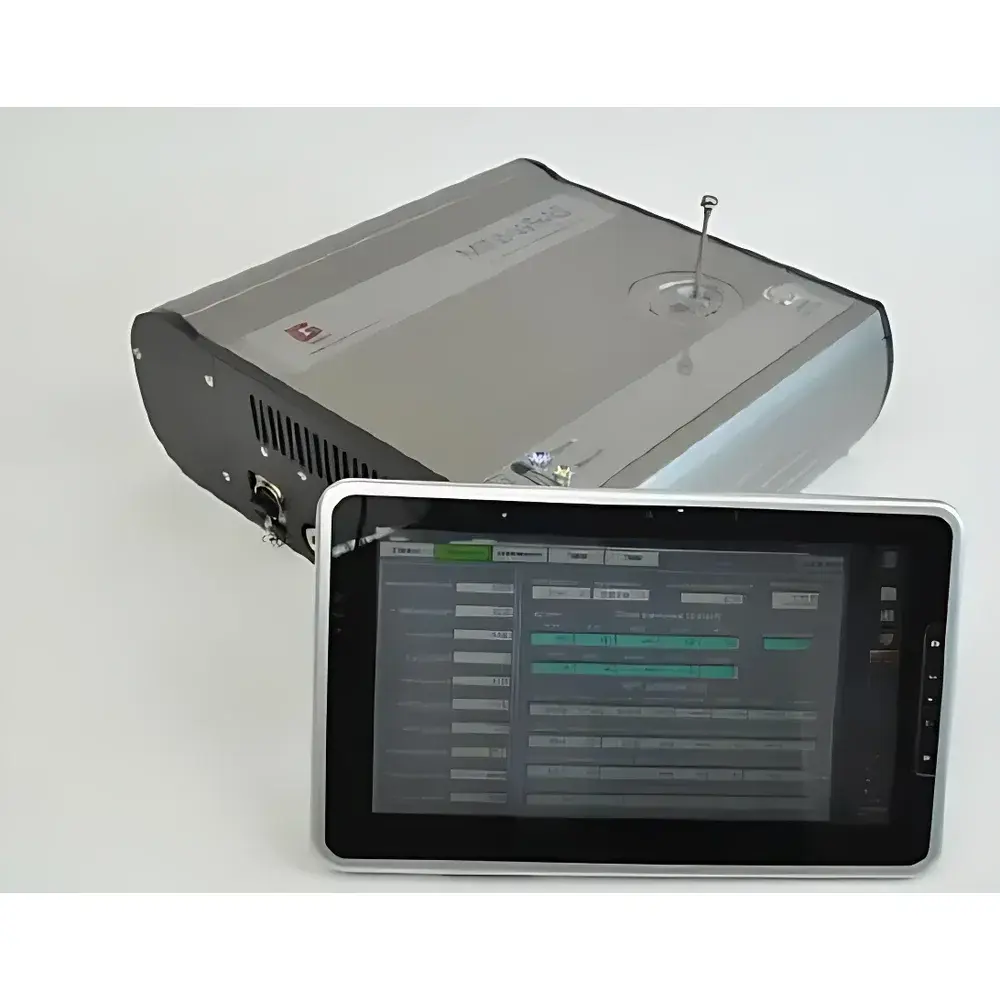
GRIMM MiniWRAS 1371 Portable Wide-Range Aerosol Particle Size Spectrometer
| Brand | GRIMM |
|---|---|
| Origin | Germany |
| Model | 1371 |
| Sampling Flow Rate | 1.2 L/min ±5% |
| Particle Size Range | 10 nm – 35 µm |
| Number Concentration Range | 1 – 3,000,000 particles/L |
| Number of Size Channels | 41 |
| Mass Concentration Range | 0.0001 – 100 mg/m³ |
Overview
The GRIMM MiniWRAS 1371 is a field-deployable, dual-technology aerosol particle size spectrometer engineered for high-fidelity, real-time characterization of airborne particulate matter across an exceptionally broad size range—from 10 nanometers to 35 micrometers. It uniquely integrates two complementary physical measurement principles: optical particle counting (OPC) for coarse and fine fractions (0.20–35 µm), and differential mobility analysis (DMA) coupled with Faraday cup electrometry for the ultrafine and nanoparticle regime (10–200 nm). This hybrid architecture enables continuous, simultaneous acquisition of number, surface area, and mass concentration distributions without reliance on radioactive sources or butanol-based diffusion charging—ensuring regulatory compliance, operational safety, and long-term stability in diverse environmental and occupational settings.
Key Features
- Dual-sensor architecture: OPC (90° light scattering at 660 nm laser wavelength) + electrostatic classification with Faraday cup detection for trace-level nanoparticle quantification
- 41 discrete size channels: 10 electrically classified channels (10–200 nm) and 31 optical channels (0.20–35 µm), aligned to EN 481-defined health-related aerosol fractions (inhalable, thoracic, respirable)
- Integrated sampling system: Constant-flow pump (1.2 L/min ±5%), auto-compensated for ambient pressure variations (1013 hPa ±120 hPa), with internal zero-air purge (0.3 L/min) for optical path cleaning during startup and standby
- Onboard power management: Rechargeable 14.4 V / 4.8 Ah Li-ion battery supporting ≥8 hours of continuous operation; external 18 VDC adapter included
- Robust field design: IP54-rated enclosure (34 × 31 × 12 cm, 8.2 kg), operating temperature range +4°C to +40°C, humidity tolerance <95% RH non-condensing
- Real-time data output: Full 41-channel number concentration (particles/L and particles/cm³) updated every 60 seconds, with automatic calculation of PM₁, PM₂.₅, PM₁₀, PM₀.₅, and PM₀.₁ mass equivalents
Sample Compatibility & Compliance
The MiniWRAS 1371 is validated for ambient air, indoor environments, workplace atmospheres, and controlled chamber studies. Its measurement methodology conforms to ISO 27891:2019 (aerosol instrumentation—requirements for particle size spectrometers), EN 481:1993 (health-related aerosol fraction definitions), and supports GLP-compliant monitoring under EU Directive 2008/50/EC (ambient air quality). The absence of radioactive materials ensures unrestricted transport and deployment in sensitive facilities (e.g., hospitals, cleanrooms, educational institutions). All calibration traceability is maintained via GRIMM’s certified reference aerosols and NIST-traceable flow meters. No consumables (e.g., butanol, radioactive sources) are required—reducing lifecycle cost and administrative burden.
Software & Data Management
Data acquisition and visualization are performed using GRIMM LabView Software 1378, compatible with Windows 7/10/11 (32- and 64-bit). The software provides full remote control via Bluetooth, USB, or RS-232 interfaces, enabling unattended long-term deployments. Raw outputs are stored in ASCII format and exportable to Excel-compatible CSV files. Audit-ready features include time-stamped metadata, instrument status logs, and automatic self-test records generated at each power-on cycle. For regulated environments, the software supports user-access controls and optional 21 CFR Part 11–compliant electronic signature modules when deployed with validated IT infrastructure.
Applications
- Ambient air quality monitoring networks requiring sub-micron resolution for source apportionment and trend analysis
- Occupational hygiene assessments in manufacturing, construction, pharmaceutical production, and nanomaterial handling facilities
- Indoor air quality diagnostics in schools, offices, and healthcare settings—especially where ultrafine particle exposure is a concern
- Research-grade validation of filtration efficiency, HVAC performance, and emission control technologies
- Mobile monitoring campaigns using vehicle-mounted or handheld configurations for spatial mapping of aerosol hotspots
- Calibration and intercomparison studies against reference instruments (e.g., SMPS, APS, TEOM)
FAQ
Does the MiniWRAS 1371 require radioactive sources or butanol for operation?
No. It uses corona discharge for nanoparticle charging and 660 nm laser-based optical detection—eliminating regulatory restrictions and maintenance overhead.
How is size calibration maintained across the full 10 nm–35 µm range?
Calibration is performed using monodisperse PSL and DEHS aerosols traceable to NIST standards; GRIMM provides annual recalibration services with documented uncertainty budgets.
Can the instrument operate autonomously for extended periods?
Yes. With its internal battery and programmable data logging interval (default 1 minute), it supports unattended 8-hour deployments; external power or solar-charging kits extend duration indefinitely.
Is the data output compatible with centralized environmental monitoring platforms?
Yes. ASCII-formatted real-time streams support integration into SCADA, IoT gateways, and cloud-based analytics platforms via serial or Bluetooth protocols.
What maintenance is required between calibrations?
Routine optical path cleaning via automated purge cycles; annual verification of flow sensor accuracy and voltage stability in the DMA section is recommended.







