
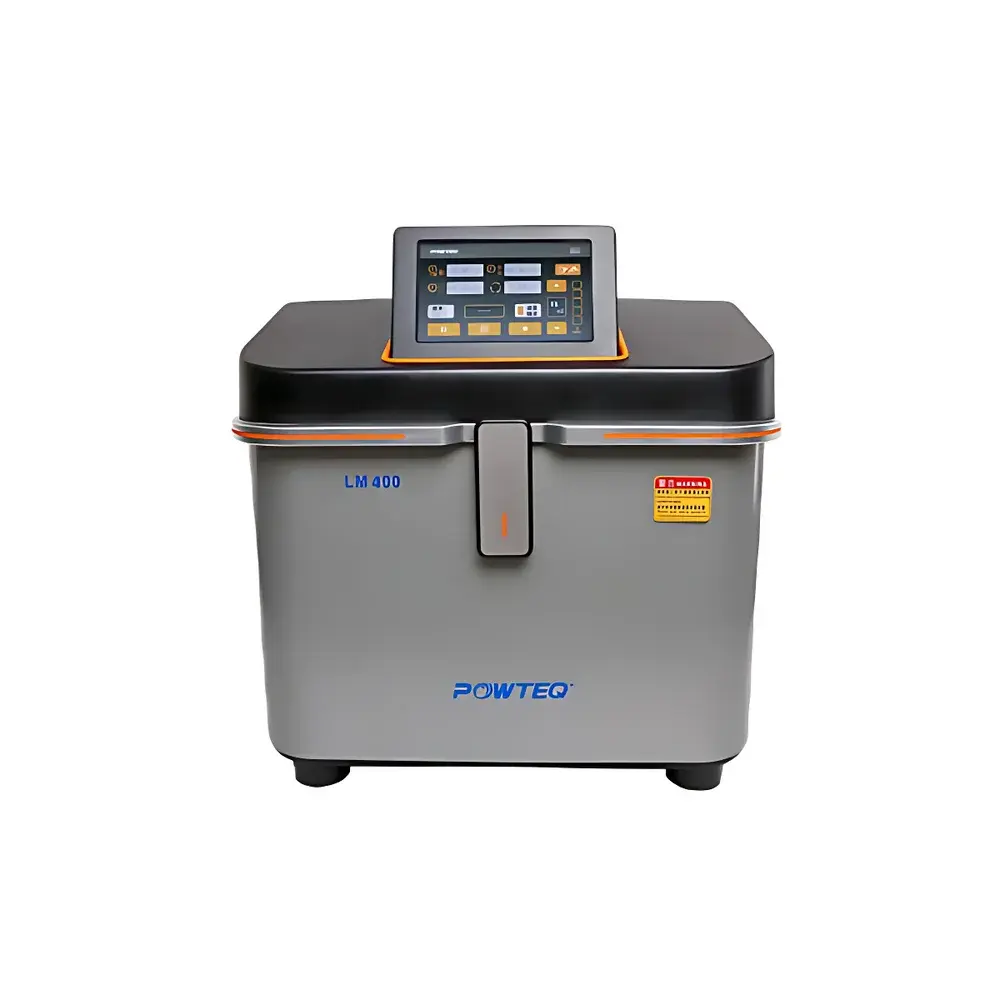
GRINDER LM400 Automated Cryogenic Ball Mill
| Brand | GRINDER |
|---|---|
| Origin | Beijing, China |
| Manufacturer Type | Direct Manufacturer |
| Instrument Type | Electromagnetic Cryogenic Ball Mill |
| Sample Compatibility | Cryogenic Samples (Liquid Nitrogen Environment) |
| Output Particle Size | 0.01–0.5 mm |
| Batch Processing Volume | 400 mL |
| Pre-cooling Chamber Capacity | 400 mL |
| Grinding Chamber Capacity | 400 mL |
| Optional Grinding Vials | 12 micro vials / 4 small vials / 1 medium vial / 1 large vial |
| Electromagnetic Frequency Range | 5–15 Hz |
| Rated Power | 1900 W |
| Safety Interlock | Lid-closed activation only |
| LN₂ Delivery | Auto-fill + manual override |
Overview
The GRINDER LM400 Automated Cryogenic Ball Mill is an engineered solution for the reproducible, high-fidelity comminution of thermolabile and tough biological, polymeric, and organic materials under strictly controlled cryogenic conditions. Operating continuously at –196 °C in a liquid nitrogen (LN₂) immersion environment, the LM400 leverages electromagnetic oscillation-driven impact mechanics—distinct from conventional rotary or planetary ball milling—to induce rapid, uniform fragmentation of samples that are otherwise resistant to room-temperature grinding. This principle ensures minimal thermal degradation, suppression of volatile compound loss, and preservation of nucleic acid integrity (DNA/RNA), protein conformation, and polymer crystallinity—critical for downstream analytical workflows including qPCR, sequencing, FTIR, DSC, and elemental analysis.
Key Features
- Electromagnetic impact mechanism delivering horizontal reciprocating motion to stainless-steel or tungsten carbide impact rods inside sealed cryo-vials—enabling consistent energy transfer without mechanical gear wear or rotational inertia limitations.
- Integrated auto-fill LN₂ delivery system with level sensors and programmable top-up cycles, eliminating manual handling risks and ensuring stable thermal maintenance throughout pre-cooling and grinding phases.
- Intuitive touchscreen interface supporting independent parameter control: pre-cooling duration (0–30 min), grinding time per cycle (0.1–99.9 min), total cycle count (1–99), and electromagnetic frequency (5–15 Hz).
- Dual-chamber architecture: 400 mL pre-cooling chamber and 400 mL active grinding chamber—designed for batch homogeneity and scalable throughput while maintaining strict thermal isolation.
- Multi-vial compatibility: configurable setups include 12 × 2 mL micro-vials, 4 × 10 mL small vials, or single 50 mL medium/large vials—supporting parallel processing across heterogeneous sample types.
- Hardware-enforced safety interlock: motor and LN₂ valves remain de-energized unless the hinged lid is fully closed and mechanically latched—compliant with IEC 61000-6-2/6-4 EMC and ISO 13857 access protection standards.
Sample Compatibility & Compliance
The LM400 is validated for use with soft-tissue biopsies (muscle, liver, brain), keratinous matrices (hair, nail, horn), mineralized tissues (bone, tooth), fibrous polymers (rubber, PET, PTFE), plant matter (seeds, roots, leaves), and pharmaceutical excipients. Its cryogenic operation meets method requirements outlined in ASTM E1988 (cryogenic sample preparation for polymer characterization), USP (microbiological control of cryopreserved materials), and ISO 17025-accredited labs’ documented procedures for nucleic acid stabilization. All vial materials (stainless steel, hardened alloy) comply with FDA 21 CFR 177.1520 for food-contact surfaces, and instrument firmware supports audit-trail logging per GLP/GMP Annex 11 and 21 CFR Part 11 when paired with GRINDER’s optional LIMS-integrated software module.
Software & Data Management
The embedded controller logs timestamped operational records—including LN₂ consumption volume, real-time temperature (via dual Pt100 probes), frequency deviation, and cycle completion status—for traceability. Optional Ethernet/Wi-Fi connectivity enables remote monitoring via GRINDER’s LabLink™ desktop application, which exports CSV/Excel reports compatible with ELN systems (e.g., LabArchives, Benchling). Method templates can be password-protected, version-controlled, and assigned to user roles—facilitating SOP enforcement and regulatory review readiness.
Applications
- Genomic & transcriptomic sample prep: high-yield, low-degradation tissue homogenization prior to DNA/RNA extraction.
- Pharmaceutical solid-state characterization: particle size reduction of amorphous dispersions and co-crystals without recrystallization.
- Materials science: dispersion of nanocomposites, cryo-milling of brittle ceramics, and pre-analysis conditioning of elastomers for TGA/DMA.
- Food authenticity testing: homogenization of heterogeneous matrices (e.g., meat blends, dairy powders) for isotopic or adulterant screening.
- Forensic toxicology: efficient cell lysis and matrix disruption in hair/nail samples for LC-MS/MS drug metabolite quantification.
FAQ
What is the minimum sample mass required for reliable grinding?
The system achieves optimal energy transfer with ≥0.1 g per vial; however, method validation is recommended for masses below 0.5 g due to potential heterogeneity in impact rod contact.
Can the LM400 be integrated into automated lab workflows?
Yes—digital I/O ports support TTL-triggered start/stop signals, and Modbus TCP protocol enables synchronization with robotic arms or sample carousel systems.
Is routine calibration required for the electromagnetic drive system?
No scheduled calibration is needed; the frequency generator is factory-calibrated with NIST-traceable instrumentation and retains stability over 10,000 operating hours.
How does the LM400 differ from standard cryo-mills using mechanical shaking?
Unlike eccentric-shaft or orbital shaker-based cryo-mills, the LM400’s direct electromagnetic actuation eliminates harmonic resonance buildup, reduces vibration transmission to adjacent equipment, and delivers higher impact velocity consistency across all vial positions.
What maintenance intervals are recommended for the LN₂ delivery subsystem?
LN₂ solenoid valves and level sensors require annual inspection; filter cartridges in the auto-fill line should be replaced every 6 months under continuous operation (≥8 hrs/day).



