
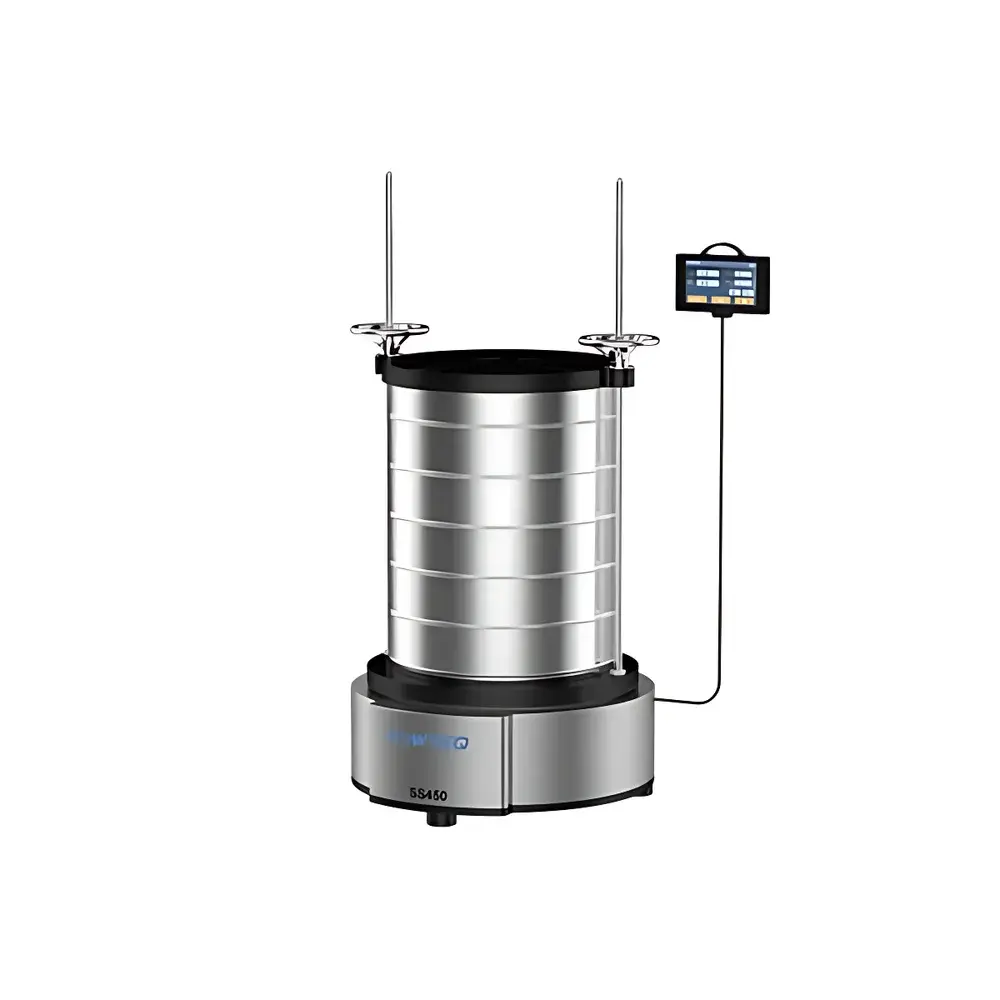
Grinderman SS450 Electromagnetic Vibratory Sieve Analyzer
| Brand | Grinderman |
|---|---|
| Origin | Beijing, China |
| Manufacturer Type | Direct Manufacturer |
| Model | SS450 |
| Principle | Electromagnetic vibratory sieving |
| Particle Size Range | 20 µm – 40 mm |
| Maximum Load Capacity | 25 kg |
| Sieve Stack Levels | 9 |
| Amplitude Range | 0.2–2.2 mm |
| Timing Range | 0–99 min |
| Intermittent Drive Interval | 0–99 s |
| Vibration Mode | 3D orbital throw motion |
| Sieve Diameter | 450 mm (17.7") |
| Programmable Parameter Sets | 9 |
| Max. Sieve Tower Mass | 50 kg |
| Dry/Wet Sieving Capability | Yes |
| Display | 5" LED Touchscreen |
Overview
The Grinderman SS450 Electromagnetic Vibratory Sieve Analyzer is a precision-engineered instrument designed for standardized particle size distribution analysis of dry or wet granular and powdered materials. It operates on the principle of controlled electromagnetic excitation, generating a reproducible three-dimensional orbital throw motion that ensures uniform particle agitation across the entire sieve surface. This motion—distinct from simple vertical or horizontal oscillation—enhances particle stratification, accelerates stratified layer formation, and minimizes blinding or agglomeration effects common in conventional mechanical shakers. The SS450 complies with internationally recognized sieving standards including ISO 2591-1, ASTM E11, and ISO 3310-1 for test sieve specifications, making it suitable for method validation under GLP and regulated QC environments.
Key Features
- Electromagnetic drive system delivering stable, maintenance-free operation with low acoustic emission (<65 dB(A) at 1 m), enabling use in shared laboratory spaces without noise mitigation infrastructure.
- Programmable 3D orbital throw motion with adjustable amplitude (0.2–2.2 mm) and time duration (0–99 min), supporting both continuous and intermittent sieving protocols.
- Integrated 5-inch LED touchscreen interface with intuitive icon-based navigation; supports multilingual UI (English, German, French, Spanish) and real-time parameter feedback.
- Nine pre-stored method profiles allow rapid recall of validated sieving conditions—including amplitude, time, pause intervals, and motion mode—for routine batch testing.
- Dual-mode capability: configurable for dry sieving (ISO 9276-2 compliant) or wet sieving (per ISO 2591-2), with optional liquid-tight sieve frame kits and drainage trays.
- Robust mechanical architecture accommodates up to 9 sieve levels (standard) or 12-level stacks (with optional extended tower), with standard 450 mm (17.7″) diameter sieves conforming to ISO 3310-1 tolerances.
- Modular design permits field-upgradable firmware and seamless integration with external data systems via USB 2.0 and RS-232 interfaces.
Sample Compatibility & Compliance
The SS450 is validated for use with free-flowing, non-cohesive, and moderately cohesive particulates ranging from fine mineral powders (e.g., kaolin, talc) to coarse aggregates (e.g., crushed granite, foundry sand). It handles organic materials including cereal grains, coffee beans, pharmaceutical granules, and biomass pellets without thermal degradation or mechanical attrition. All contact surfaces are constructed from stainless steel (AISI 304) or anodized aluminum, ensuring chemical resistance during wet sieving with aqueous or mild solvent-based suspensions. The instrument meets CE marking requirements (2014/30/EU EMC Directive and 2014/35/EU LVD Directive) and supports audit-ready documentation per FDA 21 CFR Part 11 when used with optional Grinderman SieveLink™ software (version 3.2+).
Software & Data Management
Grinderman SieveLink™ software (Windows 10/11 compatible) provides full remote control, automated data logging, and statistical reporting. It captures timestamped sieve residue weights per level, calculates cumulative undersize/oversize distributions, and generates D10/D50/D90 metrics, span, and graphical representations (histograms, Rosin-Rammler plots). Audit trails record all parameter changes, user logins, and calibration events. Data exports comply with ASTM E2852-22 for digital sieve analysis reporting and support CSV, PDF, and XML formats for LIMS integration. Software validation packages—including IQ/OQ documentation—are available upon request for regulated pharmaceutical or food-grade applications.
Applications
- Quality assurance of raw materials in cement, ceramics, and refractory manufacturing.
- Particle size verification of API blends and excipients prior to tablet compression (aligned with USP <786>).
- Soil texture classification per USDA and FAO guidelines in geotechnical and agricultural labs.
- Granulometric characterization of recycled construction aggregates for compliance with EN 12620.
- R&D screening of battery cathode/anode powders (e.g., NMC, graphite) where tap density and flowability correlate strongly with sieve cut points.
- Feedstock qualification for additive manufacturing metal powders (ASTM F3049-16).
FAQ
What sieve standards does the SS450 support?
It accepts ISO 3310-1, ASTM E11, and DIN 4188-compliant 450 mm diameter test sieves with woven wire mesh or perforated plate inserts.
Can the SS450 be calibrated traceably to national standards?
Yes—Grinderman provides optional NIST-traceable calibration kits for amplitude verification and certified reference materials (CRM) for particle size validation (e.g., NIST SRM 1990b).
Is wet sieving performed under vacuum or pressure?
No—wet sieving is gravity-fed with optional peristaltic pump integration for recirculated suspension delivery; no pressurized or vacuum-assisted modules are included in the base configuration.
How is data integrity ensured during long-duration sieving runs?
The embedded microcontroller logs all operational parameters at 100 ms intervals; power-fail recovery retains active method state and elapsed time upon reboot.
Does the SS450 meet requirements for GMP-regulated environments?
When paired with SieveLink™ software (with electronic signatures and 21 CFR Part 11 mode enabled), it fulfills ALCOA+ data governance principles for pharmaceutical and medical device QA/QC workflows.



