
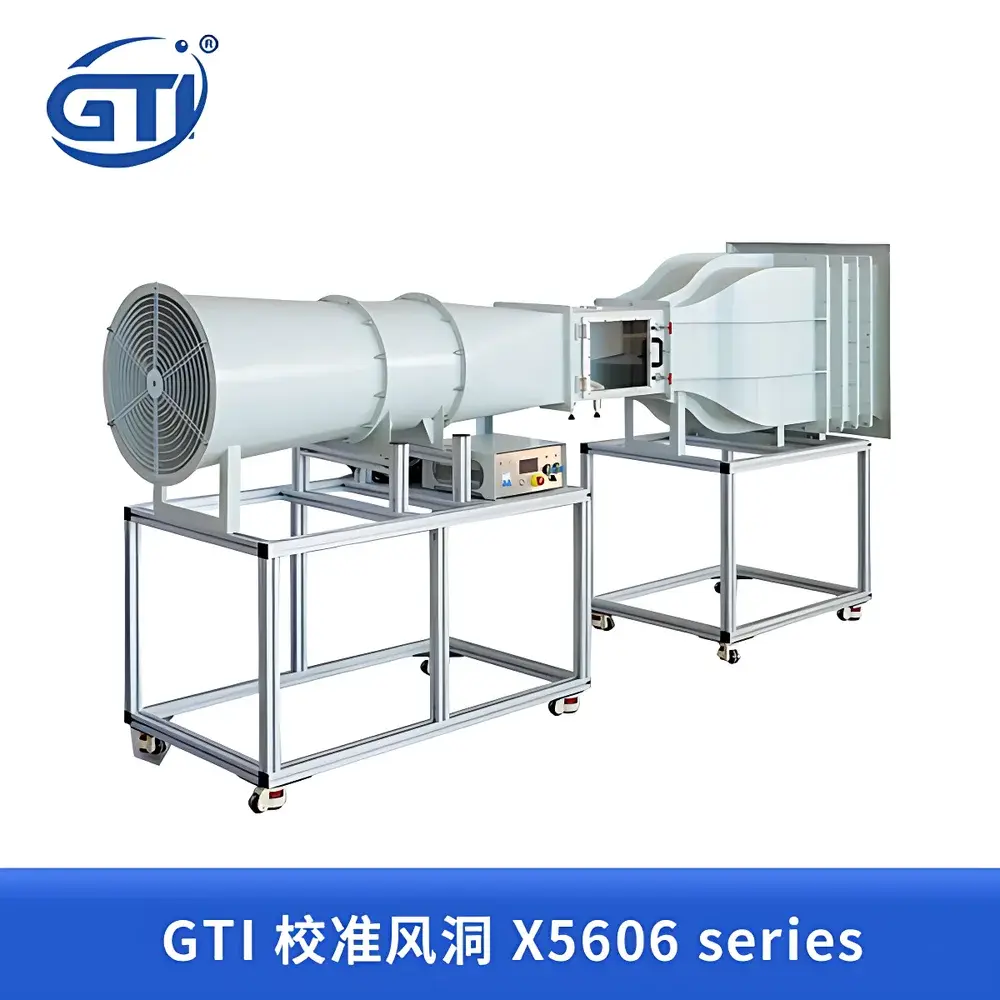
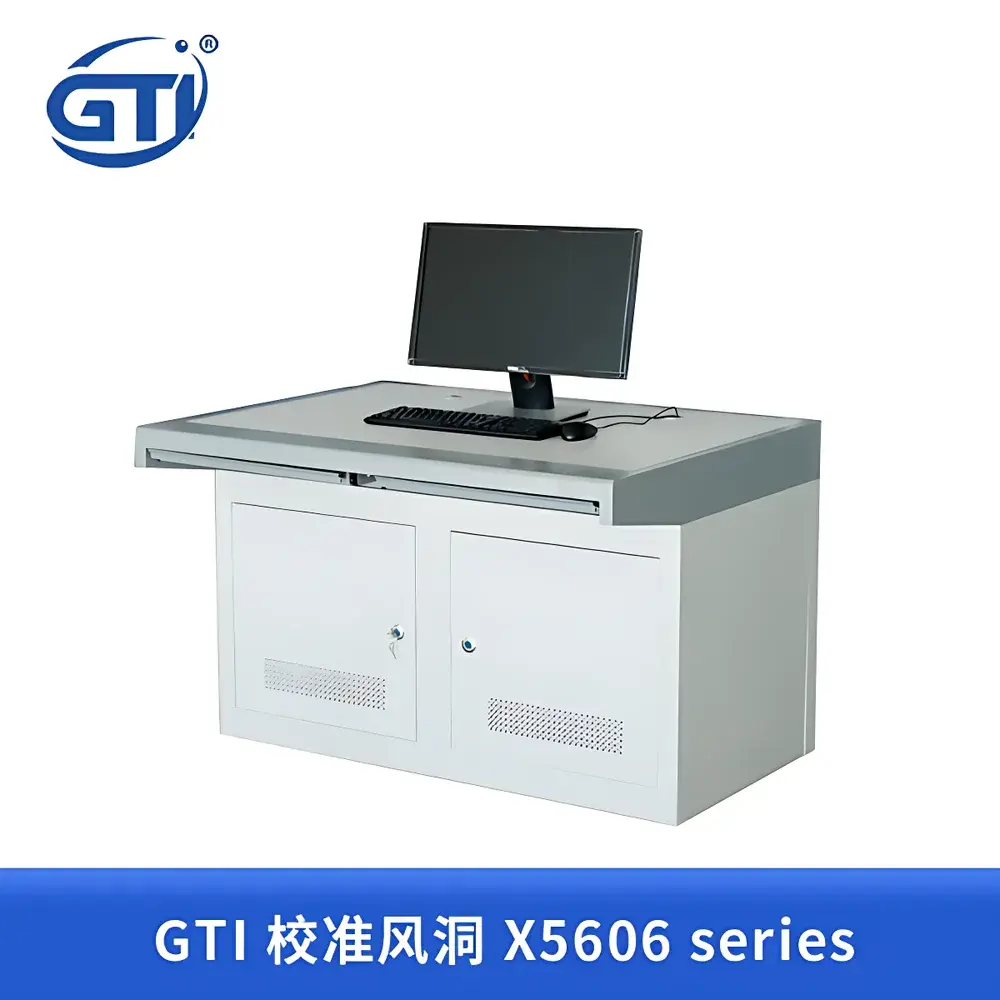
GTI X5606 Series Calibration Wind Tunnel
| Brand | GTI |
|---|---|
| Origin | Liaoning, China |
| Manufacturer Type | Manufacturer |
| Country of Origin | China |
| Model | X5606 Series |
| Wind Speed Range | 0.1–30 m/s |
| Tunnel Type | Closed-loop, DC, Low-speed Wind Tunnel |
| Test Section Dimensions | 300 mm × 300 mm (W × H) |
| Overall Dimensions | ~3000 mm × 800 mm × 1600 mm (L × W × H) |
| Flow Uniformity Coefficient | ≤1% |
| Flow Stability Coefficient | ≤0.5% |
| Motor Power | 2 kW |
| Power Supply | 220 V, 50 Hz |
| Control Mode | Manual (X5606), Manual (X5606M), Automatic (X5606A) |
| Standard Equipment | Included in X5606M & X5606A (temperature/humidity sensor, barometric pressure sensor, thermal anemometer, electronic micro-differential pressure gauge, pitot tube) |
| Software System | Included in X5606A (display, industrial PC, data acquisition module, operator console, calibration software) |
| Total Weight | ~200 kg |
Overview
The GTI X5606 Series Calibration Wind Tunnel is a precision-engineered, low-speed, closed-circuit direct-current wind tunnel designed for metrological validation and periodic calibration of air velocity sensing instruments. It operates on fundamental principles of fluid dynamics and controlled laminar-to-turbulent transition management, enabling traceable airflow generation across a calibrated range of 0.1 to 30 m/s. Unlike generic airflow test rigs, the X5606 Series integrates computational fluid dynamics (CFD)-guided structural optimization—applied to the contraction section, honeycomb flow straightener, and test section geometry—to achieve ≤1% flow uniformity and ≤0.5% temporal stability under steady-state operation. Its compact footprint (~3 m × 0.8 m × 1.6 m) and modular mechanical architecture support integration into ISO/IEC 17025-accredited calibration laboratories, national metrology institutes, and OEM quality assurance facilities where space-constrained, high-reproducibility airflow reference standards are required.
Key Features
- CFD-optimized aerodynamic design: Full-domain simulation and iterative refinement of contraction ratio, honeycomb geometry, and diffuser angle ensure minimal turbulence intensity and spatial velocity deviation within the 300 mm × 300 mm test section.
- Dual-mode airflow generation: Self-developed 2 kW DC motor-driven blower system delivers responsive, low-vibration airflow with minimized pulsation—engineered to replicate real-world operational loading conditions encountered by anemometers and pitot-static probes.
- Modular configuration options: Three variants—X5606 (manual), X5606M (manual + integrated reference sensors), and X5606A (fully automated with embedded calibration software)—enable scalability from basic verification to GLP-compliant, audit-ready calibration workflows.
- Optically accessible test section: Tempered glass side panels allow real-time visual inspection of probe alignment, flow seeding behavior (when used with smoke or particle tracers), and boundary layer development without compromising structural integrity or pressure containment.
- Integrated metrological reference suite (X5606M/X5606A): NIST-traceable temperature/humidity sensors, digital barometric pressure transducers, certified thermal anemometers, and dual-range electronic micro-differential pressure modules—all pre-aligned and thermally stabilized to minimize cross-sensitivity errors.
Sample Compatibility & Compliance
The X5606 Series accommodates a broad spectrum of air velocity measurement devices, including rotating-vane anemometers, hot-wire and hot-film anemometers, cup anemometers, ultrasonic anemometers, multi-hole pitot probes, and compact environmental monitoring stations. Its test section geometry supports both axial and angular mounting configurations per ISO 7726, ASTM D1071, and JJG 046–2021 (Chinese national calibration specification for anemometers). All variants meet mechanical and electrical safety requirements per GB 4793.1–2019 (equivalent to IEC 61010-1). The X5606A model’s software architecture complies with data integrity principles outlined in FDA 21 CFR Part 11 (electronic records/signatures), supporting role-based access control, audit trail logging, and calibration certificate auto-generation with digital signature embedding.
Software & Data Management
The X5606A variant includes a dedicated calibration software platform running on an industrial-grade Windows OS host. The system acquires synchronized time-series data from up to eight channels—including reference sensor outputs, device-under-test (DUT) analog/digital signals, and environmental parameters—via a 16-bit, 100 kS/s USB-based DAQ module. Calibration routines follow standardized procedures aligned with ISO/IEC 17025 Clause 6.4.3 (equipment verification) and include automatic uncertainty budgeting per GUM (JCGM 100:2008). Raw datasets are stored in HDF5 format with embedded metadata (operator ID, ambient conditions, sensor IDs, traceability paths); export options include CSV, PDF calibration reports (with optional lab accreditation logos), and XML for LIMS integration.
Applications
- Primary calibration of industrial anemometers used in HVAC commissioning, cleanroom monitoring, and fume hood performance verification.
- Verification of meteorological sensor arrays deployed in wind resource assessment and climate observation networks.
- Research-grade airflow characterization for aerodynamic studies of small-scale drones, ventilation grilles, and heat sink designs.
- Factory acceptance testing (FAT) and incoming inspection of velocity sensors supplied to power generation, semiconductor fabrication, and pharmaceutical manufacturing facilities.
- Training and proficiency testing for metrologists pursuing CNAS or A2LA accreditation in fluid flow measurement disciplines.
FAQ
Is the X5606 Series compliant with international calibration standards?
Yes—the system supports implementation of ISO/IEC 17025, ASTM E74, and JJG 046–2021 calibration protocols; reference sensors are supplied with valid calibration certificates traceable to NIM (China National Institute of Metrology).
Can the wind tunnel be integrated into an existing LIMS or MES environment?
The X5606A software provides RESTful API endpoints and configurable ODBC drivers for bidirectional data exchange with laboratory information management systems and enterprise manufacturing execution platforms.
What maintenance is required to sustain metrological performance?
Annual verification of reference sensor accuracy and quarterly cleaning of the honeycomb flow straightener and contraction section are recommended; full recalibration of the tunnel’s velocity profile is advised every 24 months or after structural modification.
Does GTI provide on-site installation and operator training?
Yes—GTI offers factory-certified field service engineers for mechanical commissioning, airflow mapping validation, and hands-on training covering calibration procedure execution, software operation, and uncertainty analysis fundamentals.
Are spare parts and firmware updates available post-purchase?
All critical components—including motor assemblies, DAQ modules, and software licenses—are covered under a 24-month warranty; firmware revisions and security patches are distributed via GTI’s secure customer portal with version-controlled release notes.
Related Products







