
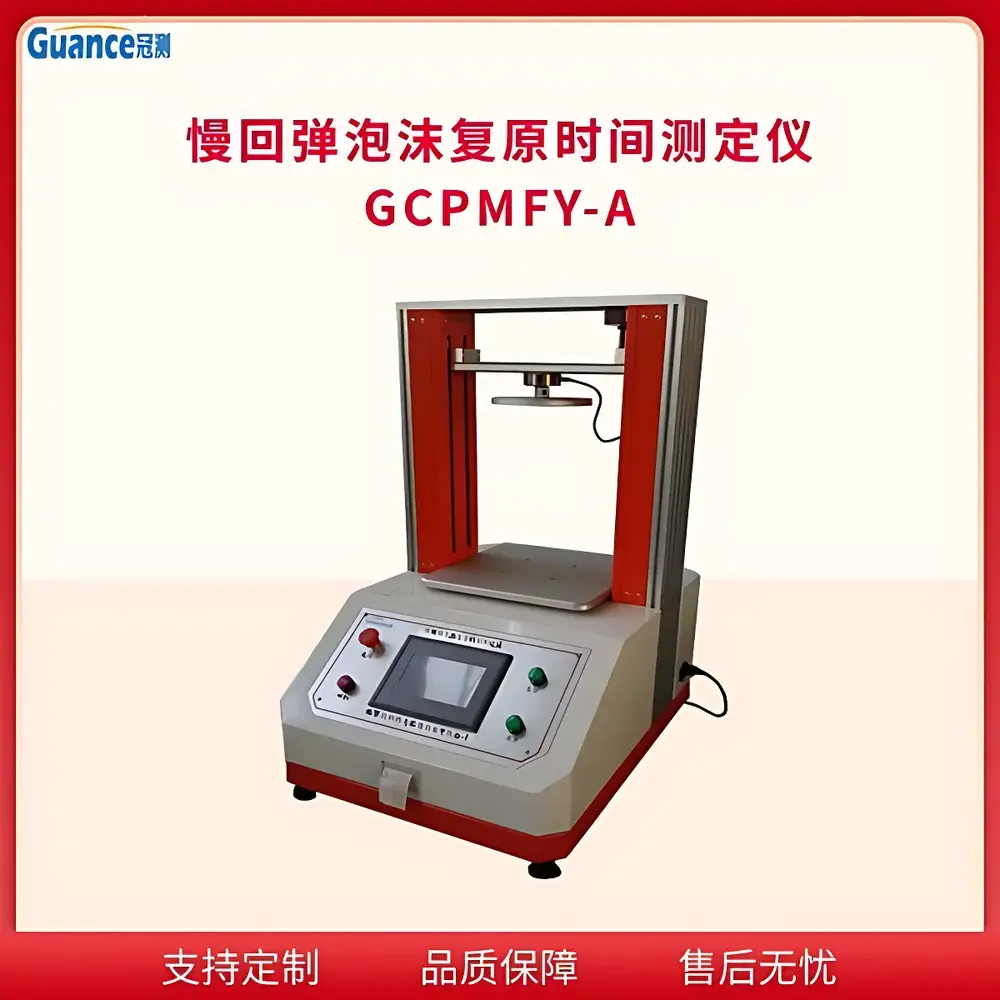
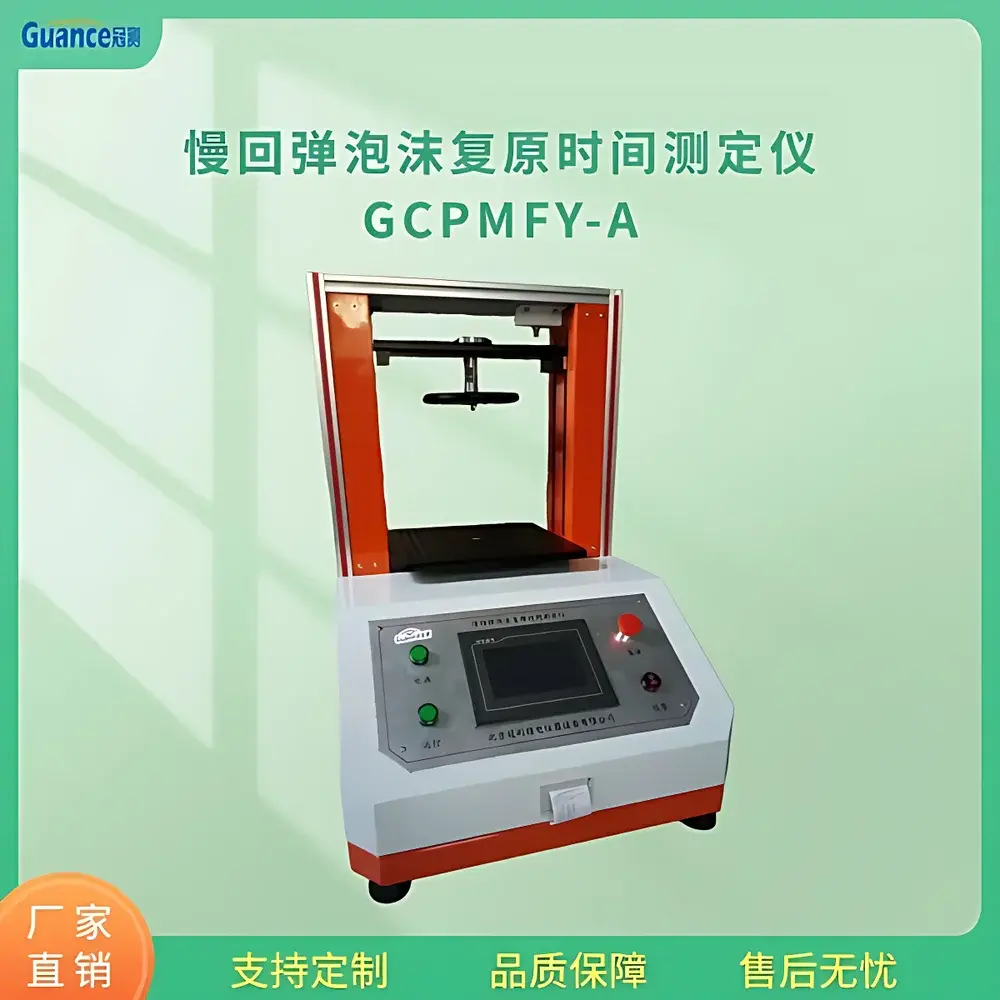
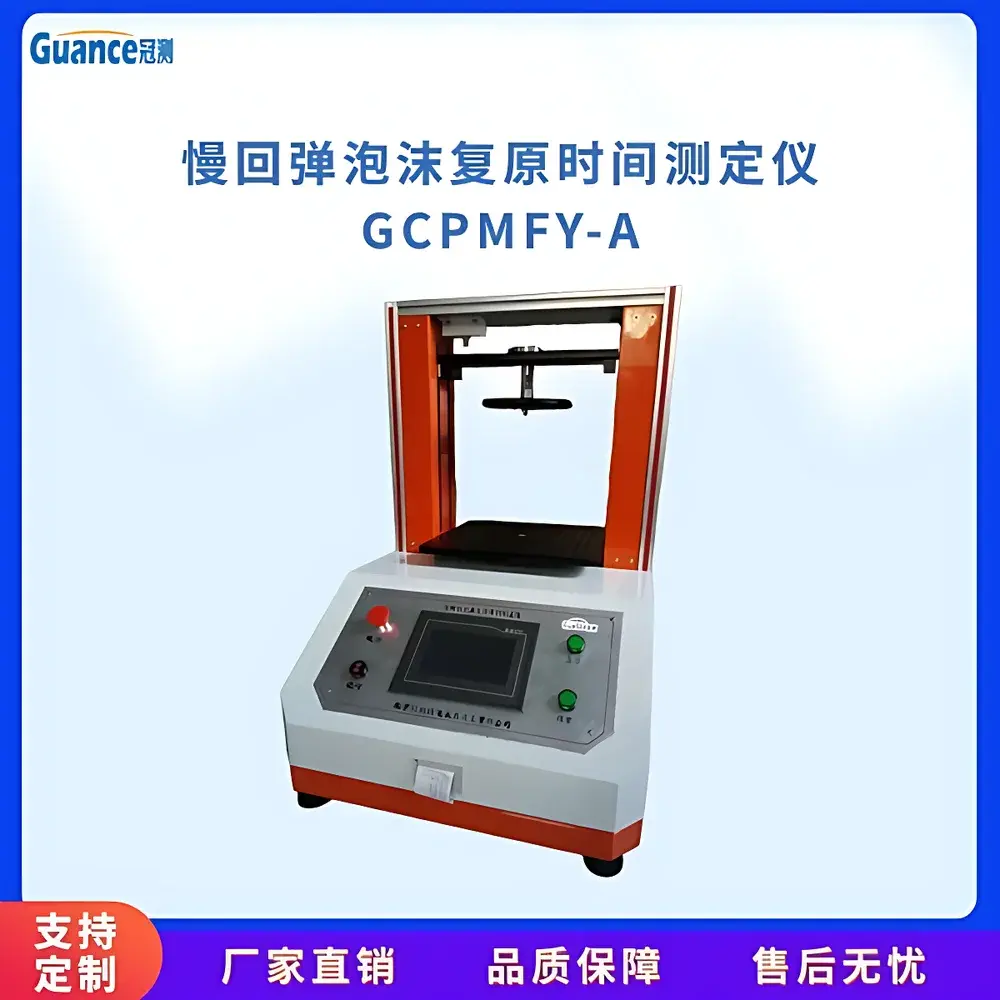
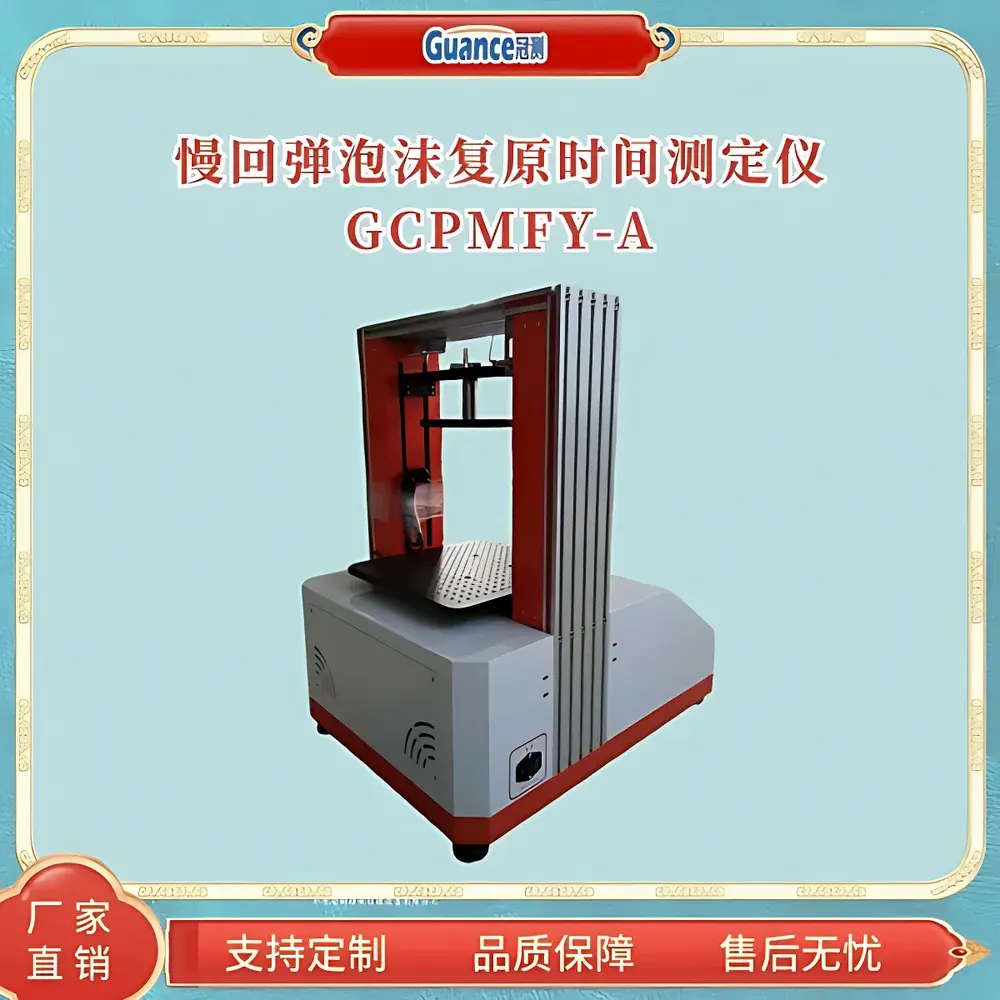
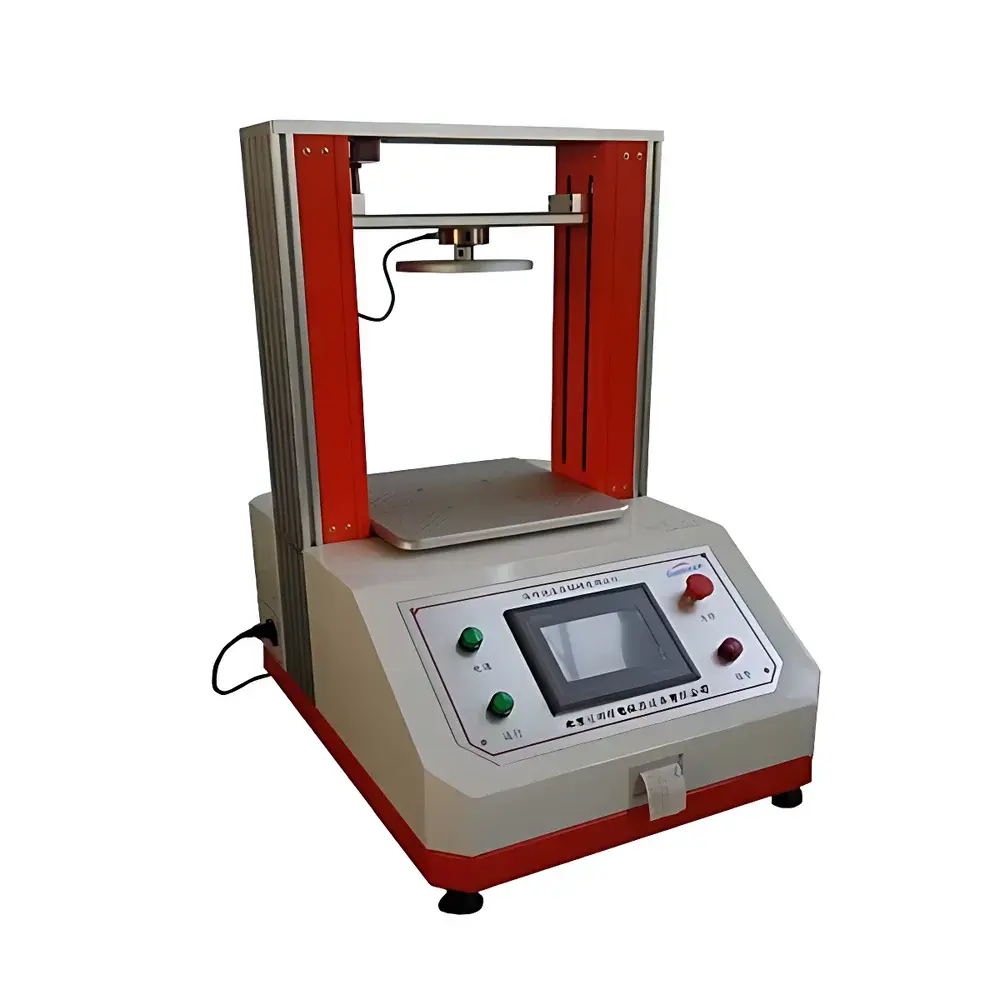
Guance Instruments GCPMFY-A Slow-Recovery Foam Recovery Time Tester
| Brand | Guance Instruments |
|---|---|
| Origin | Beijing, China |
| Manufacturer Type | Authorized Distributor |
| Country of Origin | China |
| Model | GCPMFY-A |
| Price | USD 1,700 (approx.) |
| Touchscreen | 7-inch capacitive HMI |
| Measurement Principle | Controlled compression-deformation-relaxation cycle with laser-displacement tracking and load-cell feedback |
| Compression Speed | (1000 ± 100) mm/min |
| Platen Diameter | 203 mm |
| Support Plate Perforation | Ø6.5 mm, 20 mm pitch |
| Sample Dimensions | 380 × 380 × 100 mm |
| Initial Preload Force | 4.5 N |
| Deformation Target | 75% of initial thickness |
| Dwell Time | 60 s |
| Recovery Threshold | Re-engagement of 4.5 N preload force |
| Time Resolution | 0.01 s |
| Thickness Measurement Accuracy | ±1 mm |
| Load Cell Capacity | 1000 N |
| Compliance | GB/T 26392–2011, ASTM D3574–2008 Section 12 (Recovery Time for Slow-Recovery Foams) |
Overview
The Guance Instruments GCPMFY-A Slow-Recovery Foam Recovery Time Tester is an automated, microprocessor-controlled instrumentation system engineered for precise quantification of the time required for viscoelastic polyurethane foams—particularly slow-recovery (memory) foams—to regain structural integrity following controlled mechanical deformation. It operates on a standardized compression-relaxation protocol defined in GB/T 26392–2011 and ASTM D3574–2008 (Section 12), where a 203 mm diameter circular platen applies a calibrated preload (4.5 N), compresses the specimen to 75% of its initial thickness at a nominal speed of 1000 mm/min, holds for 60 seconds, then retracts at the same speed to a position corresponding to 5% residual deformation. The recovery time is recorded as the interval between platen retraction initiation and the moment the foam re-establishes contact with the platen under the original 4.5 N preload—detected via real-time force feedback from a 1000 N precision load cell and validated by synchronized laser displacement monitoring (±1 mm accuracy). This dual-sensor architecture ensures high reproducibility across repeated trials and eliminates operator-dependent interpretation.
Key Features
- 7-inch industrial-grade capacitive touchscreen HMI with intuitive, icon-driven test navigation and real-time graphical display of force vs. time and displacement vs. time curves
- Integrated Siemens S7-1200 PLC control architecture ensuring deterministic timing, fault-tolerant operation, and seamless sequence execution
- High-resolution laser displacement sensor (±1 mm accuracy) co-located with the compression platen for non-contact thickness tracking before, during, and after deformation
- Precision servo-driven actuation system delivering consistent compression/retraction velocity (1000 ± 100 mm/min) with <0.5% speed deviation over full stroke
- Automated sample thickness measurement prior to each test cycle—eliminating manual caliper input and reducing setup variability
- Configurable test protocols: users may define custom dwell durations, compression percentages, preload forces, and recovery thresholds beyond standard methods
- Built-in thermal-stable 1000 N S-type load cell with digital signal conditioning, supporting ISO 7500-1 Class 0.5 accuracy compliance
- Onboard thermal printer (included) generates timestamped, traceable hardcopy reports containing test ID, operator name, sample ID, environmental conditions (optional ambient sensor input), raw data summary, and pass/fail status against specification limits
Sample Compatibility & Compliance
The GCPMFY-A accommodates standard test specimens measuring 380 × 380 × 100 mm—compatible with industry-standard foam block dimensions used in bedding, automotive seating, and medical cushioning applications. Its perforated support plate (6.5 mm holes on 20 mm centers) ensures uniform air venting during compression, minimizing pneumatic resistance artifacts per ASTM D3574 requirements. The instrument is fully compliant with GB/T 26392–2011 “Determination of Recovery Time for Slow-Recovery Flexible Polyurethane Foam” and ASTM D3574–2008, Section 12 (“Recovery Time”). All firmware logic, data logging intervals (10 Hz minimum sampling rate), and report generation routines are designed to support GLP and internal QA documentation requirements. While not certified to FDA 21 CFR Part 11 out-of-the-box, audit trails—including user login history, parameter change logs, and electronic signature fields—can be enabled via optional configuration for regulated environments.
Software & Data Management
The embedded control software supports CSV export of full-resolution time-series data (force, displacement, elapsed time) via USB flash drive. Each test record includes metadata such as date/time stamp, operator ID, sample identification, environmental temperature/humidity (if external sensors are connected), and calibration verification status. Data files conform to ASTM E1447–22 (Standard Practice for Electronic Storage and Retrieval of Test Data) conventions. No proprietary software installation is required on host PCs; exported datasets are directly importable into MATLAB, Python (pandas), or statistical analysis platforms (e.g., JMP, Minitab) for advanced modeling of relaxation kinetics or inter-laboratory comparison studies. Firmware updates are delivered via signed binary packages with SHA-256 checksum validation.
Applications
- Quality control of memory foam formulations in manufacturing facilities producing mattresses, pillows, and ergonomic seating
- R&D evaluation of polymer chain mobility, crosslink density, and plasticizer effects on viscoelastic recovery kinetics
- Batch-to-batch consistency verification for suppliers to OEMs in automotive interior and healthcare equipment sectors
- Failure analysis of foam degradation due to thermal aging, UV exposure, or hydrolysis—quantifying recovery time drift as an early indicator of network breakdown
- Validation of foam performance specifications in technical datasheets submitted to certification bodies (e.g., CertiPUR-US®, OEKO-TEX®)
- Academic research on time-dependent mechanical behavior of soft porous materials, including fractional-order viscoelastic modeling
FAQ
What standards does the GCPMFY-A explicitly support?
It is validated for GB/T 26392–2011 and ASTM D3574–2008 Section 12. Full test method alignment documentation—including protocol mapping tables and uncertainty budgets—is provided in the Instrument Qualification Package.
Can the instrument measure recovery time for foams thinner than 100 mm?
Yes—minimum specimen thickness is 25 mm. The laser-based auto-thickness detection adjusts all deformation targets proportionally to the measured initial height.
Is calibration traceable to national standards?
Load cell calibration is performed using NIST-traceable deadweight standards; displacement calibration uses laser interferometry. A Certificate of Calibration (with uncertainty statements) is issued with each unit.
Does the system support network connectivity or LIMS integration?
Ethernet port is available for TCP/IP communication. Optional MODBUS TCP or OPC UA server modules enable direct integration with laboratory information management systems (LIMS) or MES platforms.
What maintenance is required for long-term accuracy?
Annual verification of load cell linearity and laser alignment is recommended. No consumables are required; the servo motor and linear guide system are sealed and lubricated for life under normal operating conditions.
Related Products



