
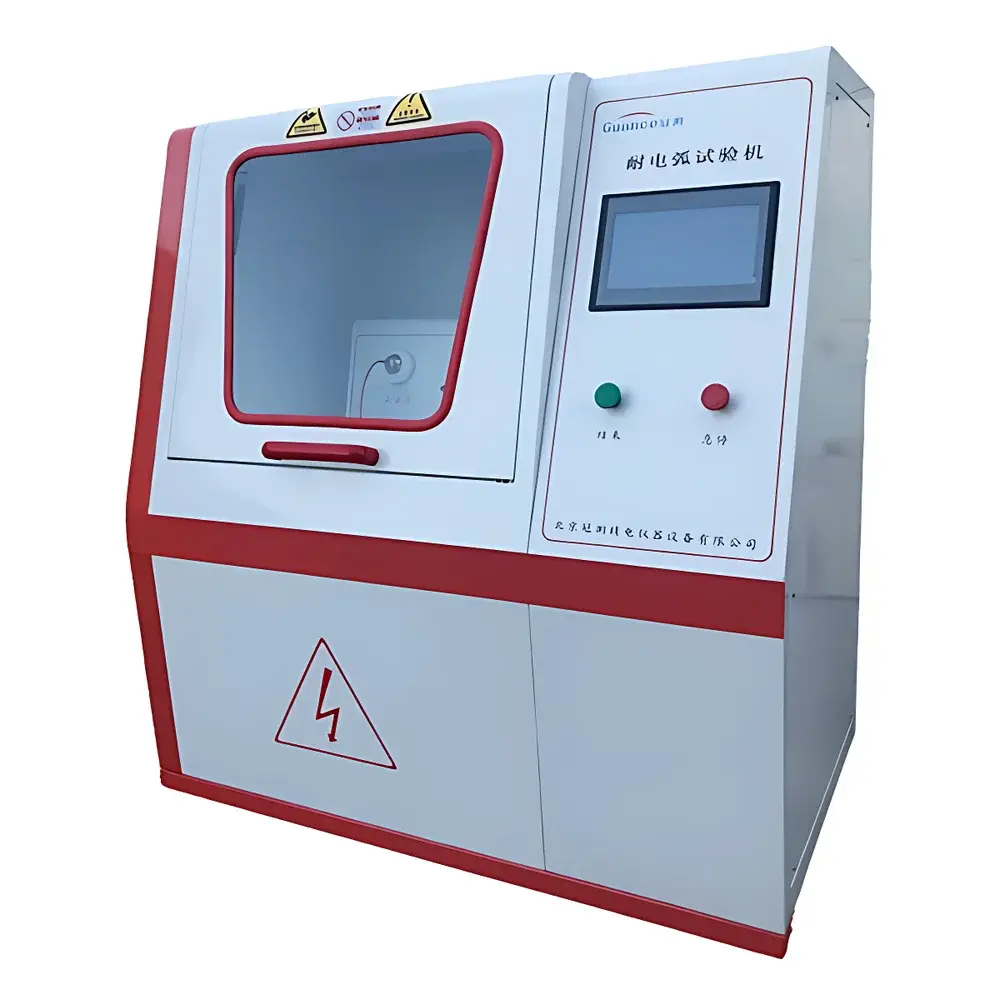
Guance Instruments NDH-B3 High-Voltage Arc Resistance Universal Tester
| Brand | Guance Instruments |
|---|---|
| Origin | Beijing, China |
| Manufacturer Type | Authorized Distributor |
| Product Category | Domestic |
| Model | NDH-B3 |
| Instrument Type | Electronic Universal Testing Machine |
| Arc On/Off Time Accuracy | < ±1 ms |
| Voltage Regulation Capacity | 3 kVA |
| High-Voltage Transformer Capacity | 3 kVA, 0–20 kV Output |
| Rated Test Voltage | 12.5 kV |
| Voltage Accuracy | ±1% |
| Current Control Accuracy | ±3% |
| Current Measurement Accuracy | ±1.5% |
| Electrode Force on Specimen | (0.5 ± 0.05) N |
| Electrode Material | Tungsten Rod |
| Electrode Spacing | (6.35 ± 0.1) mm (IEC), (6.0 ± 0.1) mm (ASTM) |
| Ambient Temperature | (23 ± 2) °C |
| Ambient Humidity | (50 ± 5)% RH |
| Input Power | 220 V AC / 50 Hz |
| Output Voltage Range | 0–17.5 kV AC |
| Test Current Settings | 10, 20, 30, 40 mA |
Overview
The Guance Instruments NDH-B3 High-Voltage Arc Resistance Universal Tester is a precision-engineered instrument designed to evaluate the arc resistance of solid insulating materials under controlled high-voltage, low-current electric arc discharge conditions. It operates on the principle of standardized arc initiation and propagation between two tungsten electrodes spaced at precisely defined intervals—6.0 mm per ASTM D495 or 6.35 mm per IEC 61621—while applying a regulated 12.5 kV test voltage and adjustable current levels (10–40 mA). The system measures the elapsed time (in seconds) from arc initiation until specimen failure—defined as the formation of a conductive carbonized track or complete insulation breakdown. This time-based metric directly informs material classification per GB/T 1411–2002 (identical to IEC 61621:1997), ASTM D495, UL 746A, and IEC 149, supporting compliance-driven qualification in electrical insulation engineering.
Key Features
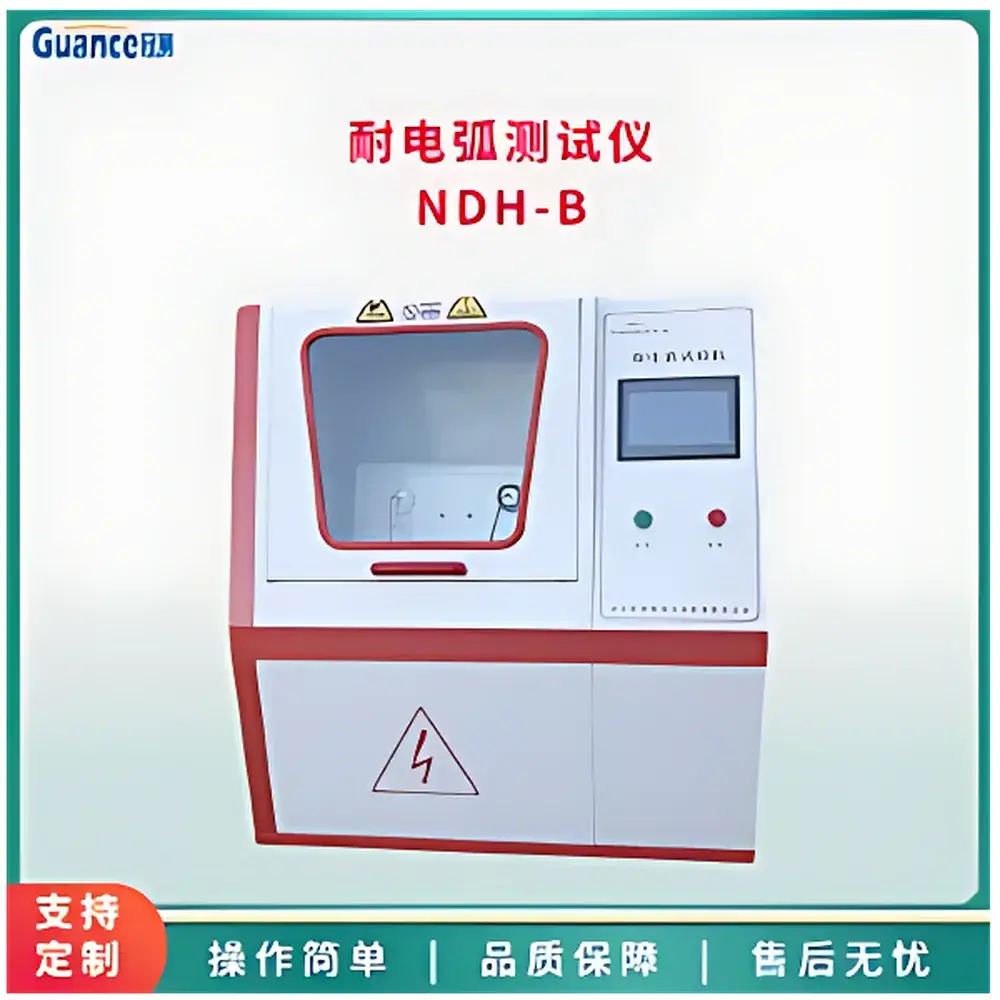
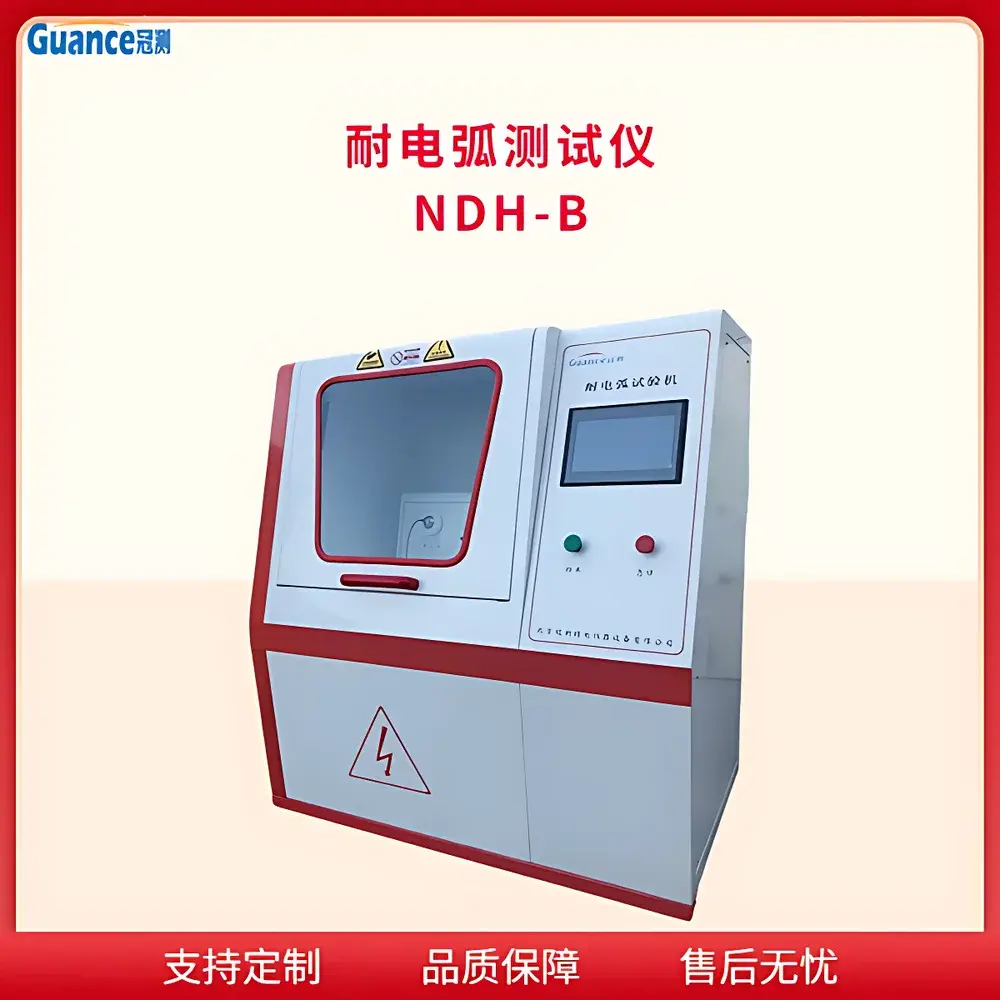
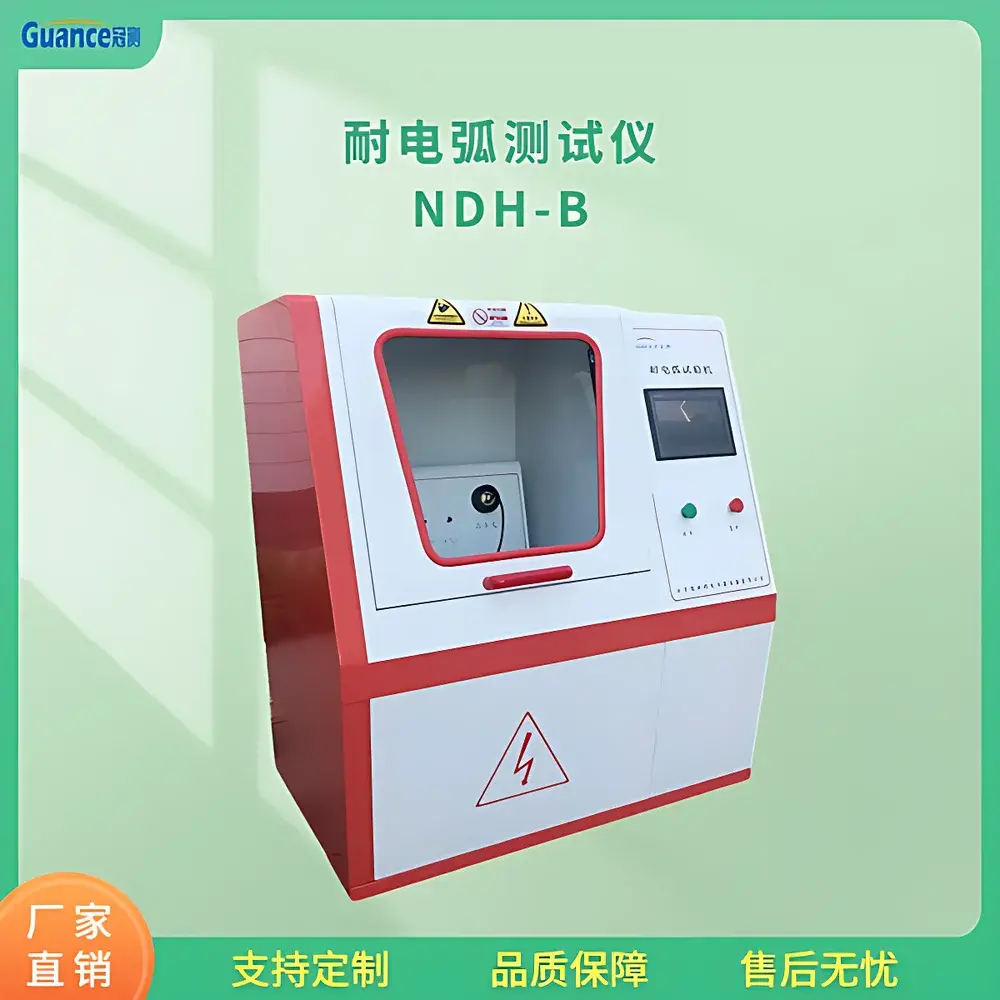
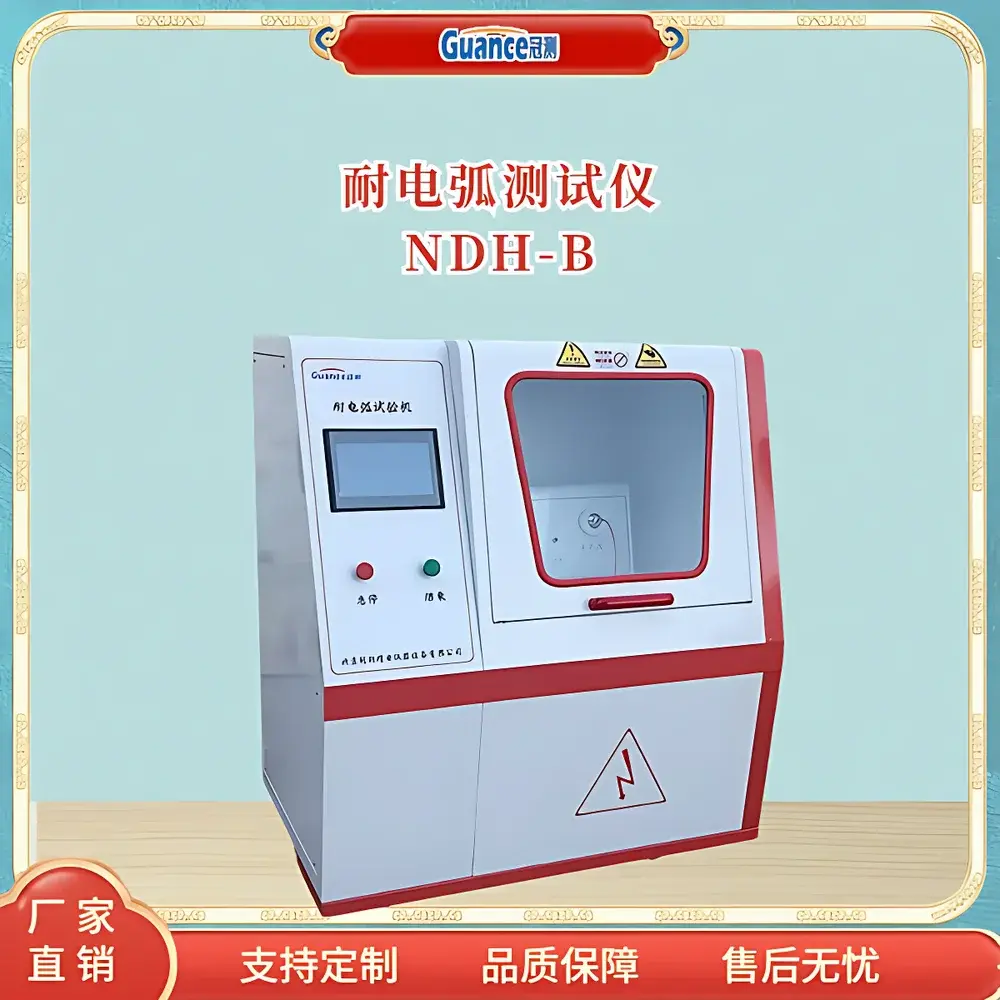
- Bilateral integrated architecture: left-side test chamber with tempered glass enclosure for real-time observation and operator safety; right-side control cabinet housing Siemens PLC and industrial-grade HMI touchscreen.
- Standards-compliant automated test execution: preloaded IEC and ASTM test protocols enable fully autonomous voltage ramping, arc timing sequence, current stepping, and post-test reset—all synchronized to ±1 ms timing resolution.
- Dual-mode current monitoring: analog panel-mounted ammeter combined with digital software readout ensures cross-verified current fidelity during dynamic arc transitions.
- Active safety subsystems: illuminated high-voltage warning tower, built-in protective resistors in low-voltage circuitry, electromagnetic interference (EMI)-hardened control architecture, and automatic zero-return after test completion.
- Inert gas purge port: enables nitrogen or argon atmosphere introduction into the test chamber to suppress oxidative degradation during extended arc exposure—critical for evaluating thermally sensitive resins or halogen-free formulations.
- Integrated calibration traceability: onboard voltage and current auto-calibration routines support routine metrological verification in accordance with ISO/IEC 17025 laboratory practices.
Sample Compatibility & Compliance
The NDH-B3 accommodates rigid flat specimens conforming to standard dimensions (typically 100 mm × 100 mm × 3.0 ± 0.4 mm) fabricated from thermosetting plastics, laminated sheet materials (e.g., G10/FR-4), insulating varnishes, epoxy molding compounds, and phenolic resins. Surface preparation requirements—including solvent cleaning with deionized water and anhydrous ethanol—align with GB/T 1411 and ASTM D495 preconditioning clauses. All mechanical and electrical performance specifications meet the essential requirements of IEC 61000-4-2 (ESD immunity), IEC 61000-4-3 (radiated RF immunity), and EN 61010-1 (safety of electrical equipment for measurement, control, and laboratory use). The instrument supports audit-ready documentation workflows compatible with GLP and GMP environments where traceable test records are mandated.
Software & Data Management
The embedded HMI interface provides real-time graphical visualization of voltage waveform, current amplitude, arc duration cycles, and cumulative test time. Test logs—including date/time stamps, operator ID, specimen ID, selected standard, applied parameters, and pass/fail status—are stored in non-volatile memory with CSV export capability. Optional Ethernet or USB data transfer enables integration into centralized LIMS platforms. Audit trail functionality satisfies FDA 21 CFR Part 11 requirements when paired with user access controls and electronic signature modules (available as configurable firmware add-ons). All software logic adheres to IEC 61131-3 programming standards for deterministic PLC execution.
Applications
This tester serves quality assurance and R&D laboratories in motor manufacturing, power electronics, appliance OEMs, and PCB substrate producers. Typical use cases include comparative arc resistance screening of alternative resin systems during material substitution studies; validation of batch-to-batch consistency in laminated board production; qualification of flame-retardant additives in polyamide or PBT compounds; and failure analysis of insulation systems subjected to partial discharge stress. Its reproducible arc initiation protocol makes it suitable for establishing baseline arc resistance values referenced in UL 746A Comparative Tracking Index (CTI) correlation studies.
FAQ
What standards does the NDH-B3 comply with?
It fully implements GB/T 1411–2002, IEC 61621:1997, ASTM D495, UL 746A, and IEC 149 test methodologies.
Can the electrode spacing be adjusted manually between IEC and ASTM configurations?
Yes—the tungsten electrodes are mounted on micrometer-adjustable holders calibrated to ±0.05 mm tolerance, allowing rapid reconfiguration between 6.0 mm (ASTM) and 6.35 mm (IEC) spacing.
Is inert gas purging required for all tests?
No—it is optional and application-specific; recommended only for oxygen-sensitive materials or when simulating sealed enclosure conditions.
How is test repeatability ensured across multiple operators?
Through standardized HMI-guided workflows, automated parameter locking, and built-in calibration checks that eliminate manual voltage/current setting errors.
Does the system support external data acquisition or SCADA integration?
Yes—Modbus RTU over RS-485 and TCP/IP Ethernet interfaces are available for third-party system integration and remote monitoring.



