
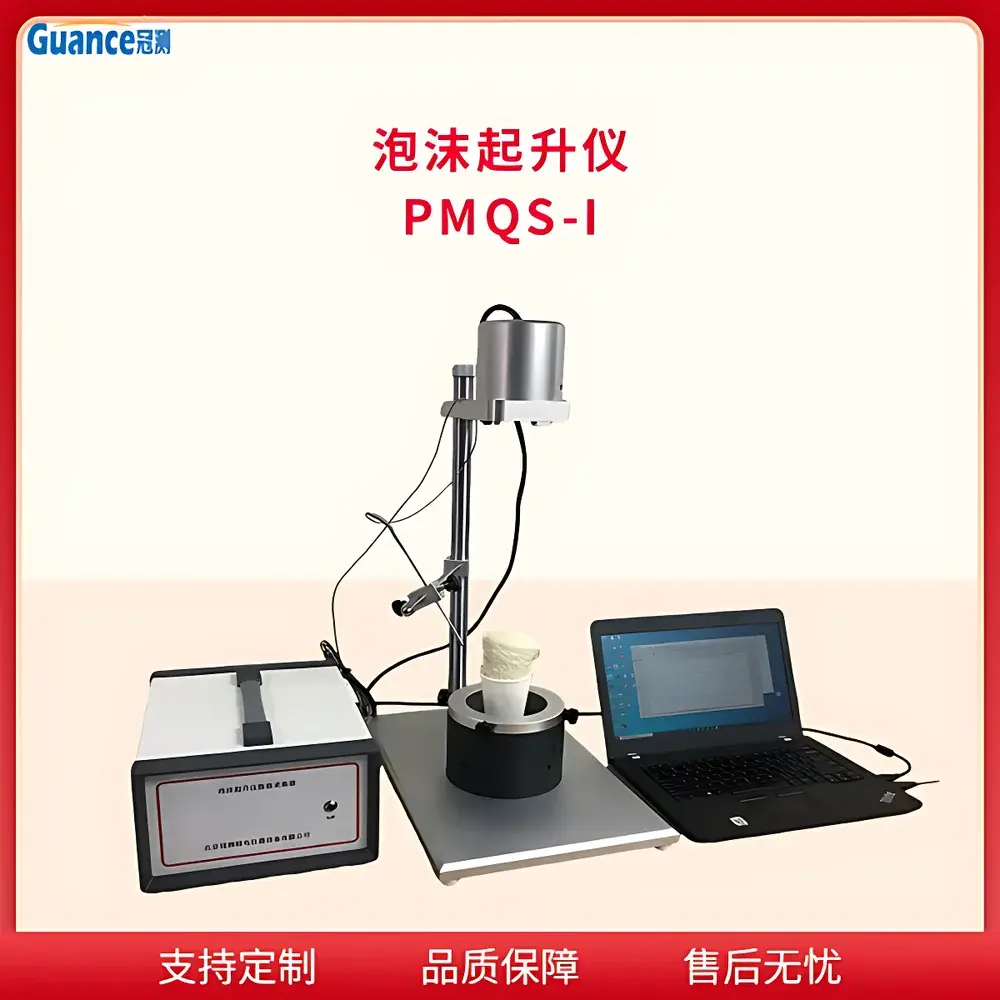
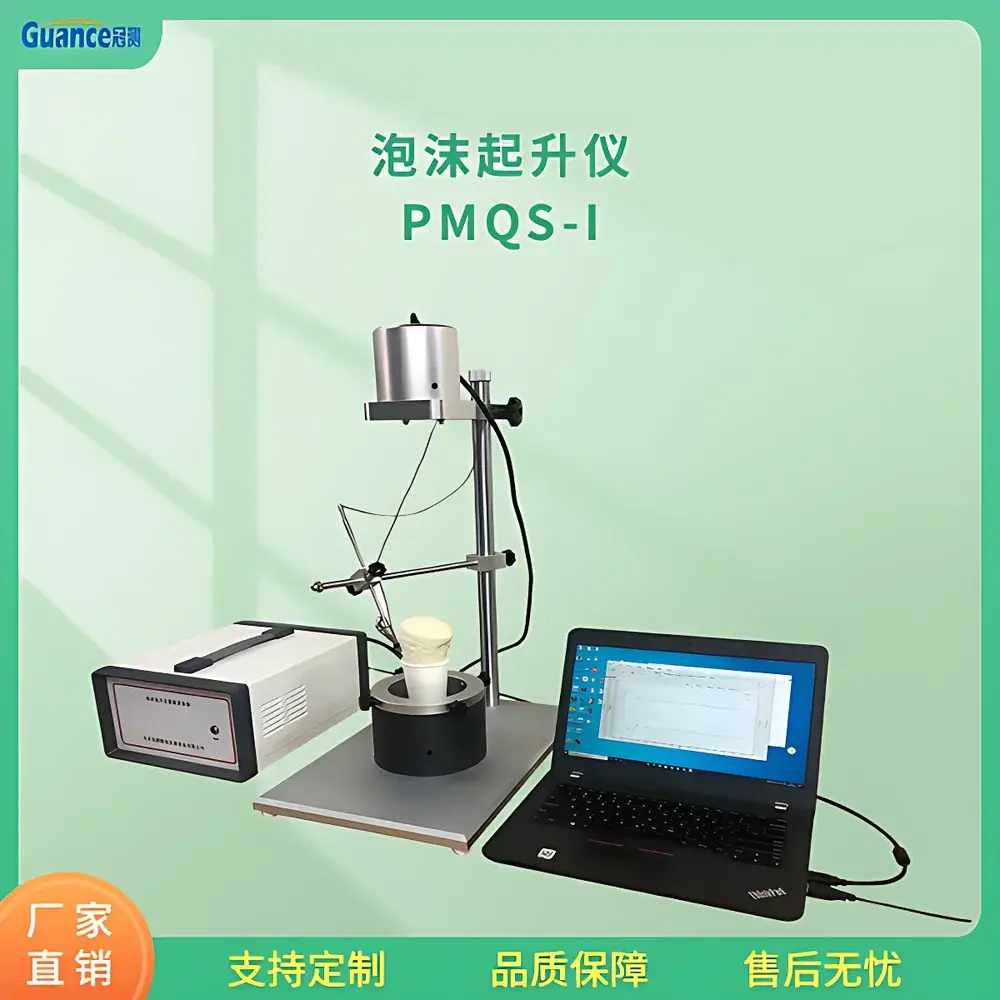
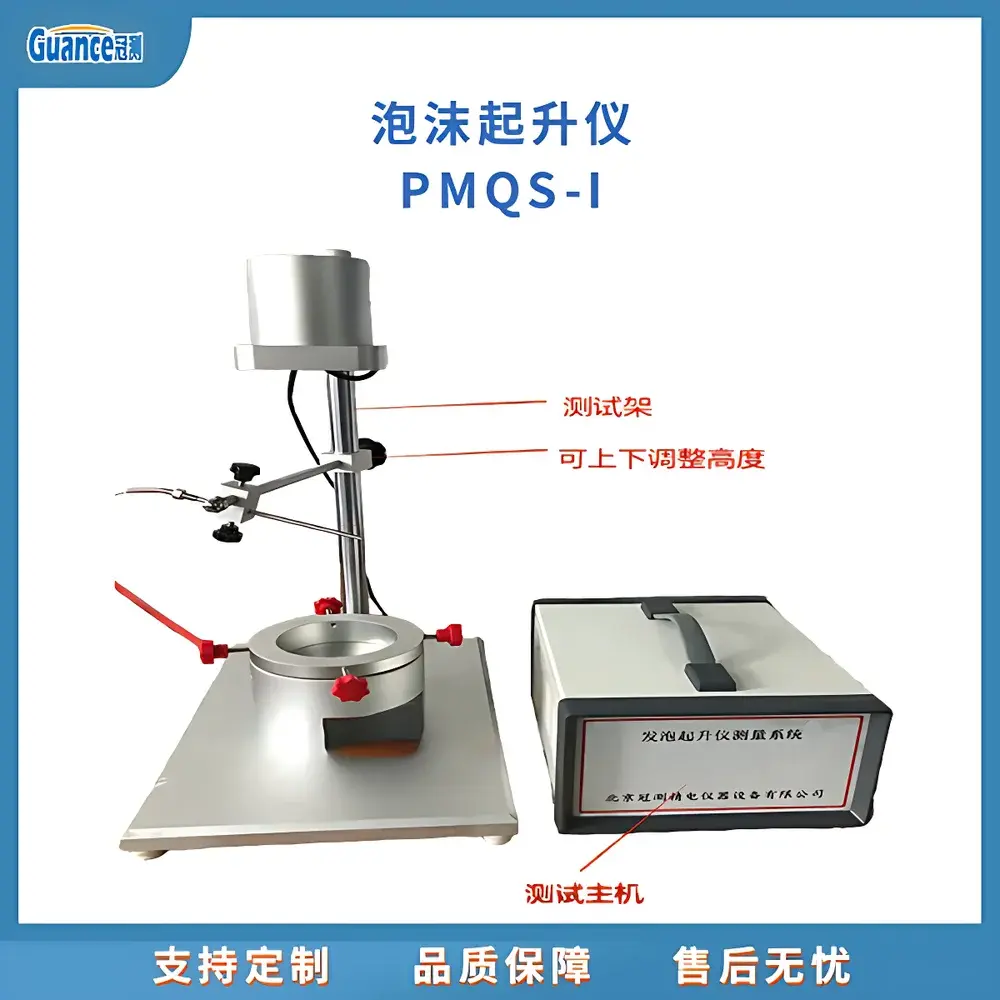
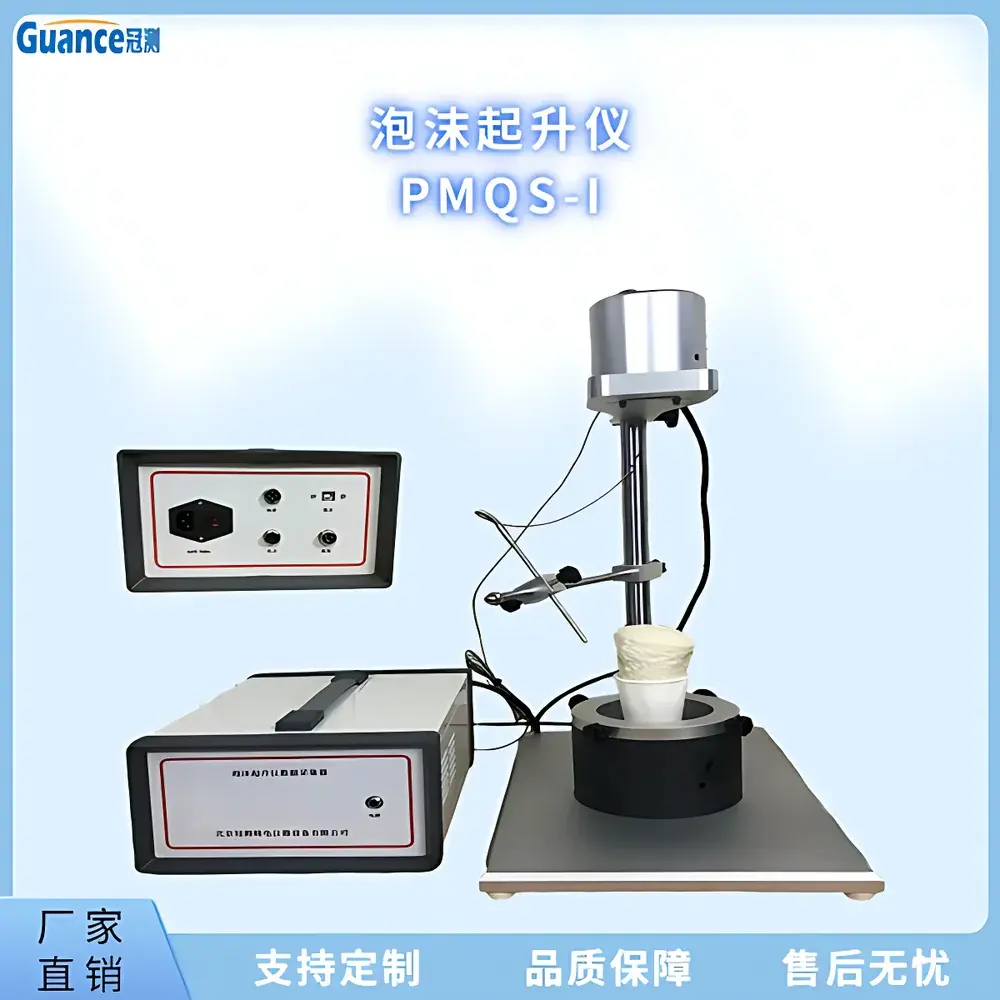
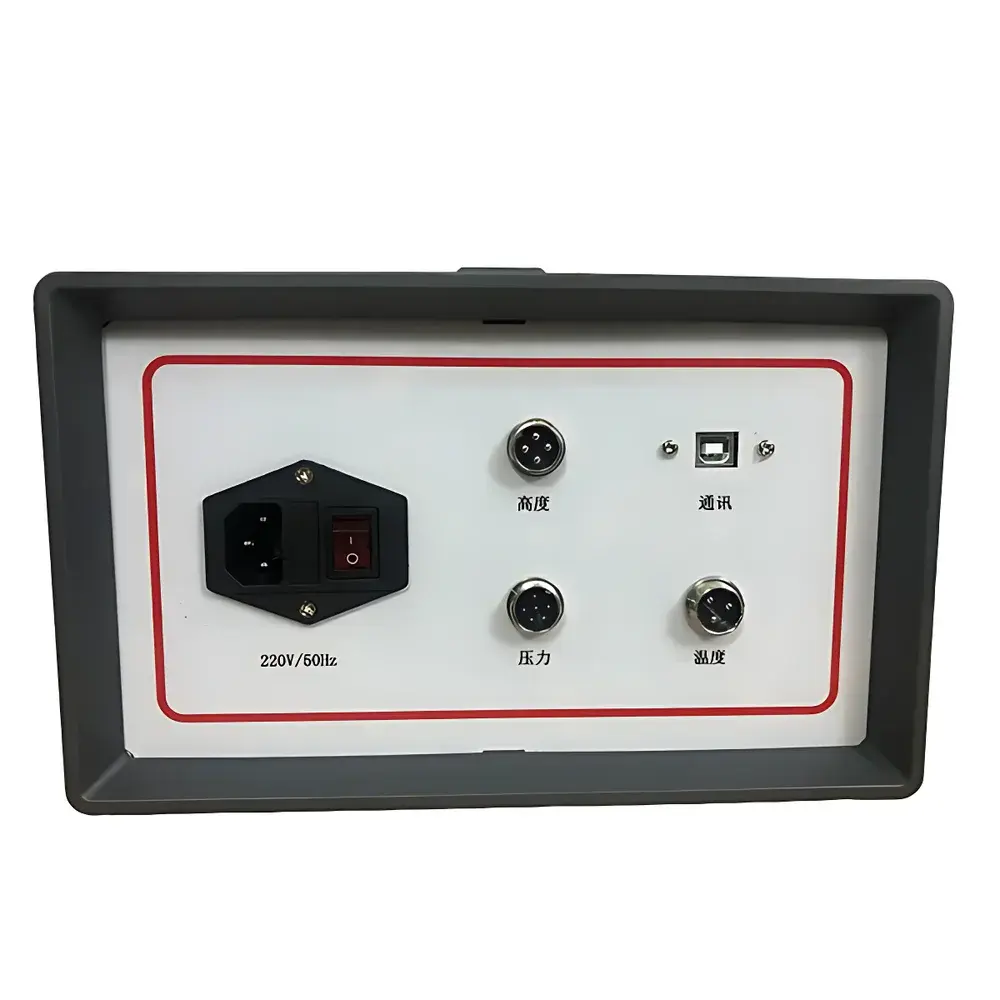
GuanCe Instruments PMQS-I.2 Automated Foam Rise Analyzer
| Brand | GuanCe Instruments |
|---|---|
| Origin | Beijing, China |
| Manufacturer Type | Authorized Distributor |
| Country of Origin | China |
| Model | PMQS-I.2 |
| Price | USD 2,250 (FOB Beijing) |
| Power Supply | 220 V AC / 50 Hz |
| Vertical Travel Range | 0–800 mm |
| Optical Sensor Accuracy | ±1 mm |
| Optical Sensor Range | 10–1000 mm |
| Temperature Probe Range | 0–500 °C (Accuracy: ±0.5% FS) |
| Pressure Sensor Range (Optional) | 0–500 N |
| Sample Cup ID | 100 mm |
| Sample Cup Height | 200 mm |
Overview
The GuanCe Instruments PMQS-I.2 Automated Foam Rise Analyzer is a dedicated benchtop instrument engineered for quantitative, time-resolved characterization of foam expansion dynamics in polymeric and chemical formulation development. It operates on the principle of non-contact optical profiling—using high-stability linear photoelectric sensors to track real-time vertical displacement of foam surface during gas evolution or chemical blowing agent decomposition. Coupled with synchronized thermal monitoring (via calibrated Pt100 or thermocouple probe), optional pressure transduction, and programmable timing logic, the system delivers traceable, repeatable metrics essential for R&D process optimization, formulation screening, and quality control in PU, silicone, and syntactic foam production.
Key Features
- Automated, motor-driven vertical stage with 0–800 mm travel range and position repeatability ≤ ±0.5 mm
- Dual-mode optical sensing: primary height tracking via precision photoelectric array (10–1000 mm range, ±1 mm accuracy); secondary validation via optional HD time-lapse imaging module
- Integrated temperature monitoring: industrial-grade probe (0–500 °C, ±0.5% full-scale accuracy) mounted coaxially with sample axis
- Configurable data acquisition: user-defined sampling intervals (10 ms–10 s), real-time curve plotting (height vs. time), and automatic event detection (onset, peak, collapse)
- Comprehensive parameter derivation: rise onset time, maximum rise height, peak rise velocity, average rise velocity (0–tpeak), collapse initiation time, % collapse at user-specified intervals, and height drift compensation based on initial liquid level
- Standard USB 2.0 and RS-485 interfaces for external PLC synchronization or SCADA integration
- CE-compliant electrical architecture with reinforced insulation and thermal cutoff protection
Sample Compatibility & Compliance
The PMQS-I.2 accommodates standard cylindrical sample containers (100 mm ID × 200 mm height), compatible with ASTM D6139 (Standard Test Method for Determining Foam Rise Profile of Polyurethane Systems) and aligned with ISO 4611 (Plastics — Determination of foam rise behavior). It supports aqueous, solvent-based, and reactive resin systems—including polyol-isocyanate blends, silicone emulsions, and detergent foams. All firmware and measurement algorithms are developed under internal GLP-aligned documentation practices; raw data files include embedded metadata (operator ID, timestamp, environmental conditions, calibration status) to support audit readiness per FDA 21 CFR Part 11 requirements when deployed in regulated QC environments.
Software & Data Management
The analyzer ships with GuanCe FoamAnalysis v3.2 software (Windows 10/11 compatible), providing intuitive workflow navigation, multi-curve overlay, statistical batch comparison (n ≥ 3), and automated report generation in PDF/CSV/XLSX formats. Data integrity safeguards include write-protected raw binary logging (.gcf), checksum verification, and optional password-protected user roles (Operator, Supervisor, Administrator). Audit trails record all parameter modifications, calibration events, and export actions—enabling full traceability for ISO/IEC 17025 laboratory accreditation. Exported datasets conform to ASTM E1447 (Standard Practice for Exchange of Analytical Data) syntax conventions.
Applications
- Formulation optimization of rigid/flexible polyurethane foams: quantifying catalyst efficiency, surfactant impact on cell nucleation, and filler-induced viscosity effects on rise kinetics
- Quality assurance in automotive seating and insulation manufacturing: verifying lot-to-lot consistency of blowing agent decomposition profiles
- Academic research in colloid and interface science: correlating foam stability metrics with surface tension, drainage rate, and lamella coalescence thresholds
- Regulatory submission support: generating reproducible rise curves compliant with EU REACH Annex VII test requirements for foam-forming substances
- Process troubleshooting in continuous foam lines: identifying deviations in pre-gel time or post-rise shrinkage linked to metering pump drift or ambient humidity fluctuations
FAQ
What standards does the PMQS-I.2 comply with for foam testing?
It is functionally aligned with ASTM D6139 and ISO 4611; full compliance documentation (including uncertainty budgets and traceable calibration certificates) is provided upon request.
Can the system operate unattended for extended periods?
Yes—equipped with thermal overload protection, auto-shutdown after idle timeout, and non-volatile memory for power-loss recovery.
Is third-party calibration service available?
GuanCe Instruments maintains ISO/IEC 17025-accredited calibration partners in Germany, Singapore, and the USA; on-site verification services are offered under annual maintenance contracts.
How is height drift compensated during long-duration tests?
The software applies real-time baseline correction using the initial 5-second liquid-level stabilization window, followed by adaptive filtering to suppress mechanical vibration artifacts.
Does the optional pressure sensor meet hazardous area classification requirements?
The standard 500 N load cell is rated IP65; ATEX/IECEx-certified variants (II 2G Ex db IIB T4 Gb) are available as custom configurations.



