
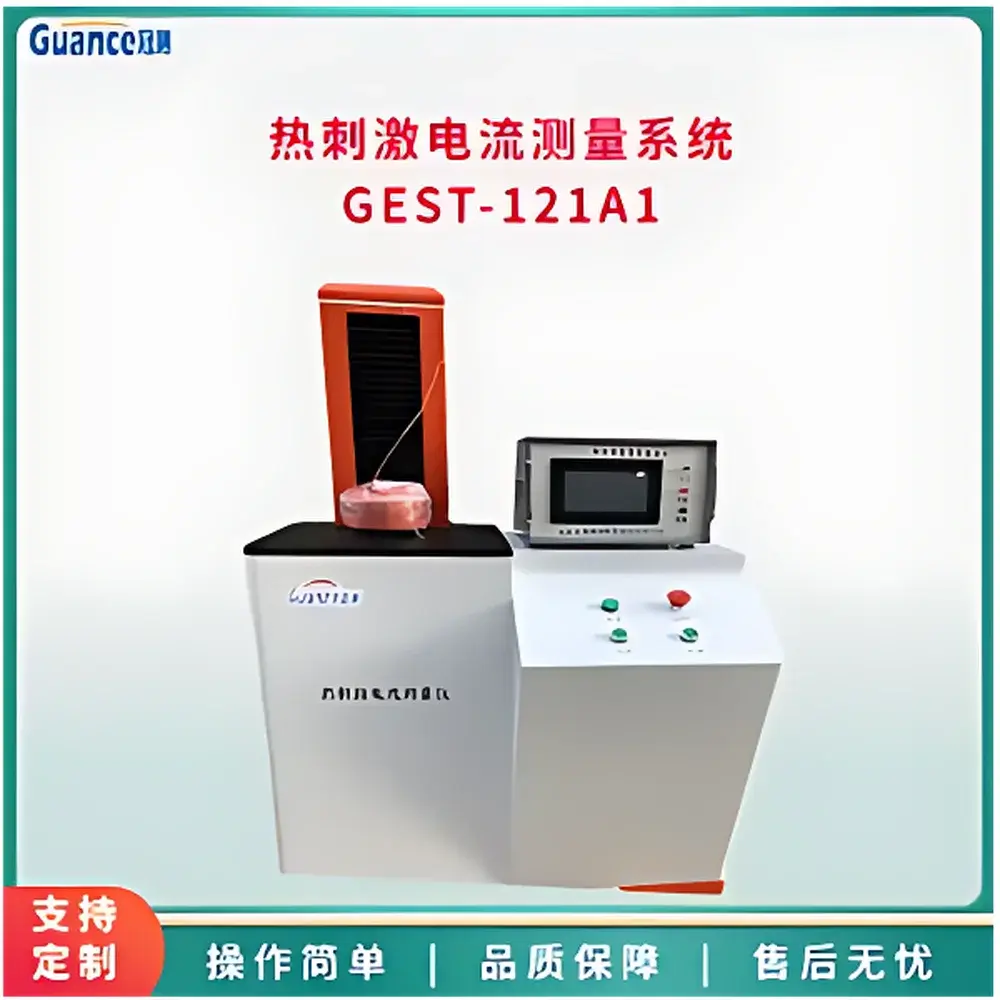
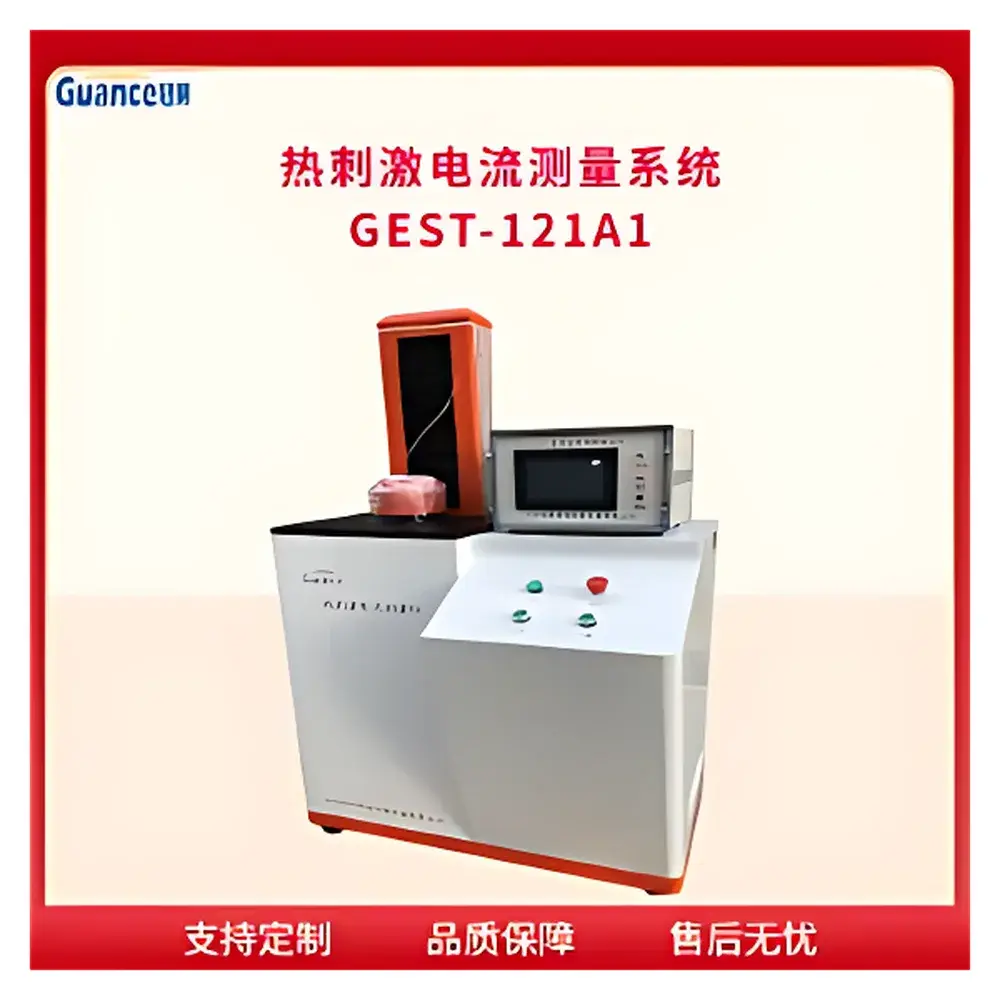
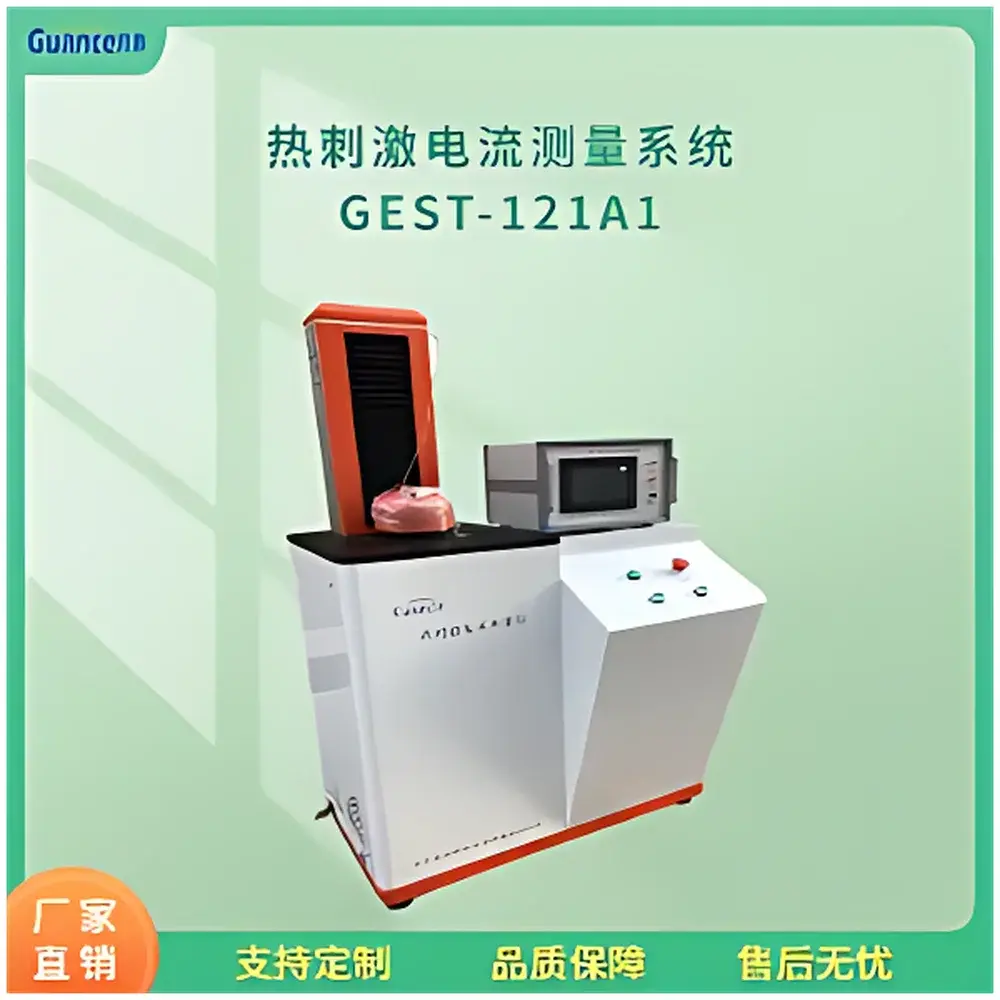
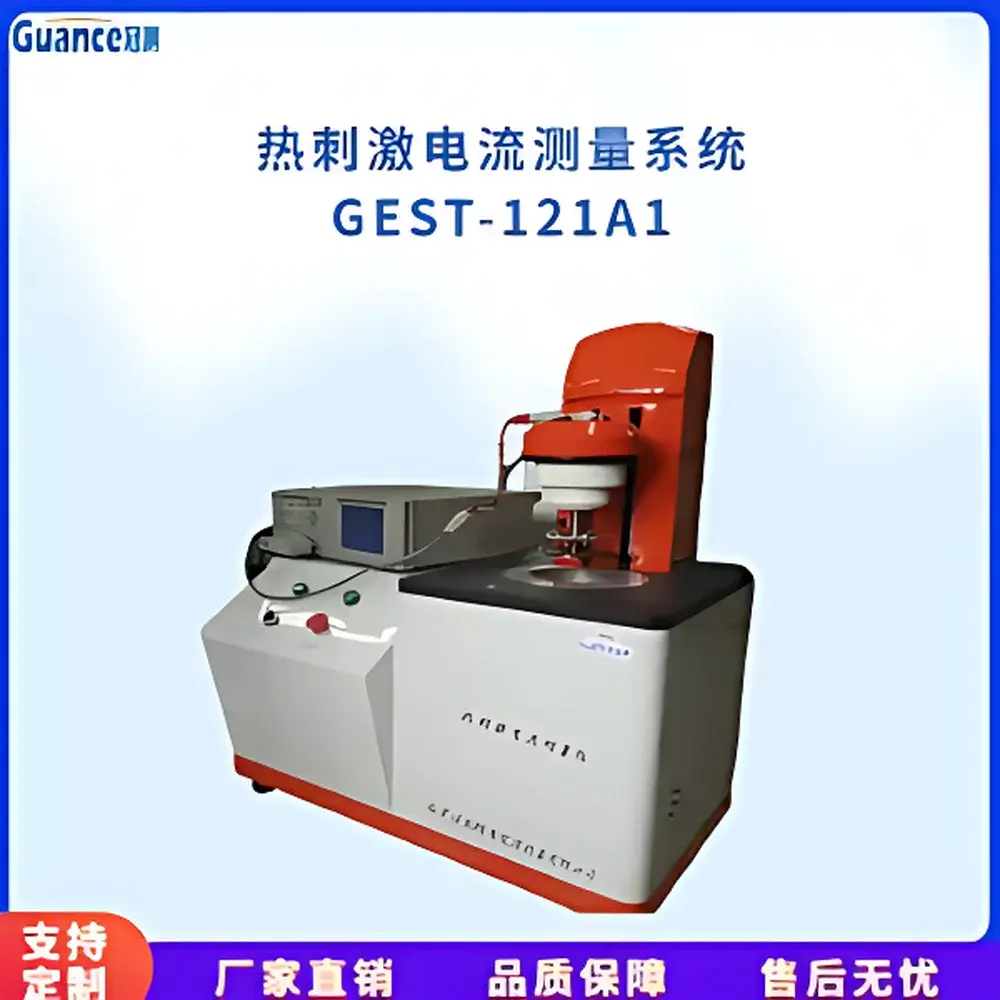
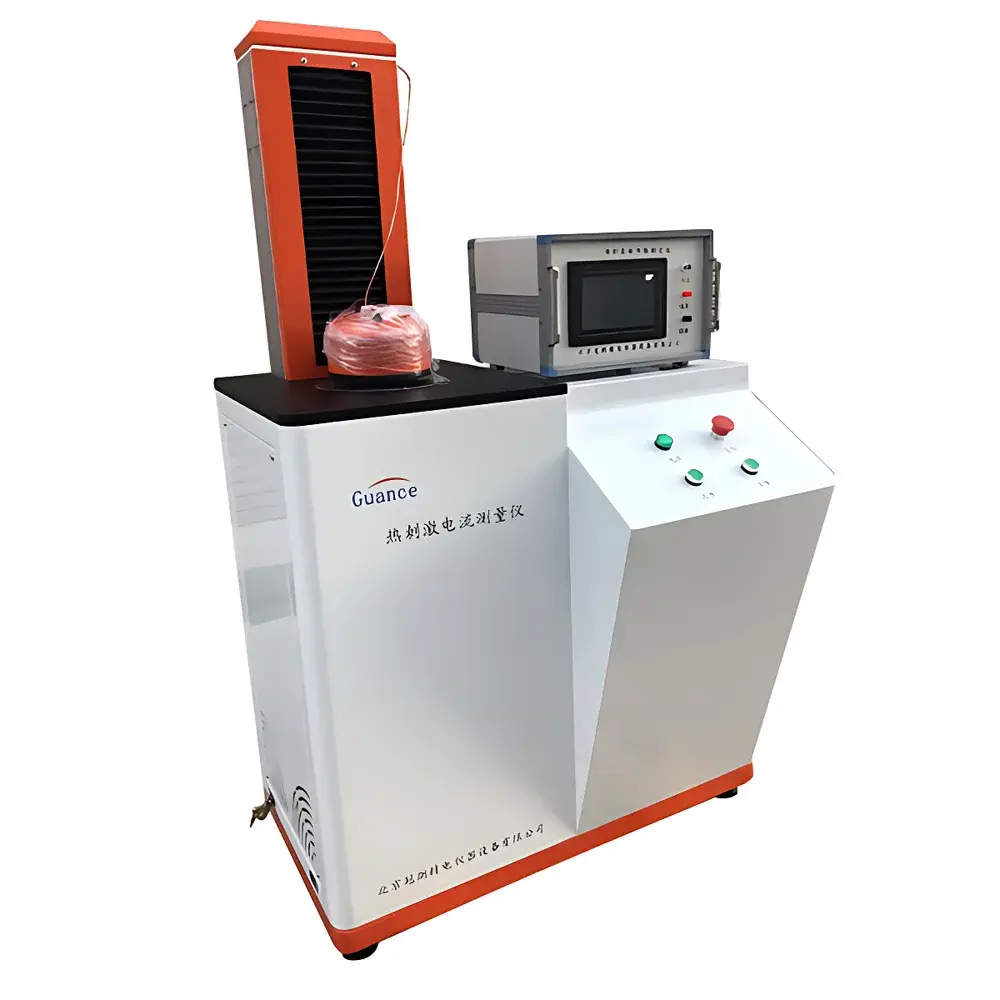
GuanCe Thermally Stimulated Current (TSC) Measurement System GEST-121A1
| Brand | GuanCe Instruments |
|---|---|
| Origin | Beijing, China |
| Manufacturer Type | Authorized Distributor |
| Origin Category | Domestic (China-made) |
| Model | GEST-121A1 |
| Price | USD 1,250 (FOB Beijing) |
| Minimum Current Resolution | 1 fA (1×10⁻¹⁵ A) |
| Temperature Range | −40 °C to +250 °C |
| Heating/Cooling Rate | 0.5–10 °C/min |
| DC Voltage Ranges | 10 V / 50 V / 100 V / 250 V / 500 V / 1000 V |
| Electrode Diameter | 10 mm |
| Sample Stage | Motorized Vertical Positioning |
| Heating Method | Resistive Wire Heater |
| Cooling Method | Compressor-Based Refrigeration |
| Thermal Transfer Fluid | Dimethyl Silicone Oil (2 cSt, 10 L capacity) |
| Data Acquisition | PC-controlled, real-time dynamic curve display |
| Data Export | CSV and Excel-compatible reports with timestamped metadata |
| Fully Automated Test Sequence | Parameter-defined start/hold/stop logic with zero manual intervention post-initiation |
| Power Rating | 1500 W |
| Net Weight | 100 kg |
Overview
The GuanCe Thermally Stimulated Current (TSC) Measurement System GEST-121A1 is a precision benchtop instrument engineered for quantitative analysis of charge carrier dynamics in dielectric and insulating materials under controlled thermal excitation. Based on the fundamental principle of thermally stimulated depolarization current (TSDC), the system measures weak transient currents (down to 1 fA) generated when trapped charges are thermally released from defect states during programmed temperature ramping. This enables characterization of trap energy depth, trap density distribution, and relaxation mechanisms—critical parameters in polymer electrets, ferroelectric ceramics, cable insulation, aerospace composites, and solid-state electrolytes. The GEST-121A1 integrates a high-stability cryo-heating chamber, low-noise electrometer architecture, and synchronized voltage bias control to ensure reproducible TSC spectra acquisition across wide thermal and electrical operating windows.
Key Features
- Ultra-low-current measurement capability with 1 fA (1×10⁻¹⁵ A) resolution, achieved via guarded electrometer design and optimized shielding against electromagnetic interference.
- Wide operational temperature range from −40 °C to +250 °C, enabled by dual-mode thermal control: Peltier-assisted pre-cooling followed by resistive heating and compressor-driven active cooling using dimethyl silicone oil as thermal transfer medium.
- Precise thermal programming with adjustable ramp rates (0.5–10 °C/min) and programmable isothermal hold durations at user-defined temperatures—essential for deconvolution of overlapping trap levels.
- Multi-range DC bias supply (10 V to 1000 V) with galvanically isolated output, supporting both low-field polarization conditioning and high-field depolarization protocols per IEC 60243-2 and ASTM D149.
- Motorized electrode stage with 10 mm diameter parallel-plate electrodes ensures repeatable sample contact pressure and eliminates operator-induced mechanical variability.
- Fully automated test execution: once parameters (start/end temperature, ramp rate, bias voltage, dwell time) are configured in software, the system executes lift-down-contact-heat-measure-cool-lift sequence without manual intervention.
- Real-time data visualization with dual-axis plotting (current vs. temperature or time), overlay-capable for comparative analysis of multiple runs.
Sample Compatibility & Compliance
The GEST-121A1 accommodates disk-shaped or slab-type solid dielectrics up to 25 mm in diameter and 5 mm thickness. Standard electrode geometry supports ASTM D257-compliant volume resistivity and surface resistivity pre-conditioning. The system meets mechanical and electrical safety requirements per GB/T 25000.51–2016 (equivalent to ISO/IEC 25051) and conforms to EMC Class B limits per GB 9254–2008. While not certified for GLP or FDA 21 CFR Part 11 out-of-the-box, its audit-ready data logging—including full parameter metadata, timestamps, hardware ID stamps, and uneditable raw binary archives—facilitates internal validation for regulated environments. Exported Excel and CSV files include traceable calibration references and instrument configuration snapshots.
Software & Data Management
The proprietary TSC Control Suite v3.2 provides intuitive workflow management through a Windows-based GUI. Core functions include: configurable thermal profile definition (multi-segment ramps with holds), real-time current/voltage/temperature synchronization, automatic baseline correction, and noise-filtered derivative analysis. All acquired data are stored in a hierarchical binary format (.tscbin) with embedded SHA-256 checksums for integrity verification. Export modules generate ISO 17025-aligned reports containing test conditions, raw curves, processed peak-fit results (e.g., initial rise, curve fitting via Gaussian or exponential decay models), and statistical summaries. Software supports external trigger input for integration into larger material testing platforms and allows remote monitoring via TCP/IP API (documentation available upon request).
Applications
- Quantification of trap energy distribution in polymeric insulators used in HVDC cable systems (IEC 62067 Annex E reference methodology).
- Evaluation of space-charge accumulation and dissipation kinetics in cross-linked polyethylene (XLPE) and ethylene-propylene rubber (EPR) under thermal-electrical stress.
- Characterization of polarization stability in relaxor ferroelectrics and polymer-ceramic nanocomposites for energy storage capacitors.
- Assessment of radiation-induced defect formation in nuclear-grade epoxy resins and quartz-filled silicones.
- Comparative aging studies of photovoltaic encapsulant materials (EVA, POE) under thermal cycling and UV exposure protocols.
- Research on ion migration barriers in solid-state battery separators and interfacial charge trapping at cathode/electrolyte boundaries.
FAQ
What is the recommended calibration frequency for the GEST-121A1?
Annual calibration using NIST-traceable current and temperature standards is advised; internal self-diagnostics run at startup verify electrometer gain stability and thermal sensor linearity.
Can the system perform isothermal depolarization current (IDC) measurements?
Yes—the software supports fixed-temperature depolarization mode with user-defined polarization time, bias removal timing, and post-removal current decay recording up to 10⁴ seconds.
Is vacuum or inert gas purging supported inside the chamber?
The chamber features a sealed port (KF16) for optional nitrogen purge or vacuum connection (up to 10⁻² mbar); standard operation uses ambient air or dry nitrogen blanket.
Does the system comply with ASTM D8199 for TSC testing?
While ASTM D8199 is currently under development (as of 2024), the GEST-121A1 implements all technically defined measurement prerequisites therein, including current resolution, thermal uniformity (<±0.5 °C across sample zone), and voltage stability (<0.1% drift over 1 h).
How is electrode contamination mitigated during repeated high-temperature testing?
Electrodes are gold-plated copper with removable ceramic insulator sleeves; cleaning protocol includes ultrasonic bath in anhydrous ethanol followed by low-temperature bake-out (120 °C, 2 h) under nitrogen flow.



