Guarder GDR-30PR Plasma Cleaner
| Brand | Guarder |
|---|---|
| Origin | Shandong, China |
| Manufacturer Type | Authorized Distributor |
| Country of Origin | China |
| Model | GDR-30PR |
| Dimensions (W×D×H) | 630 × 650 × 420 mm |
| Chamber Volume | ~30 L (290 × 290 × 360 mm) |
| Electrode Size | 180 × 210 mm (capacitively coupled, internal) |
| RF Generator | 13.56 MHz, 0–300 W continuous adjustable output with auto-impedance matching |
| Optional | 40 kHz medium-frequency plasma source |
| Control System | 7-inch HMI touchscreen + PLC (Omron/Siemens components), manual/auto modes |
| Vacuum System | Leybold vacuum pump, SMC isolation & vent valves, Inficon pressure sensor |
| Pressure Control | PID closed-loop regulation, ±1 Pa accuracy |
| Gas Delivery | Dual-channel, FITOK gas lines, mass flow controllers + needle valves |
| Operating Modes | RIE (Reactive Ion Etching) and PE (Plasma Enhanced) selectable |
| Compliance | Designed for ISO Class 5–7 cleanroom environments, compatible with GLP laboratory workflows |
Overview
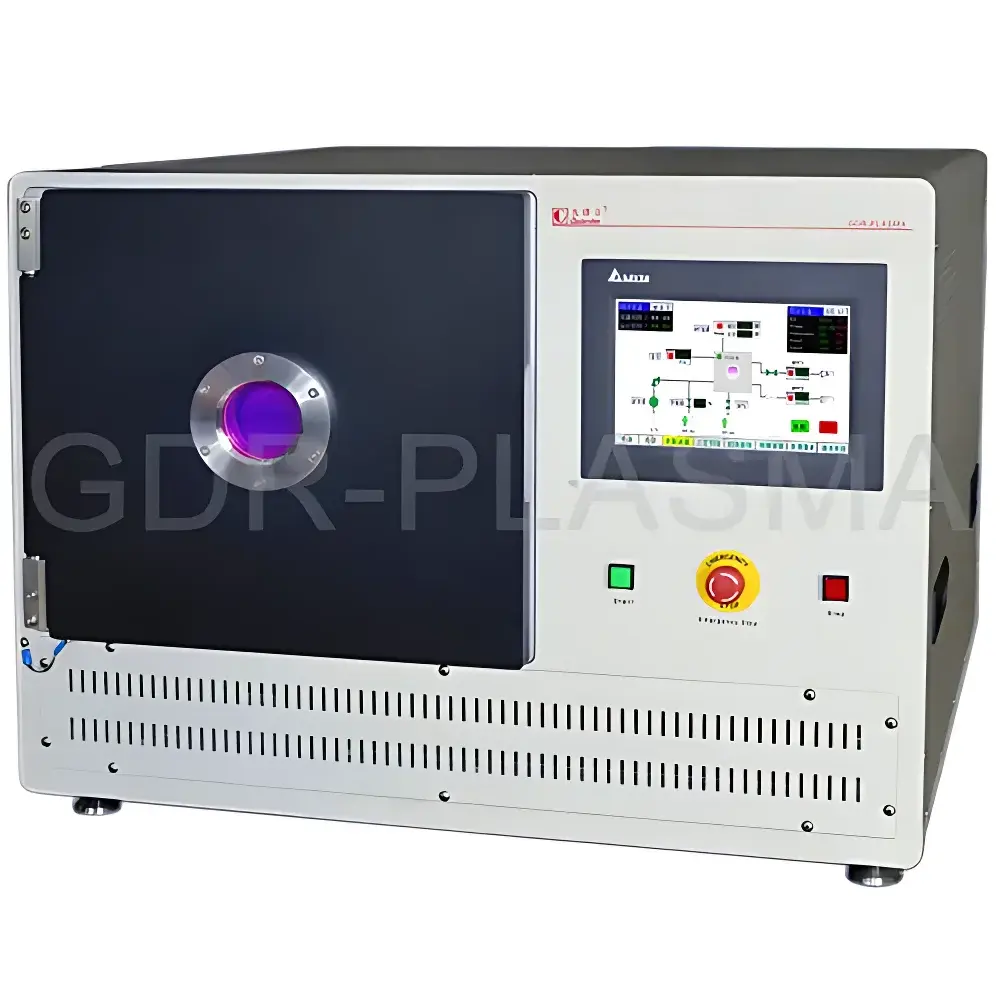
The Guarder GDR-30PR Plasma Cleaner is a compact, benchtop dry processing system engineered for precise surface modification of sensitive substrates in semiconductor R&D, microfabrication, and advanced materials laboratories. It operates on the principle of low-pressure radio-frequency (RF) plasma generation—utilizing either 13.56 MHz capacitively coupled plasma (CCP) or optional 40 kHz medium-frequency excitation—to produce highly reactive neutral species, ions, and UV photons. Unlike wet chemical methods, this dry process eliminates solvent residues, avoids interfacial contamination, and enables sub-nanometer-level control over surface chemistry and topography. The system supports both Reactive Ion Etching (RIE) mode—emphasizing directional ion bombardment for anisotropic removal—and Plasma Enhancement (PE) mode—prioritizing radical-driven isotropic cleaning and functionalization. Its integrated chamber design, built from high-purity aluminum alloy with electropolished interior surfaces, ensures minimal outgassing and particulate generation—critical for maintaining ultra-clean processing conditions required in MEMS, OLED, and thin-film photovoltaic development.
Key Features
- Benchtop footprint (630 × 650 × 420 mm) optimized for space-constrained cleanrooms and shared lab facilities
- Dual-mode plasma operation: switchable RIE and PE configurations via software-selectable RF coupling and bias parameters
- High-stability 13.56 MHz RF generator (0–300 W, continuously adjustable) with real-time auto-impedance matching to maintain plasma ignition stability across varying gas compositions and pressures
- PID-controlled vacuum environment with ±1 Pa pressure regulation accuracy—enabled by Inficon capacitance manometer feedback and fast-response SMC pneumatic valves
- Modular dual-gas delivery architecture: independent mass flow control (MFC) for two process gases (e.g., O2, Ar, CF4, N2), featuring FITOK-certified stainless-steel tubing and leak-tight VCR fittings
- Industrial-grade PLC automation (Omron CJ2M series) integrated with 7-inch resistive touchscreen HMI—supporting recipe storage, step-by-step sequence programming, and audit-trail-capable event logging
- Chamber geometry optimized for uniform plasma density: 30 L aluminum alloy vessel with symmetrical electrode placement (180 × 210 mm internal CCP electrodes) and grounded chamber walls to minimize standing-wave effects
Sample Compatibility & Compliance
The GDR-30PR accommodates wafers up to 6 inches (150 mm), diced dies, glass substrates, polymer films (e.g., PET, PI), ceramic packages, and metal foils—without requiring custom fixtures. Substrate heating is passive (no active chuck temperature control), making it suitable for thermally sensitive materials such as photoresists, organic semiconductors, and bio-functionalized surfaces. All wetted materials—including chamber gaskets, gas lines, and electrode insulators—meet USP Class VI and ASTM F2023 biocompatibility standards where applicable. The system adheres to IEC 61000-6-3 (EMC emissions) and IEC 61000-6-2 (immunity) requirements. While not certified for Class 100 (ISO 5) cleanroom installation out-of-the-box, its design supports integration into ISO 5–7 environments when paired with appropriate air filtration and exhaust scrubbing systems. Process documentation complies with GLP record-keeping conventions; electronic logs include timestamped parameter sets, alarm history, and operator ID fields—enabling traceability for internal quality audits.
Software & Data Management
Control firmware runs on a deterministic real-time OS with non-volatile recipe memory (≥100 protocols). Each protocol defines gas composition ratios, power ramp profiles, pressure setpoints, dwell times, and mode selection (RIE/PE). All operational data—including RF forward/reflected power, chamber pressure, gas flow rates, and valve status—is logged at 1 Hz resolution and exportable in CSV format via USB 2.0 interface. The HMI supports multi-language UI (English, Japanese, Korean, Simplified Chinese) and includes password-protected administrator access levels (Operator, Engineer, Supervisor) aligned with FDA 21 CFR Part 11 principles—though full electronic signature capability requires external LIMS integration. No cloud connectivity or remote telemetry is embedded; all data remains local unless manually exported—ensuring compliance with institutional IT security policies common in university and government labs.
Applications
- Removal of organic contaminants (hydrocarbons, photoresist residuals, lubricants) from Si, GaAs, and sapphire wafers prior to metallization or epitaxy
- Surface activation of PDMS, PMMA, and cyclic olefin copolymers (COC) for improved adhesion in microfluidic bonding
- Hydrophilization of PTFE and polypropylene membranes for enhanced liquid wettability in filtration and biosensing platforms
- Pre-deposition cleaning of ITO and AZO transparent conductive oxides to reduce contact resistance in OLED and perovskite solar cell stacks
- Low-damage descum of lithographic patterns after development—minimizing line-edge roughness (LER) compared to aggressive wet etches
- Functionalization of carbon nanotube and graphene surfaces with amine or carboxyl groups for covalent biomolecule immobilization
FAQ
What vacuum level can the GDR-30PR achieve?
Base pressure is typically ≤5 × 10⁻³ mbar using the included Leybold TRIVAC D-series rotary vane pump. Ultimate pressure depends on chamber conditioning and gas type but consistently reaches ≤1 × 10⁻² mbar under standard operating conditions.
Is ozone generation a concern during O2 plasma operation?
Yes—ozone forms as a natural byproduct. The system must be exhausted through a dedicated ducted fume hood or catalytic ozone destruct unit compliant with OSHA PEL (0.1 ppm 8-hour TWA) and local environmental regulations.
Can the GDR-30PR perform ashing of thick photoresist layers?
It is optimized for thin-film (<5 µm) descum and surface cleaning. For bulk resist removal (>10 µm), higher-power industrial plasma asher systems with cryogenic cooling are recommended.
Does the system support process repeatability across multiple users?
Yes—PLC-based recipe execution eliminates manual knob-turning variability. Each run records actual measured parameters (not just setpoints), enabling statistical process control (SPC) analysis when aggregated externally.
What maintenance intervals are recommended?
Electrode inspection and chamber cleaning every 50–100 operating hours; RF matching network calibration annually or after major component replacement; vacuum pump oil change every 3,000 hours or per Leybold service guidelines.