
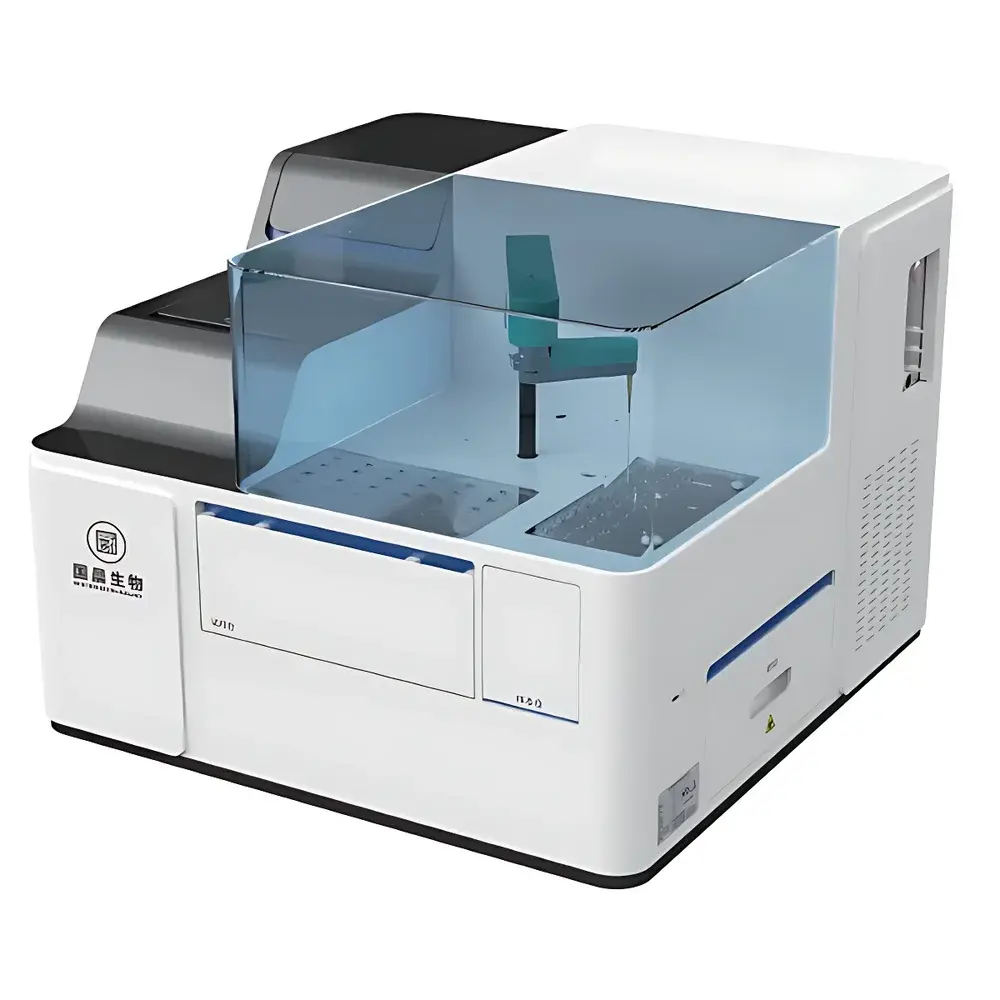
Guochen Biotechnology GCZD-A Research-Grade Fully Automated Chemiluminescence Immunoassay System
| Brand | Guochen Biotechnology |
|---|---|
| Origin | Shandong, China |
| Manufacturer Type | Original Equipment Manufacturer (OEM) |
| Product Category | Domestic |
| Model | GCZD-A Research-Grade Fully Automated Chemiluminescence Immunoassay System |
| Pricing | Available Upon Request |
Overview
The Guochen Biotechnology GCZD-A Research-Grade Fully Automated Chemiluminescence Immunoassay System is an integrated platform engineered for high-sensitivity, quantitative immunochemical analysis based on electrochemiluminescence (ECL) and chemiluminescence (CL) detection principles. Unlike conventional clinical analyzers optimized for routine diagnostics, the GCZD-A is purpose-built for research laboratories requiring full experimental control over reaction kinetics, separation dynamics, and photon detection parameters. It employs a magnetically driven solid-phase separation module coupled with precision fluidic handling and time-resolved photon counting via a high-gain photomultiplier tube (PMT) with sub-picoampere dark current and broad spectral response (300–650 nm). This architecture enables reliable quantification of ultra-low-abundance biomarkers—such as hormones, cytokines, and tumor-associated antigens—across five orders of magnitude (10⁰–10⁵ relative light units), supporting both fundamental mechanistic studies and translational assay development under GLP-aligned workflows.
Key Features
- Magnetic bead-based solid-phase separation with programmable wash cycles and precise aspiration/dispense control, minimizing nonspecific binding and carryover
- Automated reagent dispensing with ≤1.0% volumetric error across 5–200 µL range, validated per ISO 8655-6 gravimetric standards
- High-speed sample processing: up to 100 tests per hour with integrated incubation, mixing, and luminescence readout
- Configurable assay protocols: supports one-step and two-step sandwich immunoassays, competitive formats, and direct antigen binding assays
- Real-time kinetic acquisition at up to 1000 data points per second, enabling transient ECL decay profiling and reaction onset timing
- Open software architecture with documented API and SDK support for custom script integration, third-party data import/export (CSV, XML, JSON), and instrument control via TCP/IP or USB 2.0
Sample Compatibility & Compliance
The GCZD-A accommodates standard 96-well microplates (flat-bottom, white polystyrene), tube-based formats (1.5 mL Eppendorf), and custom carrier racks for non-standard consumables. It complies with IEC 61000-4 electromagnetic compatibility requirements and meets CE marking criteria for in vitro diagnostic research equipment (IVDR Annex II Class A). While not intended for clinical diagnostics per FDA 21 CFR Part 809 or EU IVDR Article 2(1), its hardware and firmware architecture aligns with key elements of analytical validation frameworks described in CLSI EP17-A2 (limit of detection), EP05-A3 (precision), and ISO 15197:2013 (system accuracy requirements for quantitative immunoassays). Audit trail functionality—including user login timestamps, protocol versioning, and raw photon count logs—is enabled by default and supports 21 CFR Part 11-compliant electronic record retention when deployed with validated LIMS integration.
Software & Data Management
The GCZD-A runs on a Linux-based embedded OS with a Qt-based graphical interface offering dual-mode operation: guided wizard mode for novice users and advanced script editor mode for protocol optimization. All luminescence data are stored in HDF5 format with embedded metadata (wavelength calibration, PMT gain setting, temperature log, magnetic field duty cycle). Built-in statistical modules calculate LOD/LOQ per CLSI EP17-A2, generate calibration curves using four-parameter logistic (4PL) regression, and export QC reports compliant with ISO/IEC 17025 documentation requirements. Raw photon counts and time-stamped event logs can be exported for offline analysis in Python (via h5py), MATLAB, or R environments—facilitating reproducible computational modeling of ECL kinetics and signal-to-noise optimization.
Applications
- Quantitative profiling of low-abundance serum biomarkers (e.g., IL-6, PSA, cortisol) in preclinical and translational research
- Time-resolved investigation of ECL reaction mechanisms, including Ru(bpy)₃²⁺/TPA and luminol/H₂O₂ systems
- Development and validation of novel chemiluminescent labels, nanomaterial-enhanced probes, and enzyme-mimetic catalysts
- High-throughput screening of monoclonal antibody affinity and epitope binning using multiplexed capture strategies
- Method transfer from manual benchtop CL platforms to automated workflows, supporting ISO 15189 method validation protocols
- Education and training in immunoassay engineering, microfluidics integration, and photonic detection system design
FAQ
Is the GCZD-A suitable for clinical diagnostic use under FDA or CE-IVDR regulations?
No. The GCZD-A is designated exclusively for research use (RUO) and is not certified for in vitro diagnostic (IVD) applications. Its validation documentation and quality management system conform to ISO 13485:2016 for research instrumentation, not IVD regulatory pathways.
Can the system perform multiplexed detection in a single well?
Not natively. The GCZD-A uses single-channel PMT detection; however, spatially resolved multiplexing can be implemented via sequential addition of spectrally distinct labels and wavelength-selective optical filtering—requiring external optical modification and custom software scripting.
What maintenance protocols are recommended for long-term PMT stability?
Daily warm-up (30 min), quarterly dark current verification, and biannual PMT gain recalibration using NIST-traceable light sources are advised. Full service intervals are specified at 12 months or 5,000 operational hours, whichever occurs first.
Does the system support remote monitoring and control?
Yes. Via Ethernet connection, users may initiate runs, monitor real-time photon flux, access audit logs, and receive email/SNMP alerts using the included web-based dashboard compatible with modern browsers and mobile devices.
Are consumables proprietary or compatible with third-party reagents and plates?
All fluidic interfaces and plate carriers adhere to ANSI/SBS standards. No proprietary consumables are required; users may employ commercially available magnetic beads, CL substrates, and 96-well plates from major suppliers without performance compromise.







