
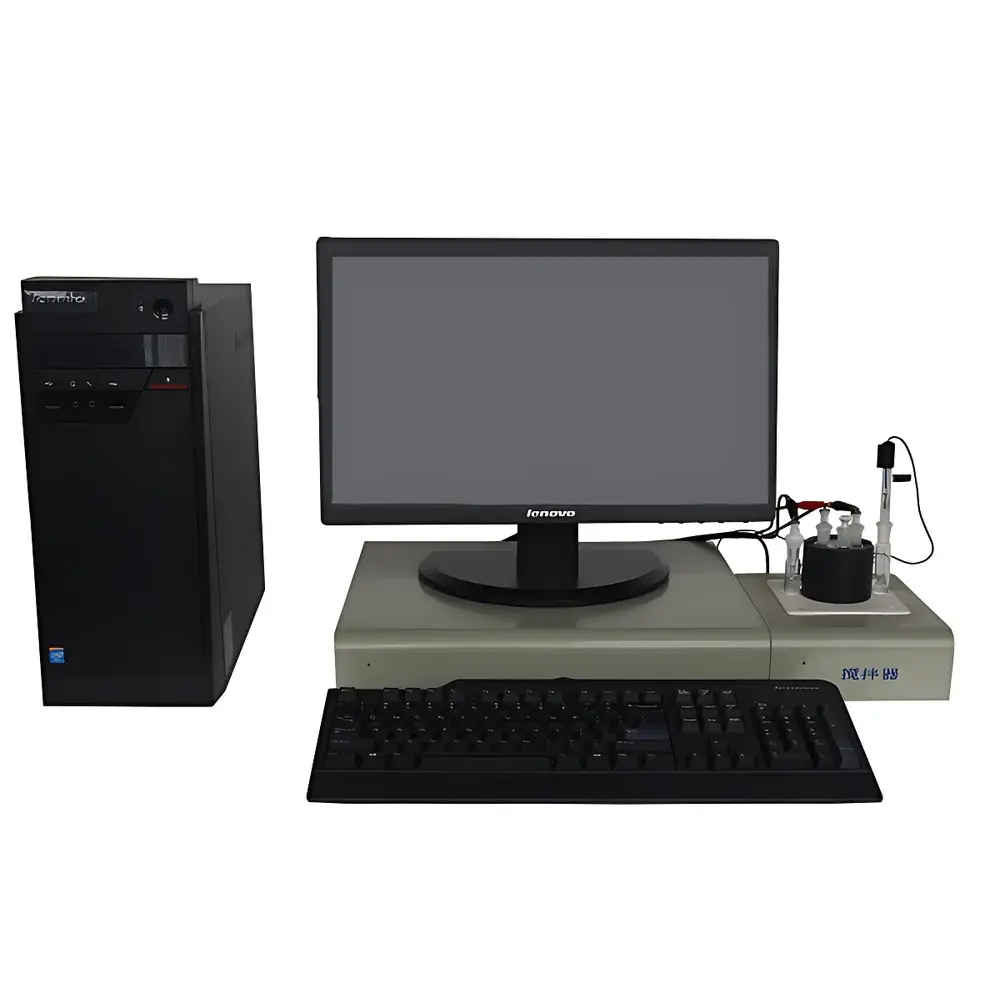
GUOCHUANG BR-3000A Bromine Number and Bromine Index Analyzer
| Brand | GUOCHUANG |
|---|---|
| Origin | Jiangsu, China |
| Manufacturer Type | Direct Manufacturer |
| Model | BR-3000A |
| Measurement Principle | Microcoulometric Titration (Electrogenerated Bromine) |
| Standards Compliance | GB/T 1815–1997, SH/T 1551–2018, ASTM D1492, SH/T 0630–1996 |
| Bromine Number Range | 0–300 g Br/100 g sample |
| Bromine Index Range | 0–1000 mg Br/100 g sample |
| Resolution | 0.001 mg Br |
| Accuracy | ±3% ±0.2 g Br (bromine number) |
| Detection Limit | 0.01 mg Br |
| Cell Volume | 150 mL |
| Power Consumption | 30 W |
| Weight | 4 kg |
| Dimensions (L×W×H) | 350 × 280 × 160 mm |
Overview
The GUOCHUANG BR-3000A Bromine Number and Bromine Index Analyzer is a dedicated microcoulometric titration system engineered for precise quantification of unsaturation in hydrocarbon-based samples via electrogenerated bromine. Operating on the fundamental principle of controlled electrolysis—where bromide ions (Br⁻) are oxidized at the anode to produce molecular bromine (Br₂) in situ—the instrument measures the total charge consumed during titration to determine bromine reactivity. This coulometric approach eliminates the need for standard bromine solutions, thereby minimizing handling hazards, reagent variability, and calibration drift. The BR-3000A is optimized for routine quality control and specification compliance in petroleum refining, petrochemical production, and specialty solvent manufacturing, where accurate assessment of olefinic content directly correlates with oxidative stability, gum formation potential, and catalyst poisoning risk.
Key Features
- Integrated microcoulometric cell with 150 mL working volume, designed for stable baseline and rapid electrode response.
- Dual-range measurement capability: high-resolution quantification of both bromine number (0–300 g Br/100 g) and bromine index (0–1000 mg Br/100 g), supporting analysis across light naphthas to heavy distillates.
- Real-time current integration and endpoint detection algorithm ensures automatic termination without manual intervention or visual endpoint interpretation.
- Dedicated Windows-based control software performs real-time current monitoring, Faraday’s law-based calculation, and automatic unit conversion between bromine number and bromine index.
- Robust architecture with low-power consumption (30 W) and compact footprint (350 × 280 × 160 mm), suitable for benchtop deployment in QC laboratories operating under ISO/IEC 17025 or ASTM-compliant workflows.
- Calibration traceability supported via certified reference materials; system verification includes blank determination, recovery testing, and linearity checks per SH/T 0630–1996 protocol.
Sample Compatibility & Compliance
The BR-3000A is validated for use with non-aqueous, low-polarity matrices including gasoline, kerosene, diesel fuel, base oils, white spirits, and aromatic hydrocarbons such as benzene, toluene, and xylene. Samples must be free of strong oxidizers, halogenated solvents, or excessive water (>50 ppm), which may interfere with bromine generation or cause electrode passivation. The analyzer meets the methodological requirements of multiple international standards: GB/T 1815–1997 for benzene products, SH/T 1551–2018 for aromatic hydrocarbons, ASTM D1492 for coulometric bromine index determination, and SH/T 0630–1996 for general petroleum products. While not inherently 21 CFR Part 11 compliant, audit-ready data logs—including timestamped current profiles, integrated charge values, operator ID, and calibration history—can be exported in CSV or PDF format for GLP/GMP documentation.
Software & Data Management
The proprietary acquisition and analysis software provides full instrument control, including cell conditioning, background current stabilization, sample injection timing, and dynamic endpoint recognition. All raw current-vs.-time data are stored with metadata (date/time, operator, sample ID, method version). Calculated results display both bromine number and bromine index simultaneously, with uncertainty estimates derived from replicate measurements and method-defined accuracy tolerances. Data export supports LIMS integration via ODBC drivers; audit trails record all parameter changes, result modifications, and user logins. Software updates are distributed via secure vendor portal, with version-controlled release notes aligned to standard revision cycles of referenced test methods.
Applications
- Quality assurance of refinery streams: monitoring olefin saturation efficiency in hydrotreating units.
- Specification testing of commercial gasoline blends against ASTM D4814 limits for bromine index (typically ≤10–30 mg Br/100 g).
- Stability evaluation of jet fuels per DEF STAN 91-91 or NATO F-34, where elevated bromine index indicates degradation-prone components.
- R&D screening of catalytic cracking feedstocks to correlate bromine reactivity with coke yield and catalyst deactivation rates.
- Verification of hydrogenation completeness in synthetic lubricant base stocks prior to additive blending.
FAQ
What sample preparation is required prior to analysis?
Samples should be homogenized and introduced via syringe into the titration cell without dilution. For viscous or wax-containing samples (e.g., certain diesel fractions), preheating to 40–50 °C may improve transfer consistency.
How often must the electrolyte solution be replaced?
Typical electrolyte (LiBr in glacial acetic acid/methanol) remains stable for up to 72 hours of continuous operation; replacement is recommended after 10–15 analyses or if background current exceeds 10 nA.
Can the BR-3000A be used for chlorine or iodine determination?
No—the system is configured exclusively for bromine generation and detection; electrode geometry, cell design, and software algorithms are not adaptable to other halogens.
Is external gas purging required?
Yes. A continuous flow of dry, oil-free nitrogen (≥99.998% purity) at 20–30 mL/min is mandatory to exclude atmospheric moisture and oxygen, both of which suppress bromine generation efficiency and elevate baseline noise.
Does the instrument support automated sample introduction?
Not natively—the BR-3000A requires manual syringe injection. However, third-party autosamplers with compatible solvent resistance and inert fluid paths can be integrated using TTL-triggered start signals.
Related Products





