
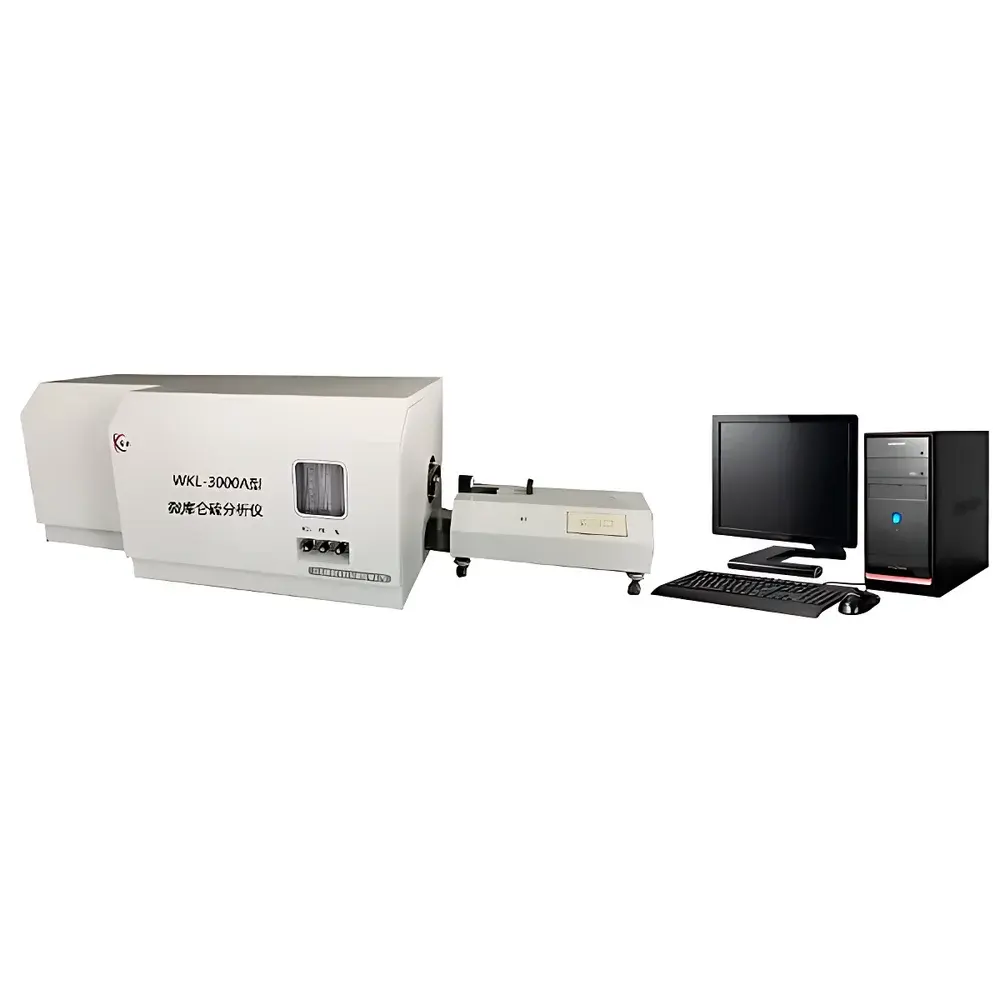
GUOCHUANG WKL-3000A Microcoulometric Sulfur Analyzer
| Brand | GUOCHUANG |
|---|---|
| Origin | Jiangsu, China |
| Manufacturer Type | Direct Manufacturer |
| Country of Origin | China |
| Model | WKL-3000A |
| Detection Principle | Microcoulometric Titration (Oxidative Coulometry) |
| Sample Types | Liquid, Gas, Solid |
| Sulfur Range | 0.05–10,000 ppm (dilutable for high concentration |
| Bias Voltage Range | 0–500 mV |
| Temperature Control Range | Ambient to 1000 °C |
| Temperature Accuracy | ±1 °C |
| Power Supply | AC 220 V ± 22 V, 50 Hz ± 0.5 Hz |
| Power Consumption | 3.5 kW |
| Dimensions (L×W×H) | 860 × 440 × 380 mm |
| Weight | 46 kg |
| Compliance Standards | NB/SH/T 0253–2021, SH/T 0222, ASTM D3120–08, ASTM D3246–15, GB/T 11060.4–2017, GB/T 12688.6–1990, GB/T 11141–2014, GB/T 6324.4–2008, GB/T 3208–2009, SH/T 1147–2008, YB/T 5022–2016 |
| Relative Standard Deviation (RSD) | ≤2% (S > 100 ppm), ≤3% (10–100 ppm), ≤5% (1–10 ppm), ≤10% (0.2–1 ppm) |
| Carrier Gases | Technical-grade nitrogen and oxygen |
Overview
The GUOCHUANG WKL-3000A Microcoulometric Sulfur Analyzer is a precision laboratory instrument engineered for the quantitative determination of total sulfur in petroleum, petrochemical, coal-derived, and industrial organic materials using oxidative microcoulometric titration. This technique relies on controlled pyrolytic oxidation of sulfur-containing compounds at high temperature (up to 1000 °C), followed by conversion of sulfur oxides to SO₂, which is then quantitatively titrated in an electrolytic cell via coulometric detection. The system measures the charge required to regenerate the titrant (I₃⁻ or Ag⁺, depending on electrolyte configuration), enabling direct calculation of sulfur mass based on Faraday’s law. Designed for routine QC/QA laboratories and R&D facilities, the WKL-3000A delivers trace-level sensitivity (0.05 ppm), wide dynamic range (0.05–10,000 ppm), and robust reproducibility across heterogeneous sample matrices—liquid fuels, liquefied petroleum gas (LPG), natural gas condensates, coal tar fractions, styrene monomer, light olefins, and aromatic hydrocarbons.
Key Features
- Integrated high-temperature pyrolysis furnace with precise PID-controlled heating (ambient to 1000 °C, ±1 °C stability) and dual-zone thermal management for optimized combustion efficiency and minimal memory effects.
- Digital bias voltage regulation (0–500 mV) for real-time optimization of electrochemical cell response, enhancing signal-to-noise ratio and detection limit consistency.
- Modular sample introduction system supporting automated liquid injection (via programmable syringe pump), gas sampling (with calibrated mass flow controller), and solid sample analysis (using quartz boat and optional ash-free pretreatment protocol).
- Self-calibrating coulometric detection cell with platinum indicator and generator electrodes, maintained under inert carrier gas (N₂/O₂ mixture) to ensure stoichiometric SO₂ oxidation and minimize electrode passivation.
- Embedded microprocessor-based control unit synchronized with PC-hosted acquisition software, enabling closed-loop feedback for titration endpoint recognition and automatic baseline correction.
- Compliance-ready hardware architecture: all critical parameters—including bias voltage, furnace temperature, gas flow rates, and coulombic charge integration—are logged with timestamped audit trails, supporting GLP/GMP documentation requirements.
Sample Compatibility & Compliance
The WKL-3000A accommodates diverse sample forms without matrix-specific hardware modification: volatile liquids (e.g., gasoline, naphtha), pressurized gases (LPG, natural gas), and thermally stable solids (coal extracts, coke oven tars, polymer additives). Its analytical performance aligns with internationally recognized standard methods, including NB/SH/T 0253–2021 (light distillates), SH/T 0222 (LPG), ASTM D3120–08 and D3246–15 (petroleum gases), GB/T 11060.4–2017 (natural gas), and YB/T 5022–2016 (crude benzene). Method validation data confirm linearity (r² ≥ 0.9995 over full range), recovery rates of 97–103% for certified reference materials (CRMs), and repeatability meeting ISO 5725-2 criteria. Instrument design supports regulatory compliance frameworks including FDA 21 CFR Part 11 (electronic records/signatures) when operated with validated software configurations.
Software & Data Management
Control and data acquisition are executed via GUOCHUANG’s proprietary Windows-based application, featuring intuitive workflow-driven interface for method setup, sequence programming, real-time signal visualization, and post-run report generation. Raw coulombic current traces, temperature profiles, and gas flow logs are stored in binary format with embedded metadata (operator ID, sample ID, calibration status, environmental conditions). Export options include CSV, PDF, and XML formats compatible with LIMS integration. Audit trail functionality records all user actions—including parameter edits, calibration events, and result overrides—with immutable timestamps and operator authentication. Data integrity safeguards include automatic backup, cyclic buffer protection against power loss, and configurable retention policies aligned with ISO/IEC 17025 documentation requirements.
Applications
- Refinery QC: Total sulfur screening of gasoline, diesel, jet fuel, and feedstocks per ASTM D3120 and GB/T 11141.
- Coal chemical processing: Quantification of organic sulfur in coal liquefaction products, pitch, and crude benzene per YB/T 5022.
- Petrochemical manufacturing: Trace sulfur monitoring in ethylene, propylene, BTX streams, and styrene monomer (GB/T 12688.6, SH/T 1147).
- Environmental compliance testing: SO₂ precursor analysis in synthetic natural gas and biogas prior to pipeline injection (GB/T 11060.4).
- Research laboratories: Reaction pathway studies involving sulfur removal catalysts, desulfurization kinetics, and speciation modeling via sequential fractionation.
FAQ
What sample preparation is required for solid coal-derived materials?
Crushed and homogenized solids are loaded into quartz boats; optional pre-ashing (per ASTM D3177) may be applied to eliminate volatile interferences. No acid digestion or derivatization is needed.
Can the system analyze ultra-low-sulfur diesel (ULSD) at 10 ppm level with acceptable precision?
Yes—validated RSD ≤3% at 10 ppm (n=6) using 10 µL injection volume and optimized bias voltage; detection limit is confirmed at 0.05 ppm per NB/SH/T 0253–2021 protocol.
Is third-party calibration verification supported?
The analyzer accepts NIST-traceable sulfur CRMs (e.g., SRM 2723a, 2724b) and includes built-in calibration verification routines compliant with ISO/IEC 17025 Clause 7.7.
How is gas-phase sampling quantified without internal standardization?
Volumetric flow rate is measured in real time via thermal mass flow controller; sulfur mass is calculated from integrated coulombs, sample volume, and ideal gas law—eliminating need for surrogate standards.
Does the instrument meet cybersecurity requirements for networked lab environments?
Firmware v2.3+ supports TLS 1.2 encrypted communication, role-based access control, and configurable password policies—aligned with IEC 62443-3-3 for industrial control systems.






