
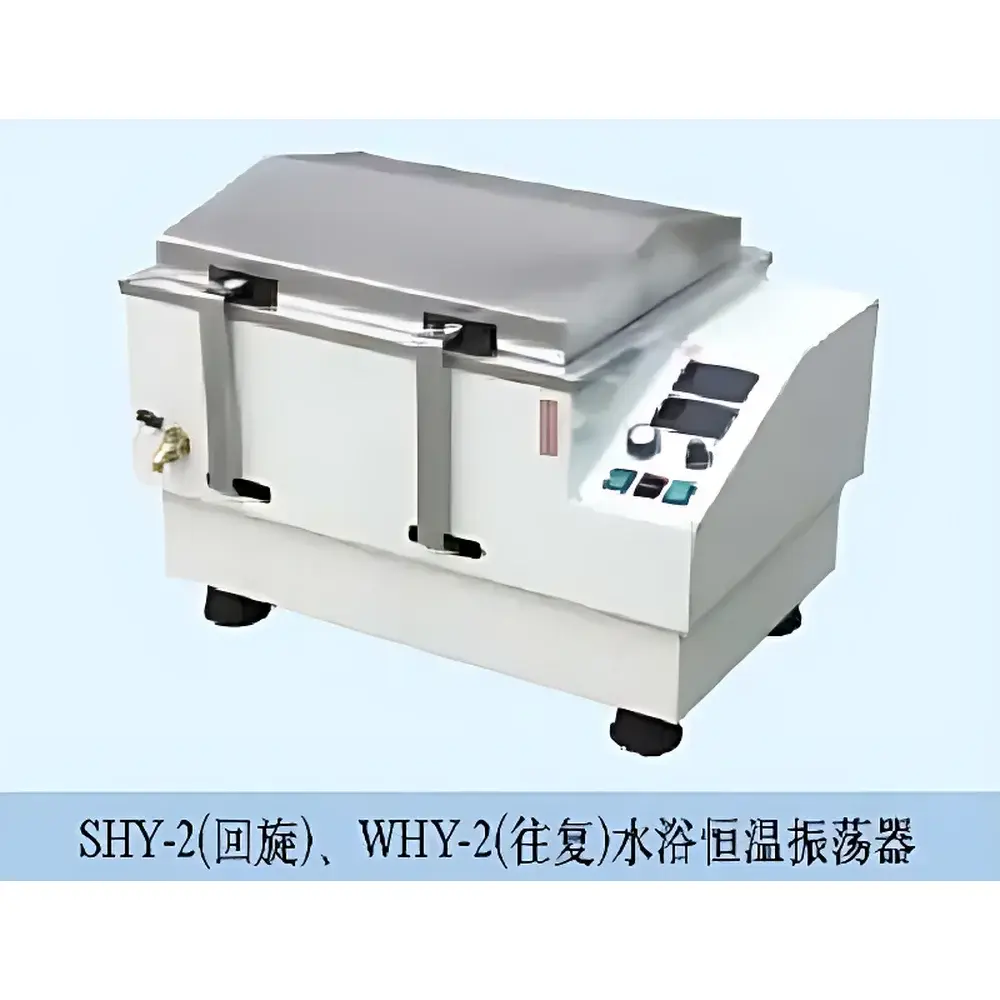
GUOYI WHY-2HS Water Bath Constant-Temperature and Constant-Speed Shaker
| Brand | GUOYI |
|---|---|
| Model | WHY-2HS |
| Power Supply | 220 V, 50 Hz |
| Total Power | 1600 W |
| Oscillation Mode | Reciprocating |
| Frequency Range | 0–300 rpm (adjustable) |
| Stroke Amplitude | 20 mm |
| Temperature Range | Ambient to 99 °C |
| Construction | Stainless steel water bath tank, cold-rolled steel housing with powder coating |
| Heating System | Bottom-mounted immersion heater |
| Control | Digital PID temperature controller with setpoint memory and overshoot suppression |
| Speed Control | Digital display with constant-speed feedback circuit |
| Compliance | Designed for GLP-compliant labs |
| Safety Features | Grounded chassis, dry-run protection, spill-resistant control panel |
Overview
The GUOYI WHY-2HS Water Bath Constant-Temperature and Constant-Speed Shaker is an engineered platform for precise, reproducible incubation and agitation of biological and biochemical samples under controlled thermal and mechanical conditions. It operates on the principle of reciprocating linear oscillation within a thermostatically regulated water bath environment—ensuring uniform heat transfer via convection and minimizing thermal gradients across sample vessels. Unlike air-jacketed shakers, the water bath design provides superior temperature homogeneity (±0.3 °C typical at 37 °C), critical for sensitive applications such as microbial growth kinetics, enzyme activity assays, cell suspension culture, and antigen-antibody binding studies. The unit integrates independent digital control loops for temperature and speed, each featuring real-time feedback and non-volatile setpoint retention—enabling unattended overnight operation in regulated laboratory environments.
Key Features
- Stainless steel water bath tank with welded seams and corrosion-resistant finish—designed for long-term exposure to aqueous buffers, saline solutions, and mild organic solvents.
- Dual independent control system: PID-based digital temperature controller with anti-overshoot algorithm and microprocessor-driven speed regulator with closed-loop tachometric feedback.
- Reciprocating oscillation mechanism with fixed 20 mm stroke amplitude—optimized for consistent mixing of flasks (up to 2 L), test tubes, and multi-well plates without vortex formation or splashing.
- Bottom-mounted high-efficiency immersion heater with thermal cut-off and dry-run protection—reduces warm-up time and improves energy utilization versus side-wall heating configurations.
- Front-panel LED display showing real-time bath temperature (upper row) and user-defined setpoint (lower row); intuitive key navigation (SET/▲/▼) for rapid parameter entry and verification.
- Powder-coated cold-rolled steel enclosure with reinforced structural frame—meets IP20 ingress protection and supports stable placement on standard lab benches or under fume hoods.
Sample Compatibility & Compliance
The WHY-2HS accommodates standard laboratory glassware including Erlenmeyer flasks (50–2000 mL), screw-cap culture tubes, and deep-well microplates when used with appropriate clamping accessories. Its uniform temperature distribution (verified per ASTM E2208-21 Annex A1) ensures compliance with common pharmacopeial methods requiring thermal consistency during shaking incubation (e.g., USP Sterility Tests, EP 2.6.27 Microbiological Examination). The device is suitable for use in GLP and GMP environments where audit trails are required; while it does not include built-in electronic signature capability, its analog/digital hybrid architecture supports external data logging via RS-232 or optional USB interface (available upon request). All electrical components conform to IEC 61010-1 safety standards for laboratory equipment.
Software & Data Management
The WHY-2HS operates as a standalone instrument with embedded firmware—no host PC or proprietary software required for basic operation. However, optional serial communication modules enable integration into centralized lab management systems. When connected to a validated data acquisition platform, users may record timestamped temperature and speed profiles compliant with FDA 21 CFR Part 11 requirements (electronic records and signatures), provided the host system implements appropriate access controls, audit trail generation, and data integrity safeguards. Firmware updates are performed via physical programming port and require authorized service technician intervention—ensuring configuration stability across validation cycles.
Applications
- Microbial cultivation: Escherichia coli, Bacillus subtilis, and yeast cultures under defined aeration and thermal conditions.
- Biochemical assay preparation: Homogenization of tissue lysates, dilution series setup, and reagent equilibration prior to spectrophotometric or HPLC analysis.
- Immunology workflows: Antigen coating of ELISA plates, blocking step optimization, and secondary antibody incubation with agitation.
- Environmental microbiology: BOD testing, coliform enumeration, and biodegradation rate studies using liquid-phase reactors.
- Pharmaceutical QC: Dissolution profile development, stability-indicating method validation, and excipient compatibility screening.
FAQ
What is the maximum load capacity for flask clamps on the WHY-2HS?
The platform supports up to 15 kg total mass—including clamps, adapters, and vessels—distributed evenly across the tray surface. Load imbalance exceeding ±10% between left/right halves may trigger automatic speed reduction.
Does the unit include calibration certificates for temperature and speed?
Factory calibration is performed per internal SOPs traceable to NIST-certified references. Optional UKAS-accredited calibration certificates (temperature ±0.2 °C, speed ±2 rpm) are available at time of order.
Can the WHY-2HS operate continuously for 72+ hours?
Yes—rated for continuous duty cycle at ≤85% of maximum temperature and speed settings. Thermal derating applies above 85 °C; sustained operation at 99 °C requires periodic cooling intervals per maintenance schedule.
Is the water bath resistant to sodium azide or ethanol-based solutions?
The stainless steel tank resists short-term exposure (<4 h) to ≤5% v/v ethanol and ≤0.1% w/v sodium azide. Prolonged contact with azide-containing media is not recommended due to potential passivation layer degradation.
How is firmware version verified and updated?
Press and hold SET + ▼ for 5 seconds during power-on to display firmware revision (e.g., “V2.14”). Updates require dedicated programmer hardware and are conducted only by GUOYI-authorized service centers to maintain regulatory compliance.





