
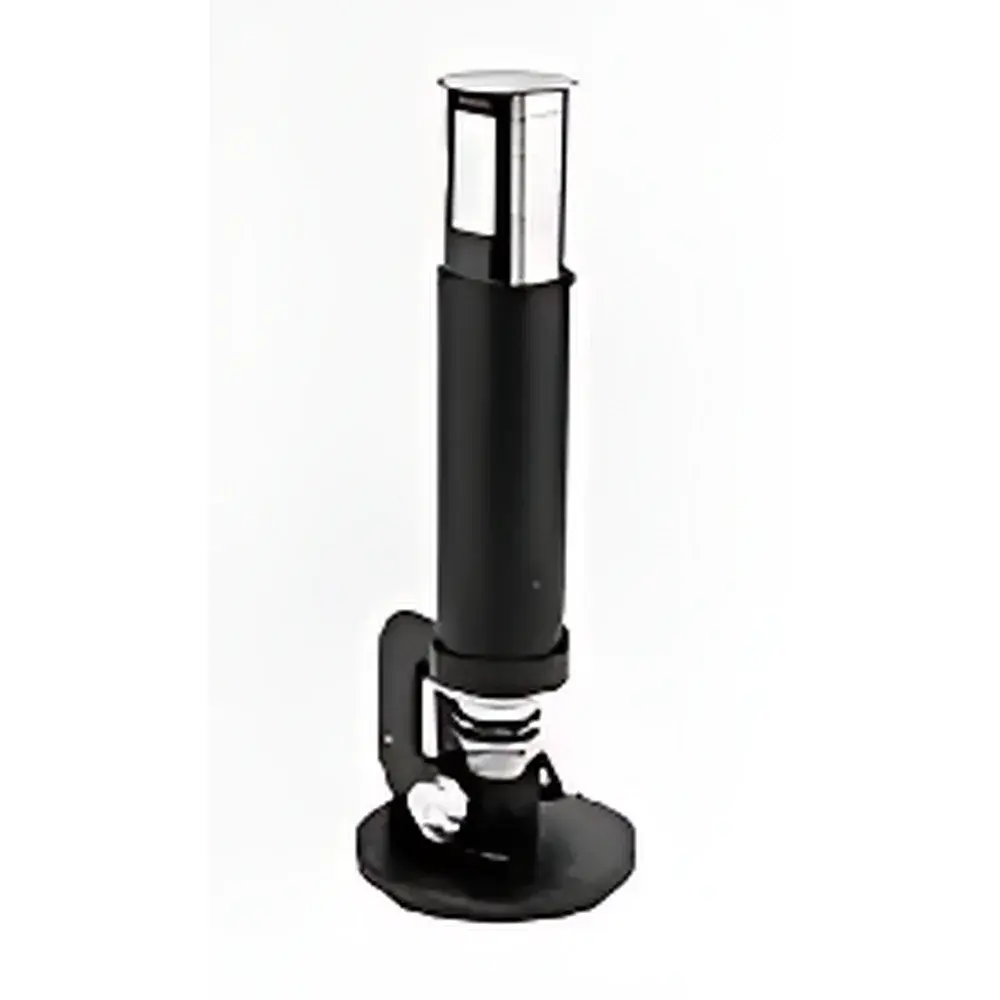
Gurley Model 4110N Air Permeability Tester
| Brand | Gurley |
|---|---|
| Origin | USA |
| Model | 4110N |
| Measuring Principle | Gravity-driven piston displacement (Gurley-type) |
| Test Area Options | 1.0, 0.25, or 0.1 in² |
| Standard Piston Weight | 20 oz (567 g) |
| Applied Pressure | 4.88 in H₂O (124 Pa) |
| Volume Displaced | 25–300 mL (incremental: 25 mL first, then 50 mL steps) |
| Measurement Range (Gurley Seconds) | 2.0–2000 s (for 100 mL air at 1.0 in²) |
| Optional Low-Permeability Configuration | 5 oz piston + 0.1 in² orifice |
| Optional High-Permeability Configuration | 5 oz piston + 1.0 in² orifice |
| Cylinder Diameter | 3 in (76.2 mm) |
| Net Weight | 12–17 lbs (5.4–7.7 kg) |
| Compliance | ASTM D737, ISO 9237, TAPPI T460, GB/T 5453 |
Overview
The Gurley Model 4110N Air Permeability Tester is a precision mechanical instrument engineered for the standardized measurement of air resistance—commonly referred to as “Gurley seconds”—in porous and semi-porous sheet materials. It operates on the fundamental principle of gravity-driven piston displacement: a calibrated weighted piston descends through a sealed oil-filled cylinder under constant hydrostatic pressure, forcing a fixed volume of ambient air through a defined test area of the specimen. The elapsed time for a specified volume (typically 100 mL, configurable between 25–300 mL) to pass through the sample is recorded directly in seconds. This time-based metric correlates inversely with permeability and directly with air resistance—a critical parameter in quality assurance and R&D across packaging, filtration, medical barrier materials, and industrial textiles. Unlike electronic flowmeters or differential-pressure systems, the 4110N delivers high reproducibility without reliance on power, sensors, or calibration gases—making it a robust reference method traceable to international standards.
Key Features
- Mechanically stable, oil-damped piston system ensures consistent 4.88 in H₂O (124 Pa) test pressure—fully compliant with ASTM D737 and ISO 9237 requirements for textile and paper permeability testing.
- Interchangeable orifice plates (1.0, 0.25, and 0.1 in²) enable precise range adaptation: standard 20 oz piston for mid-range materials (e.g., kraft paper, nonwovens); optional 5 oz piston for high-permeability films or low-resistance filter media.
- Graduated volumetric cylinder with dual-scale readout: direct visual timing via engraved scale (25 mL initial increment, followed by 50 mL steps up to 300 mL) and optional analog/digital timer integration.
- Tool-free sample clamping mechanism: rotating handwheel actuates parallel platens to uniformly compress specimens between precision-ground brass gaskets—minimizing edge leakage and ensuring full-area sealing.
- Modular base design supports optional accessories including automatic digital timer, pneumatic release kit, and calibrated weight sets for periodic verification per ISO/IEC 17025 laboratory practice.
Sample Compatibility & Compliance
The 4110N is validated for flat, dimensionally stable sheet materials ≤ 3 mm thick and exhibiting no macroscopic curl or elasticity-induced seal failure. Common applications include uncoated and coated papers (e.g., cigarette paper, filter board), spunbond/meltblown nonwovens, microporous polyethylene membranes, metallized PET laminates, and breathable medical packaging substrates. All test configurations adhere strictly to the procedural definitions in ASTM D737 (“Standard Test Method for Air Permeability of Textile Fabrics”), ISO 9237 (“Textiles — Determination of Air Permeability of Fabrics”), TAPPI T460 (“Air Resistance of Paper (Gurley Method)”), and GB/T 5453 (“Determination of Air Permeability of Textiles”). Instrument-level compliance supports GLP documentation workflows, including manual logbook entries traceable to operator ID, date, and environmental conditions (temperature/humidity logged separately per ISO 186).
Software & Data Management
The Gurley 4110N is a standalone mechanical tester and does not incorporate embedded firmware or proprietary software. However, its analog output—time-in-seconds—is fully compatible with external data acquisition systems. Laboratories routinely integrate the device with USB timers (e.g., Ohaus SF40A), programmable logic controllers (PLCs), or LIMS platforms via TTL pulse triggering or RS-232 serial adapters. For regulated environments operating under FDA 21 CFR Part 11 or EU Annex 11, users implement paper-based or electronic audit trails documenting piston calibration history (weight verification per NIST-traceable mass standards), orifice plate certification, and daily operational checks—consistent with ISO/IEC 17025 clause 6.4.1 on equipment suitability.
Applications
- Quality control of cigarette paper permeability to ensure consistent burn rate and tar delivery profiles.
- Validation of barrier integrity in sterile medical packaging—correlating Gurley seconds with microbial ingress risk per ISO 11607.
- Process optimization of meltblown nonwoven production for N95 respirator filtration media.
- Comparative assessment of coating uniformity on barrier-coated paperboard used in food packaging.
- Baseline characterization of geotextile breathability for landfill liner compatibility studies.
FAQ
What standards does the Gurley 4110N comply with?
ASTM D737, ISO 9237, TAPPI T460, and GB/T 5453—covering air permeability testing for textiles, paper, and packaging materials.
Can the instrument measure very low-permeability films?
Yes—when equipped with the optional 5 oz piston and 0.1 in² orifice plate, the system extends resolution into the 500–2000 second range, suitable for high-barrier metallized or PVDC-coated films.
Is operator training required to achieve repeatable results?
Minimal training is needed for basic operation; however, ISO/IEC 17025-accredited labs require documented competency assessments covering specimen conditioning (per ISO 187), clamping torque consistency, and piston descent observation protocol.
How often must the piston weight be recalibrated?
Annual verification against NIST-traceable mass standards is recommended; more frequent checks are advised if the instrument undergoes mechanical shock or operates in high-humidity environments where oil viscosity may drift.
Does Gurley provide installation or validation support?
Gurley-certified field service engineers offer IQ/OQ documentation packages, including dimensional verification, pressure profile validation, and uncertainty budgeting per GUM (JCGM 100:2008).



