
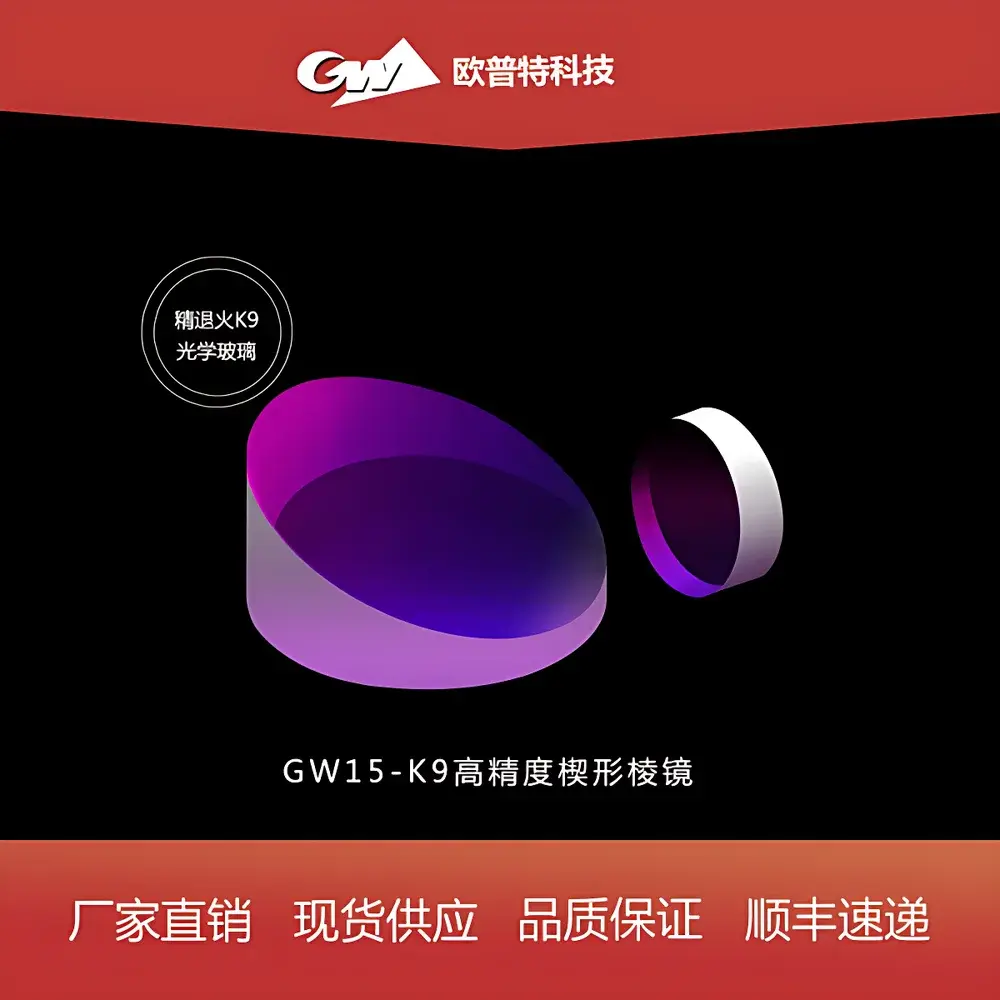
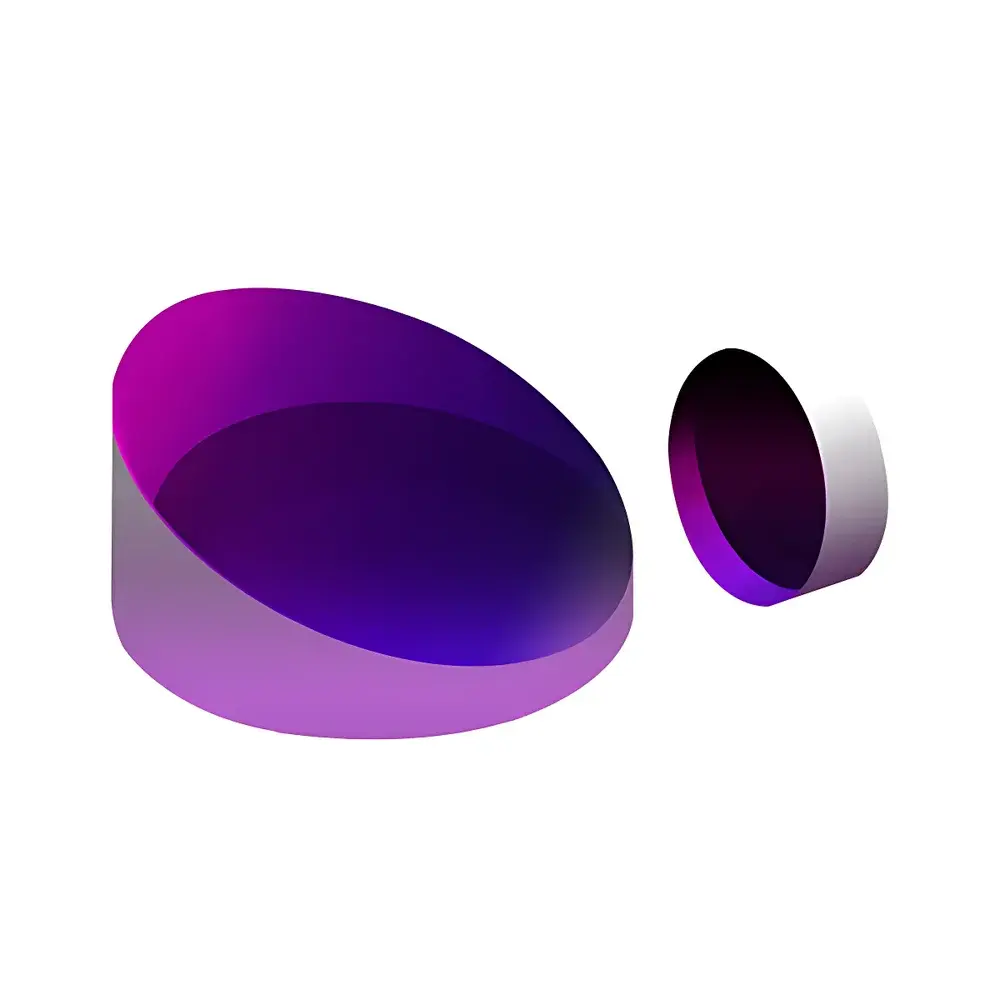
GW15-K9 Precision Wedge Prism
| Origin | Beijing, China |
|---|---|
| Manufacturer Type | Distributor |
| Product Origin | Domestic (China) |
| Model | GW15 |
| Price Range | USD 0.15–75.00 (per unit) |
| Component Category | Optical Element |
| Substrate Material | K9 Borosilicate Crown Glass |
| Diameter | 25.0 mm |
| Edge Thickness | 3.0 mm |
| Beam Deviation Angle @633 nm | 0.5°–6.0° |
| Wedge Angle | 0°58′–11°21′ |
| Diopter | 0.87–10.51 |
| Available Coatings | Uncoated, AR @350–700 nm, AR @600–1100 nm, AR @900–1700 nm |
Overview
The GW15-K9 Precision Wedge Prism is a high-accuracy optical component engineered for controlled beam steering, angular displacement calibration, and optical path length adjustment in precision interferometric, alignment, and laser cavity applications. Fabricated from certified Schott K9 (BK7-equivalent) borosilicate crown glass, the prism exhibits excellent homogeneity (Δn ≤ 5×10⁻⁶), low bubble/inclusion content (ISO 10110-3 Class 5), and tight surface quality specifications (scratch-dig 20–10 per MIL-PRF-13830B). Its wedge geometry induces deterministic angular deviation of incident collimated light via refraction at two non-parallel surfaces—governed by Snell’s law and the prism’s apex angle. Unlike parallel windows or flat optics, the GW15 series introduces a fixed, repeatable lateral beam shift and minimal wavefront distortion (<λ/10 PV @633 nm), making it suitable for demanding applications in metrology-grade optical benches, tunable filter assemblies, and polarization-sensitive setups where angular stability and thermal drift compensation are critical.
Key Features
- Precision-ground and polished wedge surfaces with surface flatness λ/20 @633 nm (typical) and parallelism tolerance <5 arcsec between base and wedge faces.
- K9 substrate compliant with ISO 10110-4:2015 optical material standards, including certified refractive index (nd = 1.5163 ± 0.0002) and Abbe number (νd = 64.2).
- Consistent edge thickness control (±0.05 mm) and diameter tolerance (±0.05 mm) ensuring mechanical compatibility with standard lens mounts (e.g., SM1, RMS) and kinematic optomechanics.
- Multiple anti-reflection coating options deposited via ion-assisted e-beam evaporation: broadband VIS (350–700 nm, Ravg < 0.5%), NIR (600–1100 nm), and SWIR (900–1700 nm), each meeting ISO 9211-3 spectral performance requirements.
- Traceable dimensional and angular metrology: wedge angle certified via autocollimator measurement (calibrated to NIST-traceable standards), with uncertainty <2 arcsec (k=2).
Sample Compatibility & Compliance
The GW15-K9 wedge prism is compatible with all common visible and near-infrared laser sources (HeNe, diode, DPSS, Ti:Sapphire) and broadband illumination systems. Its K9 substrate transmits >91% per surface (uncoated) from 350 nm to 2.0 µm, with UV cutoff near 350 nm and IR absorption onset beyond 2.2 µm. All coated variants undergo environmental durability testing per MIL-C-48497A (adhesion, humidity, abrasion) and meet ISO 9211-4:2013 for coating robustness. The product conforms to RoHS Directive 2011/65/EU and REACH Annex XVII restrictions on hazardous substances. While not a medical or safety-critical device, its dimensional and optical specifications support integration into systems requiring GLP-compliant documentation—full test reports (including interferometric surface map, spectrophotometric coating data, and angular deviation verification) are available upon request for audit-ready deployment.
Software & Data Management
As a passive optical component, the GW15-K9 requires no embedded firmware or driver software. However, its geometric and optical parameters are fully compatible with industry-standard optical design platforms—including Zemax OpticStudio (ZOS), Synopsys CODE V, and Thorlabs’ OptoCAD—via provided .ZMX and .SEQ files for each wedge variant. Angular deviation, ray trace paths, and chromatic dispersion profiles (calculated using Sellmeier coefficients for K9) are pre-parameterized for rapid system modeling. For traceability, each shipped unit includes a unique serial number linked to a digital certificate of conformance (PDF), containing measured wedge angle, surface flatness map metadata, and coating spectral reflectance curves (2 nm resolution, 300–1800 nm range). These records support FDA 21 CFR Part 11–aligned electronic record retention when integrated into validated optical assembly workflows.
Applications
- Laser beam steering and fine angular alignment in free-space optical interconnects and fiber coupling stages.
- Optical cavity length tuning in external-cavity diode lasers (ECDLs) and Fabry–Pérot interferometers.
- Reference wedges for calibrating autocollimators, electronic levels, and angular encoders.
- Compensation of thermal lensing-induced beam walk-off in high-power CW laser systems.
- Construction of variable optical attenuators (VOAs) and wavelength-selective beam combiners in WDM modules.
- Integration into OCT reference arms and holographic recording setups requiring precise phase front manipulation.
FAQ
What is the maximum permissible incident beam diameter for the GW15-025 series?
The clear aperture is ≥24.0 mm; beams up to 22 mm diameter ensure full transmission without vignetting.
Can the GW15-K9 be used with ultraviolet (UV) light below 350 nm?
No—K9 glass exhibits strong absorption below 350 nm; fused silica wedges are recommended for UV applications.
Is wedge angle temperature-dependent, and what is its thermal coefficient?
Yes—the effective wedge angle varies with thermal expansion; the angular drift is <0.005 arcsec/°C over 15–35°C ambient range.
Do AR-coated versions maintain polarization state?
Yes—coating designs are non-birefringent and preserve linear/circular polarization integrity within ±0.5° retardance across the specified band.
Are custom diameters or wedge angles available?
Yes—custom configurations (e.g., Ø12.7 mm, 0.1°–15° wedge) are supported under OEM agreements with minimum order quantities and extended lead times.





