
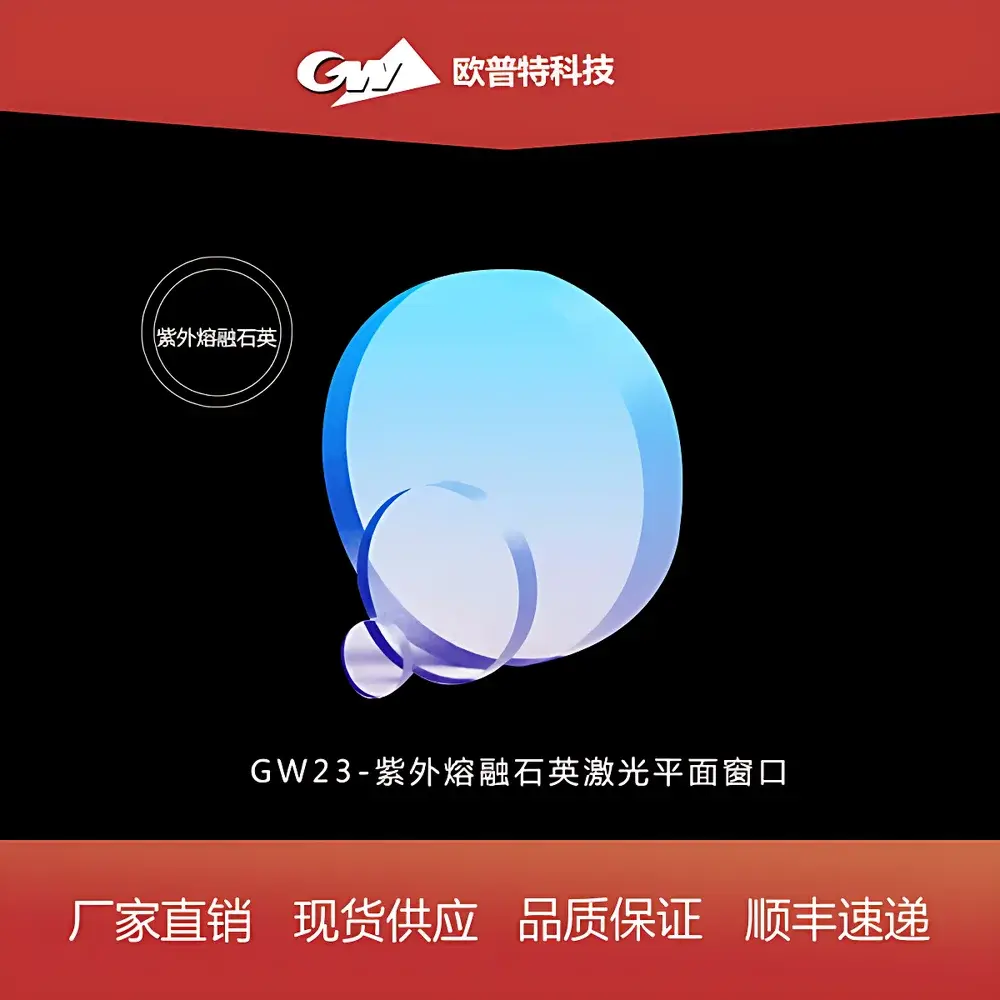

GW23 UV-Fused Silica Laser Flat Window
| Origin | Beijing |
|---|---|
| Manufacturer Type | Distributor |
| Origin Category | Domestic |
| Model | GW23 |
| Price Range | USD 1–499 |
| Component Category | Optical Element |
| Diameter Options | Φ5.0–Φ50.8 mm |
| Thickness Options | 2.0–10.0 mm |
| AR Coating | V-type, R<0.25% @266 nm, R<0.25% @355 nm, R<0.25% @532 nm, R<0.25% @1064 nm |
| Substrate Material | Synthetic Fused Silica (UV-grade) |
| Surface Quality | 10–5 scratch-dig |
| Surface Flatness | λ/10 @633 nm |
| Parallelism | <10 arcsec |
| Clear Aperture | ≥90% of diameter |
| Damage Threshold | >5 J/cm² @10 ns, 10 Hz, 1064 nm (typ.) |
Overview
The GW23 UV-Fused Silica Laser Flat Window is a precision optical component engineered for high-power and ultrafast laser systems operating across deep-ultraviolet (DUV) to near-infrared (NIR) spectral ranges. Constructed from synthetic fused silica with exceptional UV transmission, low thermal expansion (α ≈ 0.55 × 10⁻⁶ /°C), and high laser-induced damage threshold (LIDT), this window serves as a critical interface in vacuum chambers, beam delivery lines, harmonic generation setups, and cavity-enclosed laser resonators. Its optical design adheres to strict wavefront fidelity requirements: surface flatness better than λ/10 @633 nm and parallelism under 10 arcseconds ensure minimal beam distortion and phase error accumulation—critical for interferometric stability and mode-matching in single-frequency or femtosecond laser architectures.
Key Features
- UV-grade fused silica substrate with OH content 85% transmission at 266 nm and broadband transparency from 180 nm to 2.1 µm
- V-type anti-reflection (AR) coating optimized for four discrete laser wavelengths: 266 nm, 355 nm, 532 nm, and 1064 nm—with residual reflectance <0.25% per surface at each target wavelength
- Multiple standardized diameter-thickness configurations (Φ5.0–Φ50.8 mm, 2.0–10.0 mm thick) supporting mechanical integration into commercial lens mounts, kinematic flanges, and custom vacuum feedthroughs
- Surface quality rated 10–5 per MIL-PRF-13830B, verified via phase-shifting interferometry and dark-field inspection
- Clear aperture guaranteed ≥90% of nominal diameter, accommodating beam clipping margins required by ISO 11146-compliant M² measurements
- Thermally stable mounting compatibility: coefficient of thermal expansion matched to stainless steel and Invar housings for low-stress bonding and long-term alignment retention
Sample Compatibility & Compliance
The GW23 window is compatible with Class 4 laser systems compliant with IEC 60825-1:2014 and ANSI Z136.1-2022 safety standards. Its fused silica base material meets ASTM F796 specifications for optical grade quartz, while the V-coating process conforms to ISO 9211-3 for thin-film optical coatings. Each batch undergoes spectral verification using a calibrated UV-VIS-NIR spectrophotometer (200–1100 nm) and LIDT validation per ISO 21254-2:2018 (1-on-1 testing protocol). Documentation includes full spectral reflectance curves, surface flatness interferograms, and traceable calibration certificates—supporting GLP/GMP audit readiness and FDA 21 CFR Part 11 data integrity requirements when integrated into regulated manufacturing environments (e.g., photolithography tooling or medical laser OEM subsystems).
Software & Data Management
While the GW23 is a passive optical element, its product identification system enables digital traceability across optical inventory management platforms. Each part number (e.g., GW23-025A-V266) encodes dimensional, coating, and wavelength-specific metadata compatible with common lab asset tracking systems (e.g., LabWare LIMS, Thermo Fisher SampleManager). Spectral performance data—including measured R(λ) curves and LIDT histograms—is delivered in CSV and XML formats compliant with ASTM E2983 for optical component data exchange. Optional integration with Zemax OpticStudio via user-defined glass catalog entries (using Schott N-SF11-equivalent dispersion models) supports accurate tolerance analysis during beam path modeling.
Applications
- High-energy Nd:YAG and Nd:YLF laser harmonic separation optics (2ω, 3ω, 4ω extraction)
- Ultrafast Ti:sapphire and Yb-fiber amplifier output couplers and vacuum viewport windows
- Excimer laser beam conditioning in semiconductor photolithography steppers (ArF 193 nm, KrF 248 nm—requires optional extended DUV coating variant)
- Optical parametric amplifier (OPA) and difference frequency generation (DFG) stage isolation
- Calibration reference windows in radiometric measurement chains traceable to NIST SRM 2065
- Space-qualified instrumentation where outgassing rates <1×10⁻¹² g/(cm²·s) and proton radiation resistance are required
FAQ
What is the maximum recommended continuous-wave (CW) power density for the GW23 window at 532 nm?
For uncooled, convection-cooled mounting in ambient air, the practical CW limit is 10 kW/cm² at 532 nm with a 1/e² beam diameter ≥3 mm—assuming clean surface conditions and no localized contamination.
Can the GW23 be used in vacuum environments below 10⁻⁶ Torr?
Yes. All fused silica substrates are pre-baked at 450°C for 24 hours; total mass loss (TML) <0.05% and collected volatile condensable materials (CVCM) <0.005%, satisfying NASA ASTM E595 spaceflight qualification.
Is custom diameter or thickness available beyond the standard catalog options?
Yes. Custom geometries up to Φ100 mm and 20 mm thickness are manufacturable with lead times of 6–8 weeks; minimum order quantity applies.
Do you provide wavefront error (WFE) maps for individual units?
Upon request and with premium certification, full-aperture phase maps acquired via Zygo GPI interferometer (λ/20 PV typical) are supplied as TIFF + ASCII datasets.
How does the V-coating perform under UV irradiation aging tests?
Accelerated lifetime testing (2000 h @ 266 nm, 100 mW/cm², 25°C) shows no measurable increase in reflectance or absorption—confirming coating robustness for long-duration DUV exposure.





